Kang Hee-Ju, Kim Ju-Wan, Kim Seon-Young, Kim Sung-Wan, Shin Hee-Young, Shin Myung-Geun, Kim Jae-Min
Department of Psychiatry, Chonnam National University Medical School, Gwangju, Republic of Korea.
Mental Health Clinic, Chonnam National University Hwasun Hospital, Hwasun, Republic of Korea.
Psychiatry Investig. 2018 May;15(5):538-545. doi: 10.30773/pi.2017.10.2. Epub 2018 Apr 5.
Depression is associated with a major disease burden, and many individuals suffer from depressive symptoms due to an insufficient response to ostensibly adequate antidepressant treatment. Therefore, it is important to identify reliable treatment response predictors for use in developing personalized treatment strategies.
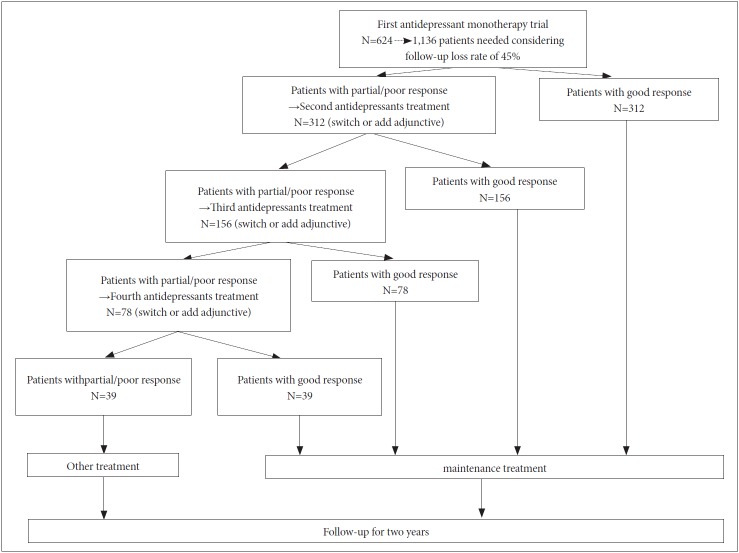
The MAKE Biomarker discovery for Enhancing anTidepressant Treatment Effect and Response (MAKE BETTER) study was performed to identify predictors of antidepressant response using a 2-year naturalistic prospective design. Participants in the MAKE BETTER study were consecutively recruited from patients who visited the Psychiatry Department of Chonnam National University Hospital, Gwangju, South Korea for treatment of a depressive disorder. Data on demographic and clinical characteristics, genetic markers measured by whole-exome sequencing, and blood markers were obtained. The types and doses of antidepressants were determined based on the clinical judgment of the psychiatrist, and the treatment outcomes (e.g., depressive and other psychiatric symptoms and issues related to safety) were assessed.
We will be able to use the data collected in this study to develop a treatment-response prediction index composed of biomarkers.
The MAKE BETTER study will provide an empirical basis for a personalized medicine approach to depression by enabling the prediction of antidepressant treatment response according the characteristics of each patient. It will thereby support evidence-based decision-making that decreases the use of a trial-and-error approach to the treatment of depressive disorders.
抑郁症与重大疾病负担相关,许多个体因对表面上足够的抗抑郁治疗反应不足而患有抑郁症状。因此,识别可靠的治疗反应预测指标以用于制定个性化治疗策略很重要。
开展了“增强抗抑郁治疗效果及反应的生物标志物发现(MAKE BETTER)”研究,采用为期2年的自然前瞻性设计来识别抗抑郁反应的预测指标。MAKE BETTER研究的参与者连续招募自韩国光州全南国立大学医院精神科就诊的抑郁症患者。获取了人口统计学和临床特征、通过全外显子测序测量的基因标志物以及血液标志物的数据。抗抑郁药的类型和剂量根据精神科医生的临床判断确定,并评估治疗结果(如抑郁和其他精神症状以及与安全性相关的问题)。
我们将能够利用本研究收集的数据来开发由生物标志物组成的治疗反应预测指数。
MAKE BETTER研究将通过根据每位患者的特征预测抗抑郁治疗反应,为抑郁症的个性化医疗方法提供实证依据。从而支持基于证据的决策制定,减少对抑郁症治疗采用试错法。