National Mastitis Center, Division of Bacteriology, Kimron Veterinary Institute, Bet Dagan, Israel
IB3, Heriot Watt University, Edinburgh, United Kingdom.
mBio. 2018 Apr 3;9(2):e00423-18. doi: 10.1128/mBio.00423-18.
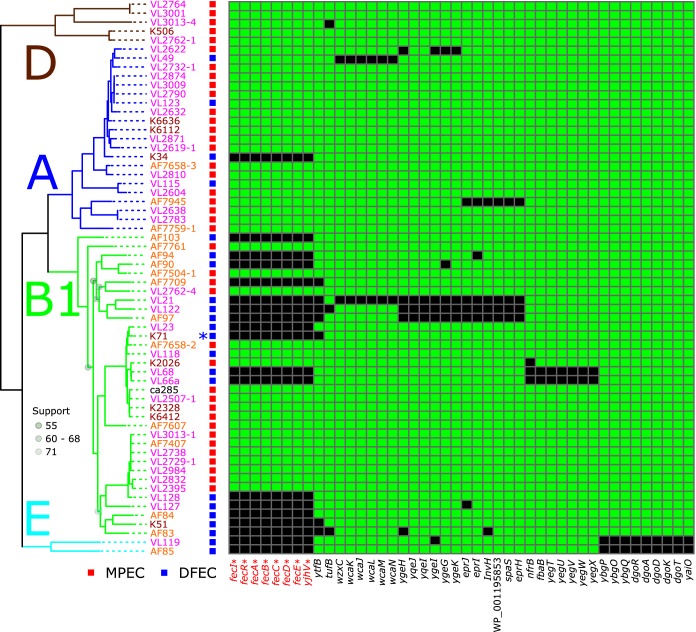
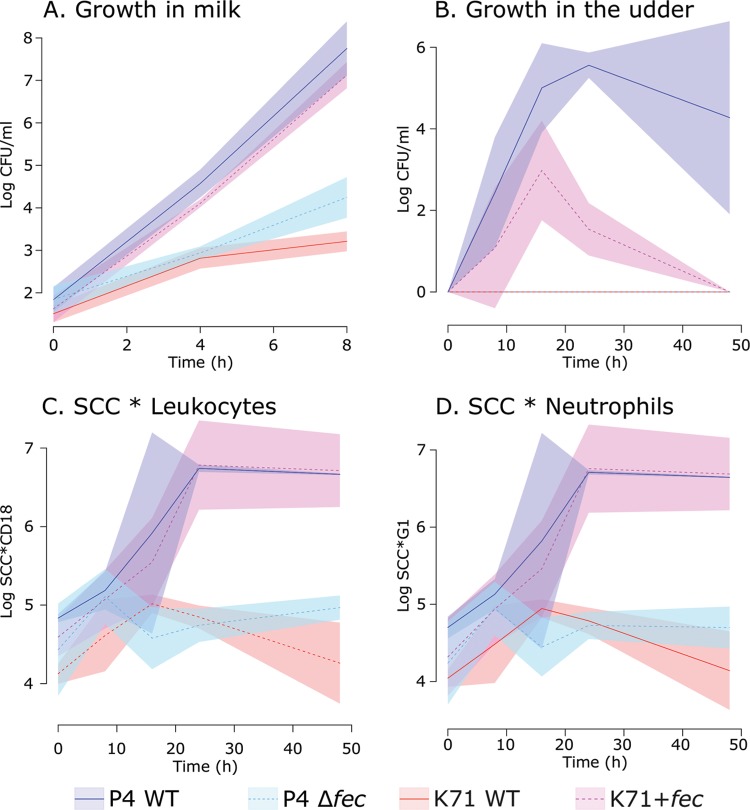
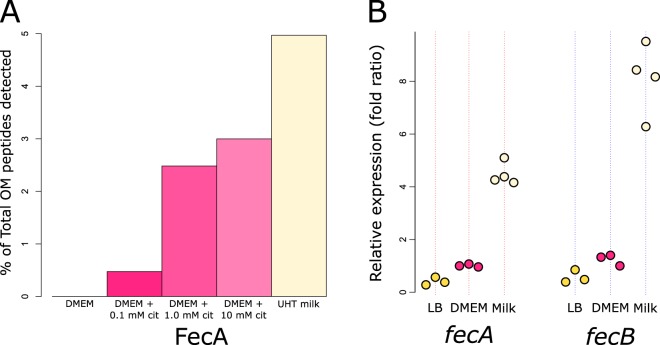
are major bacterial pathogens causing bovine mastitis, a disease of great economic impact on dairy production worldwide. This work aimed to study the virulence determinants of mammary pathogenic (MPEC). By whole-genome sequencing analysis of 40 MPEC and 22 environmental ("dairy-farm" [DFEC]) strains, we found that only the locus () for ferric dicitrate uptake was present in the core genome of MPEC and that it was absent in DFEC genomes ( < 0.05). Expression of the FecA receptor in the outer membrane was shown to be citrate dependent by mass spectrometry. FecA was overexpressed when bacteria were grown in milk. Transcription of the gene and of the inner membrane transport component gene was upregulated in bacteria recovered from experimental intramammary infection. The presence of the system was shown to affect the ability of to grow in milk. While the rate of growth in milk of -positive () DFEC was similar to that of MPEC, it was significantly lower in DFEC lacking Furthermore, deletion of reduced the rate of growth in milk of MPEC strain P4, whereas -transformed non-mammary gland-pathogenic DFEC strain K71 gained the phenotype of the level of growth in milk observed in MPEC. The role of in intramammary pathogenicity was investigated in cows, with results showing that an MPEC P4 mutant lacking lost its ability to induce mastitis, whereas the DFEC K71 mutant was able to trigger intramammary inflammation. For the first time, a single molecular locus was shown to be crucial in MPEC pathogenicity. Bovine mastitis is the major infectious disease in dairy cows and the leading cause of economic loss to the global dairy industry, directly contributing to the price of dairy products on supermarket shelves and the financial hardships suffered by dairy farmers. Mastitis is also the leading reason for the use of antibiotics in dairy farms. Good farm management practices in many countries have dramatically reduced the incidence of contagious mastitis; however, the problems associated with the incidence of environmental mastitis caused by bacteria such as have proven intractable. bacteria cause acute mastitis, which affects the health and welfare of cows and in extreme cases may be fatal. Here we show for the first time that the pathogenicity of causing mastitis in cows is highly dependent on the ferric citrate uptake system that allows the bacterium to capture iron from citrate. The Fec system is highly expressed during infection in the bovine udder and is ubiquitous in and necessary for the bacteria that cause mammary infections in cattle. These results have far-reaching implications, raising the possibility that mastitis may be controllable by targeting this system.
是引起牛乳腺炎的主要细菌性病原体,乳腺炎是全球奶牛养殖业中具有重大经济影响的疾病。本研究旨在研究乳腺炎病原菌(MPEC)的毒力决定因子。通过对 40 株 MPEC 和 22 株环境(“奶牛场”[DFEC])菌株的全基因组测序分析,我们发现只有 ferric dicitrate 摄取的 基因座()存在于 MPEC 的核心基因组中,而在 DFEC 基因组中不存在(<0.05)。通过质谱法证实了外膜中 FecA 受体的表达依赖于柠檬酸。当细菌在牛奶中生长时,FecA 被过度表达。从实验性乳腺炎感染中回收的细菌中, 基因和内膜转运成分 基因的转录被上调。结果表明, 系统的存在会影响 在牛奶中生长的能力。虽然 阳性()DFEC 在牛奶中的生长速度与 MPEC 相似,但在缺乏 的 DFEC 中则明显较低。此外, 的缺失降低了 MPEC 菌株 P4 在牛奶中的生长速度,而非乳腺致病性 DFEC 菌株 K71 的 转化则获得了在 MPEC 中观察到的在牛奶中生长水平的表型。在奶牛中研究了 在乳腺炎中的致病性,结果表明,缺乏 的 MPEC P4 突变体丧失了引起乳腺炎的能力,而缺乏 的 DFEC K71 突变体能够引发乳腺炎。这是首次证明单个分子基因座对 MPEC 致病性至关重要。牛乳腺炎是奶牛的主要传染病,也是全球奶牛养殖业经济损失的主要原因,直接导致超市货架上乳制品价格上涨,以及奶农面临经济困难。乳腺炎也是奶牛场使用抗生素的主要原因。在许多国家,良好的农场管理实践已大大降低了传染性乳腺炎的发病率;然而,由 等细菌引起的环境性乳腺炎问题仍然难以解决。 细菌引起急性乳腺炎,影响奶牛的健康和福利,在极端情况下可能致命。在这里,我们首次表明,导致奶牛乳腺炎的 的致病性高度依赖于铁柠檬酸摄取系统,该系统使细菌能够从柠檬酸中捕获铁。在牛乳房的感染过程中,Fec 系统高度表达,并且在引起牛乳腺炎的 细菌中普遍存在且是必需的。这些结果具有深远的意义,为通过靶向该系统控制乳腺炎提供了可能。