García-Arias Francy L, Osorio-Guarín Jaime A, Núñez Zarantes Victor M
Corporación Colombiana de Investigación Agropecuaria, Corpoica, Centro de Investigación Tibaitatá, Mosquera, Colombia.
Front Plant Sci. 2018 Mar 20;9:362. doi: 10.3389/fpls.2018.00362. eCollection 2018.
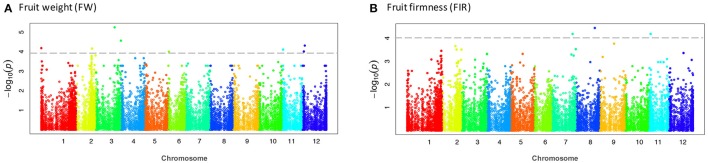
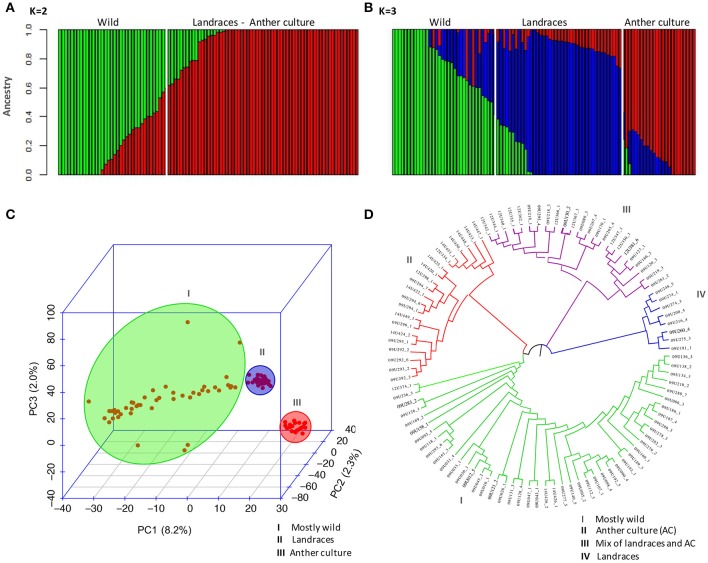
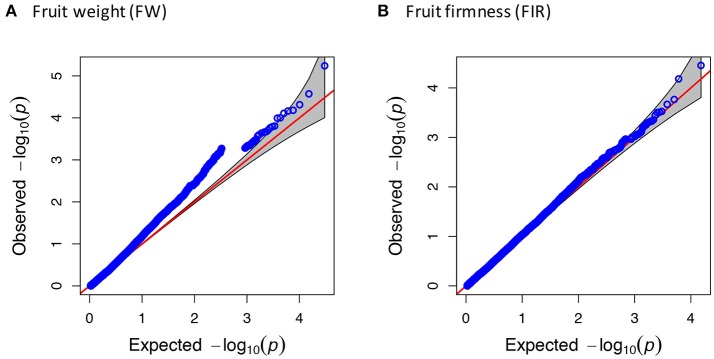
Association mapping has been proposed as an efficient approach to assist plant breeding programs to investigate the genetic basis of agronomic traits. In this study, we evaluated 18 traits related to yield, (FWP, NF, FWI, and FWII), fruit size-shape (FP, FA, MW, WMH, MH, HMW, DI, FSI, FSII, OVO, OBO), and fruit quality (FIR, CF, and SST), in a diverse collection of 100 accessions of including wild, landraces, and anther culture derived lines. We identified seven accessions with suitable traits: fruit weight per plant (FWP) > 7,000 g/plant and cracked fruits (CF) < 4%, to be used as parents in cape gooseberry breeding program. In addition, the accessions were also characterized using Genotyping By Sequencing (GBS). We discovered 27,982 and 36,142 informative SNP markers based on the alignment against the two cape gooseberry references transcriptomes. Besides, 30,344 SNPs were identified based on alignment to the tomato reference genome. Genetic structure analysis showed that the population could be divided into two or three sub-groups, corresponding to landraces-anther culture and wild accessions for = 2 and wild, landraces, and anther culture plants for = 3. Association analysis was carried out using a Mixed Linear Model (MLM) and 34 SNP markers were significantly associated. These results reveal the basis of the genetic control of important agronomic traits and may facilitate marker-based breeding in .
关联作图已被提议作为一种有效的方法,以协助植物育种计划研究农艺性状的遗传基础。在本研究中,我们评估了100份不同材料(包括野生种、地方品种和花药培养衍生系)中与产量相关的18个性状(单株果实重量、无果、果实重量指数I、果实重量指数II)、果实大小形状(果径、果长、果实横径、果实横径/果长、果长/果实横径、果实横径/果长、果实形状指数、果实形状指数II、果形椭圆度、果形偏度)和果实品质(果实硬度、果肉颜色、可溶性固形物含量)。我们鉴定出七份具有合适性状的材料:单株果实重量>7000克/株且裂果率<4%,可作为灯笼果育种计划的亲本。此外,还使用简化基因组测序(GBS)对这些材料进行了特征分析。基于与两个灯笼果参考转录组的比对,我们发现了27982个和36142个信息性SNP标记。此外,基于与番茄参考基因组的比对,鉴定出30344个SNP。遗传结构分析表明,该群体可分为两个或三个亚组,当K=2时,分别对应地方品种-花药培养材料和野生材料;当K=3时,对应野生、地方品种和花药培养植株。使用混合线性模型(MLM)进行关联分析,有34个SNP标记显著关联。这些结果揭示了重要农艺性状的遗传控制基础,并可能促进灯笼果的基于标记的育种。