Sassoni Enrico
Department of Civil, Chemical, Environmental and Materials Engineering (DICAM), University of Bologna, Via Terracini 28, 40131 Bologna, Italy.
Materials (Basel). 2018 Apr 4;11(4):557. doi: 10.3390/ma11040557.
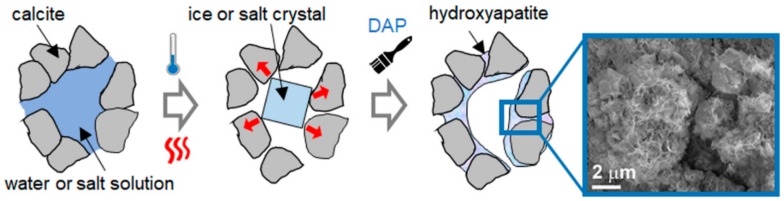
The present paper reviews the methods and the performance of in situ formation of calcium phosphates (CaP) for the conservation of materials belonging to cultural heritage. The core idea is to form CaP (ideally hydroxyapatite, HAP, the most stable CaP at pH > 4) by reaction between the substrate and an aqueous solution of a phosphate salt. Initially proposed for the conservation of marble and limestone, the treatment has been explored for a variety of different substrates, including sandstones, sulphated stones, gypsum stuccoes, concrete, wall paintings, archaeological bones and paper. First, the studies aimed at identifying the best treatment conditions (e.g., nature and concentration of the phosphate precursor, solution pH, treatment duration, ionic and organic additions to the phosphate solution, mineralogical composition of the new CaP phases) are summarized. Then, the treatment performance on marble and limestone is reviewed, in terms of protective and consolidating effectiveness, compatibility (aesthetic, microstructural and physical) and durability. Some pilot applications in real case studies are also reported. Recent research aimed at extending the phosphate treatment to other substrates is then illustrated. Finally, the strengths of the phosphate treatment are summarized, in comparison with alternative products, and some aspects needing future research are outlined.
本文综述了用于保护文化遗产材料的磷酸钙(CaP)原位形成的方法及其性能。其核心思想是通过基材与磷酸盐盐水溶液之间的反应形成CaP(理想情况下为羟基磷灰石,HAP,在pH>4时最稳定的CaP)。该处理最初是为保护大理石和石灰石而提出的,现已针对各种不同的基材进行了探索,包括砂岩、硫酸化石材、石膏灰泥、混凝土、壁画、考古骨骼和纸张。首先,总结了旨在确定最佳处理条件(例如,磷酸盐前体的性质和浓度、溶液pH值、处理持续时间、向磷酸盐溶液中添加离子和有机物、新CaP相的矿物组成)的研究。然后,从保护和加固效果、兼容性(美学、微观结构和物理方面)和耐久性方面综述了该处理对大理石和石灰石的性能。还报道了一些实际案例研究中的试点应用。接着阐述了旨在将磷酸盐处理扩展到其他基材上的最新研究。最后,与替代产品相比,总结了磷酸盐处理的优点,并概述了一些需要未来研究的方面。