Institute of Clinical Pharmacy and Pharmaceutical Sciences, College of Medicine, National Cheng Kung University, Tainan, Taiwan.
School of Pharmacy, College of Medicine, National Cheng Kung University, Tainan, Taiwan.
Int J Neuropsychopharmacol. 2018 Apr 1;21(4):319-324. doi: 10.1093/ijnp/pyx093.
Patients with bipolar disorder are at high risk of metabolic disturbance after mood stabilizer treatment. However, the mediators linking the two conditions remain unknown. In this study, we investigated whether fibroblast growth factor-21 (FGF21) was associated with metabolic effects and treatment response in depressed bipolar disorder patients.
We recruited 78 community-dwelling controls and 137 bipolar disorder patients; the latter were interviewed using the Chinese Version of the Modified Schedule of Affective Disorder and Schizophrenia-Life Time. Upon study entry, the bipolar disorder patients were all in a major depressive status, with 17-item Hamilton Depression Rating Scale (HDRS) scores >15. They received valproate (500-1000 mg daily) for 12 weeks, and fluoxetine 20 mg daily was permitted to treat depressive symptoms. Fasting plasma level of FGF21, lipid profiles, and body weight were collected at baseline and after 12 weeks of treatment.
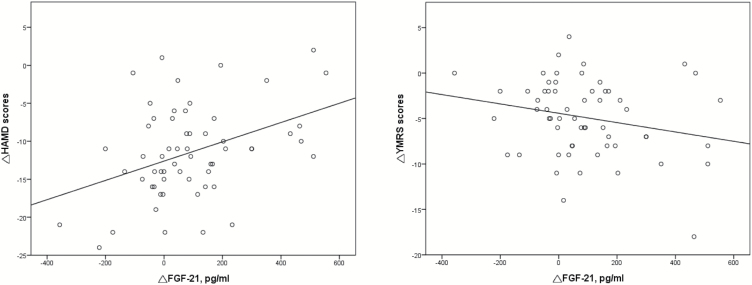
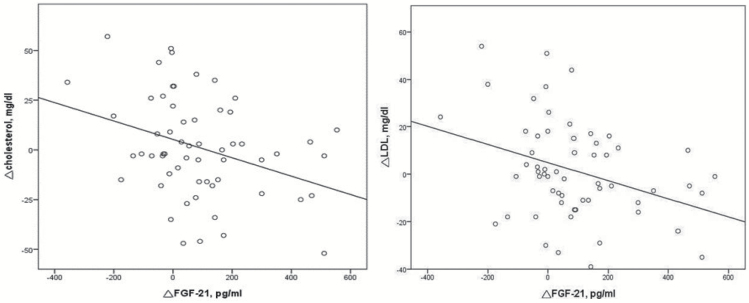
At baseline, the demographic characteristics, FGF21 level, and metabolic indices did not differ significantly between the controls and bipolar disorder patients. After 12 weeks of treatment, the FGF21 level (167.7±122.0 to 207.1±162.3 pg/mL, P=.001), body weight and waist circumference had increased significantly (P<.001 and P=.028, respectively). Moreover, the change in FGF21 level was significantly correlated with the changes in HDRS score (r=0.393, P=.002), total cholesterol (r=-0.344, P=.008), and low-density lipoprotein (r=-0.347, P=.007).
The central and peripheral mediating effects of FGF21 on bipolar disorder depression treatment might be opposite. High peripheral FGF21 levels might link regulation of metabolic effect and resistance to treatment in bipolar disorder.
心境稳定剂治疗后,双相情感障碍患者发生代谢紊乱的风险较高。然而,将这两种情况联系起来的中介因素仍不清楚。在这项研究中,我们研究了成纤维细胞生长因子 21(FGF21)是否与抑郁性双相情感障碍患者的代谢效应和治疗反应有关。
我们招募了 78 名社区居民对照者和 137 名双相情感障碍患者;后者使用中文版改良心境障碍和精神分裂症终生访谈进行访谈。研究开始时,双相情感障碍患者均处于重度抑郁状态,17 项汉密尔顿抑郁评定量表(HDRS)评分>15。他们接受丙戊酸钠(每天 500-1000mg)治疗 12 周,允许氟西汀 20mg 每日治疗抑郁症状。在基线和治疗 12 周后采集空腹血浆 FGF21 水平、血脂谱和体重。
基线时,对照组和双相情感障碍患者的人口统计学特征、FGF21 水平和代谢指标无显著差异。治疗 12 周后,FGF21 水平(167.7±122.0 至 207.1±162.3pg/ml,P=.001)、体重和腰围均显著增加(P<.001 和 P=.028)。此外,FGF21 水平的变化与 HDRS 评分的变化显著相关(r=0.393,P=.002)、总胆固醇(r=-0.344,P=.008)和低密度脂蛋白(r=-0.347,P=.007)。
FGF21 对双相情感障碍抑郁治疗的中枢和外周中介作用可能相反。外周 FGF21 水平升高可能与双相情感障碍代谢效应的调节和治疗抵抗有关。