Department of Sciences for Health Promotion and Mother and Child Care "G. D'Alessandro", University of Palermo, Via A. Giordano 3, 90127, Palermo, Italy.
Laboratory of Neurogenetics and Neuroscience, Institute G. Gaslini, Via Gerolamo Gaslini 5, 16100, Genoa, Italy.
Ital J Pediatr. 2018 Apr 4;44(1):45. doi: 10.1186/s13052-018-0483-z.
The aim of this retrospective study was to define clinical and molecular characteristics of a large sample of neurofibromatosis type 1 (NF1) patients, as well as to evaluate mutational spectrum and genotype-phenotype correlation. NF1 is a relatively common neurogenetic disorder (1:2500-1:3000 individuals). It is caused by mutations of the NF1 gene on chromosome 17ql1.2, with autosomal dominant pattern of inheritance and wide phenotypical variability. Café-au-lait spots (CALs), cutaneous and/or subcutaneous neurofibromas (CNFs/SCNFs), skinfold freckling, skeletal abnormalities, Lisch nodules of the iris and increased risk of learning and intellectual disabilities, as well as tumors of the nervous system and other organs are its main clinical features.
The preliminary group collected 168 subjects with clinical suspicion of NF1. They were evaluated following the National Institutes of Health (NIH) criteria for NF1, revised by Gutmann et al. 1997, integrated for 67 of them by molecular testing. According to these references, 112 of 168 patients were diagnosed as NF1. The sample was characterized by an equal sex ratio (57 males, 55 females) and age distribution ranging from 10 days to 60 years of age (mean age, 13 years).
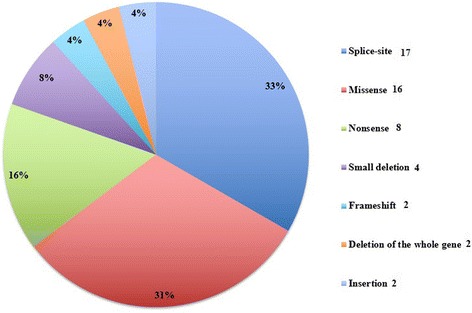
A wide spectrum of clinical features has been observed in our patients. Mutational analysis resulted positive in 51 cases (76%). Twenty-four mutations detected in our cohort have not been reported to date.
This study may contribute to a better definition of genotypic and phenotypic features of NF1 patients, with respect to further insights into the clinical characterization of the disease. In addition, an amplification of the spectrum of mutations in the NF1 gene has been documented.
本回顾性研究旨在确定大量神经纤维瘤病 1 型(NF1)患者的临床和分子特征,并评估突变谱和基因型-表型相关性。NF1 是一种相对常见的神经遗传疾病(每 2500-3000 人中有 1 例)。它是由 17 号染色体 q11.2 上的 NF1 基因突变引起的,具有常染色体显性遗传模式和广泛的表型变异性。咖啡牛奶斑(CAL)、皮肤和/或皮下神经纤维瘤(CNFs/SCNFs)、皮肤褶皱雀斑、骨骼异常、虹膜的利斯结节和学习障碍和智力障碍的风险增加,以及神经系统和其他器官的肿瘤是其主要临床特征。
初步收集了 168 例临床疑似 NF1 的患者。他们按照 NIH 制定的 NF1 标准进行评估,由 Gutmann 等人修订,1997 年,其中 67 例通过分子检测进行了整合。根据这些参考标准,168 例患者中有 112 例被诊断为 NF1。该样本的性别比例相等(57 名男性,55 名女性),年龄分布在 10 天至 60 岁之间(平均年龄为 13 岁)。
我们的患者观察到了广泛的临床特征。突变分析在 51 例(76%)中呈阳性。在我们的队列中检测到的 24 个突变迄今尚未报道。
本研究可能有助于更好地定义 NF1 患者的基因型和表型特征,进一步深入了解疾病的临床特征。此外,NF1 基因中的突变谱得到了扩展。