Mentink-Vigier Frédéric, Mathies Guinevere, Liu Yangping, Barra Anne-Laure, Caporini Marc A, Lee Daniel, Hediger Sabine, G Griffin Robert, De Paëpe Gaël
Univ. Grenoble Alpes , CEA , CNRS , INAC-MEM , F-38000 Grenoble , France . Email:
Francis Bitter Magnet Laboratory , Department of Chemistry , Massachusetts Institute of Technology , Cambridge , MA 02139 , USA.
Chem Sci. 2017 Dec 1;8(12):8150-8163. doi: 10.1039/c7sc02199b. Epub 2017 Oct 2.
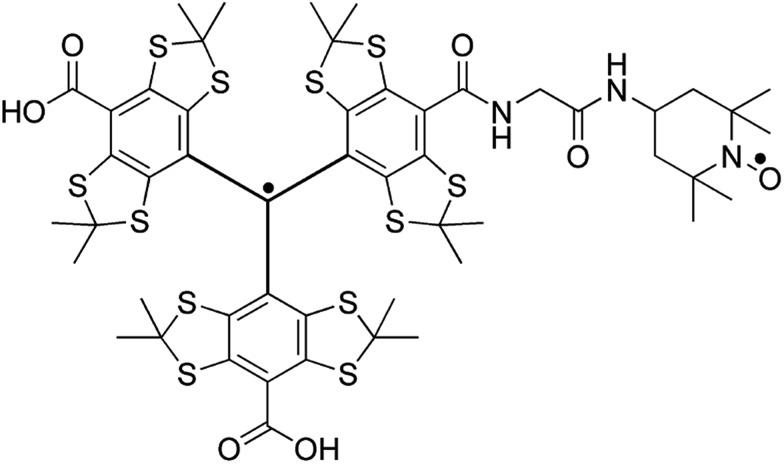
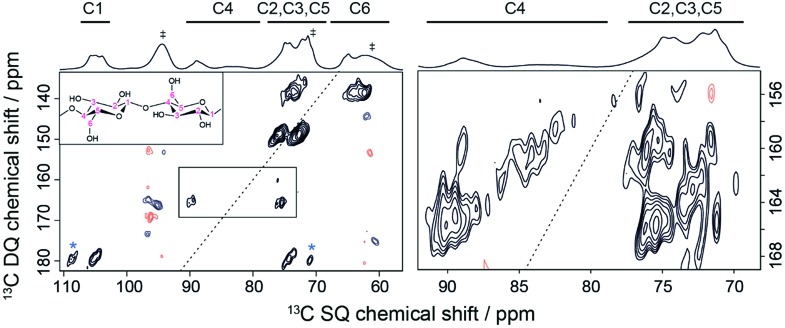
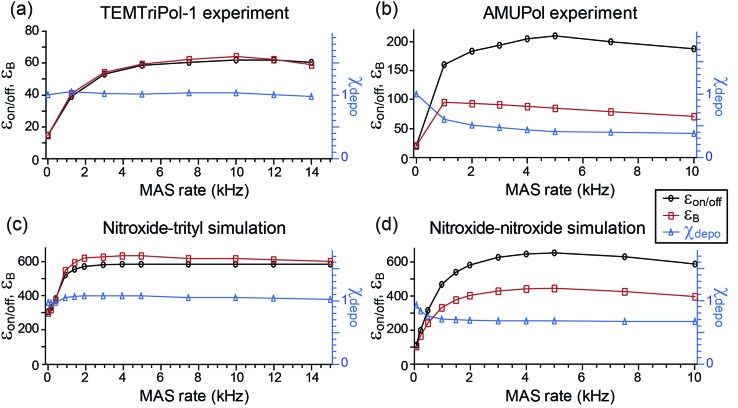
Dynamic nuclear polarization (DNP) has the potential to enhance the sensitivity of magic-angle spinning (MAS) NMR by many orders of magnitude and therefore to revolutionize atomic resolution structural analysis. Currently, the most widely used approach to DNP for studies of chemical, material, and biological systems involves the cross-effect (CE) mechanism, which relies on biradicals as polarizing agents. However, at high magnetic fields (≥5 T), the best biradicals used for CE MAS-DNP are still far from optimal, primarily because of the nuclear depolarization effects they induce. In the presence of bisnitroxide biradicals, magic-angle rotation results in a reverse CE that can deplete the initial proton Boltzmann polarization by more than a factor of 2. In this paper we show that these depolarization losses can be avoided by using a polarizing agent composed of a narrow-line trityl radical tethered to a broad-line TEMPO. Consequently, we show that a biocompatible trityl-nitroxide biradical, TEMTriPol-1, provides the highest MAS NMR sensitivity at ≥10 T, and its relative efficiency increases with the magnetic field strength. We use numerical simulations to explain the absence of depolarization for TEMTriPol-1 and its high efficiency, paving the way for the next generation of polarizing agents for DNP. We demonstrate the superior sensitivity enhancement using TEMTriPol-1 by recording the first solid-state 2D C-C correlation spectrum at natural isotopic abundance at a magnetic field of 18.8 T.
动态核极化(DNP)有潜力将魔角旋转(MAS)核磁共振(NMR)的灵敏度提高多个数量级,从而彻底改变原子分辨率结构分析。目前,在化学、材料和生物系统研究中,最广泛使用的DNP方法涉及交叉效应(CE)机制,该机制依赖双自由基作为极化剂。然而,在高磁场(≥5 T)下,用于CE MAS-DNP的最佳双自由基仍远非最佳选择,主要是因为它们会引起核去极化效应。在双氮氧自由基双自由基存在的情况下,魔角旋转会导致反向CE,使初始质子玻尔兹曼极化消耗超过两倍。在本文中,我们表明,通过使用由连接到宽线TEMPO的窄线三苯甲基自由基组成的极化剂,可以避免这些去极化损失。因此,我们表明,一种生物相容性三苯甲基-氮氧自由基双自由基TEMTriPol-1在≥10 T时提供最高的MAS NMR灵敏度,并且其相对效率随磁场强度增加。我们使用数值模拟来解释TEMTriPol-1不存在去极化及其高效率的原因,为下一代DNP极化剂铺平了道路。我们通过在18.8 T磁场下以天然同位素丰度记录第一个固态二维C-C相关谱,证明了使用TEMTriPol-1具有卓越的灵敏度增强效果。