Krezanoski Paul J, Bangsberg David R, Tsai Alexander C
Department of Medicine, Zuckerberg San Francisco General Hospital, University of California, San Francisco, San Francisco, California, USA.
Department of Pediatrics, Zuckerberg San Francisco General Hospital, University of California, San Francisco, San Francisco, California, USA.
J Glob Health. 2018 Jun;8(1):010411. doi: 10.7189/jogh.08.010411.
Insecticide-treated bednets (ITNs) are recommended for use by 3.4 billion people at risk of malaria world-wide. Policy makers rely on measurements of ITN use to optimize malaria prevention efforts. Self-reports are the most common means of assessing ITN use, but self-reports may be biased in a way that reduces their reliability as a proxy for ITN adherence. This meta-analysis compared self-reported and two methods which are more objective measures of ITN use to explore whether self-reports overestimate actual ITN adherence.
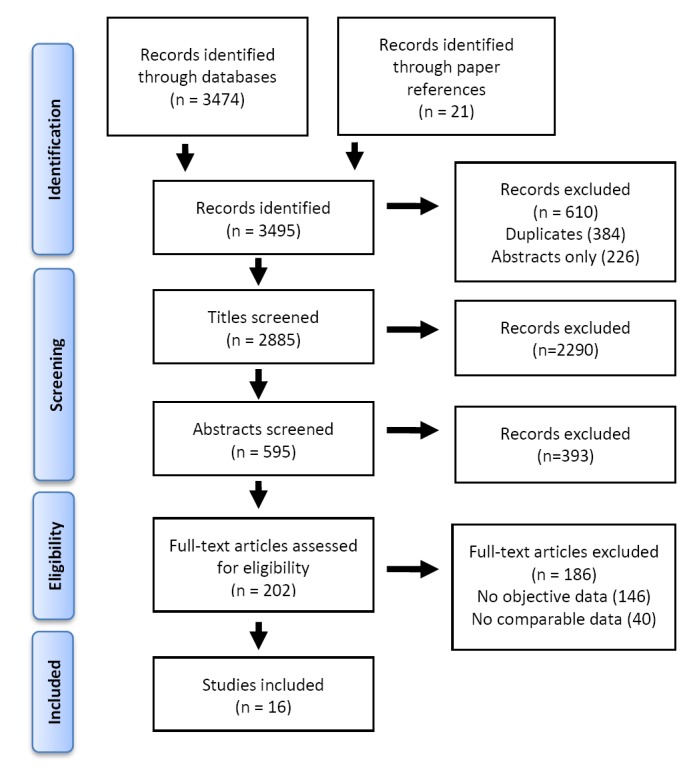
A comprehensive search of electronic databases and hand searching reference lists resulted in screening 2885 records and 202 articles were read in full. Sixteen articles with comparable data were chosen for the meta-analysis. Comparable data was defined as self-reported and objectively measured ITN use (observation of a mounted ITN or surprise visits confirming use) at the same unit of analysis, covering the same time period and same population. A random effects model was used to determine a weighted average risk difference between self-reported and objectively measured ITN use. Additional stratified analyses were conducted to explore study heterogeneity.
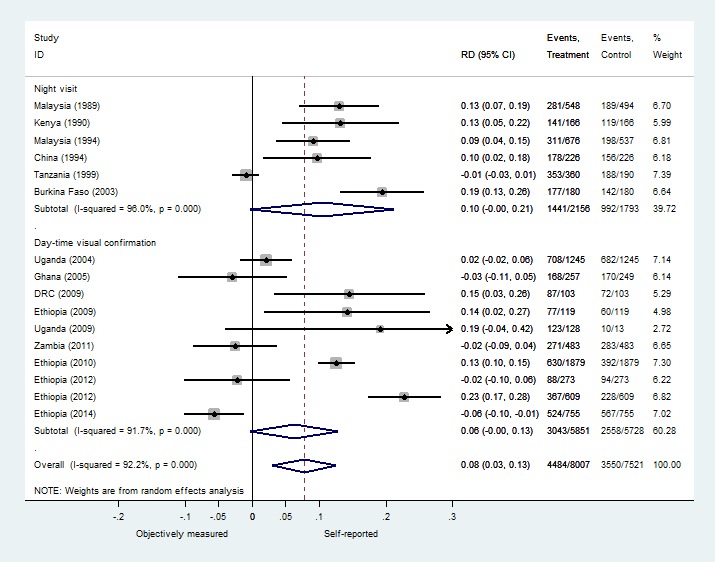
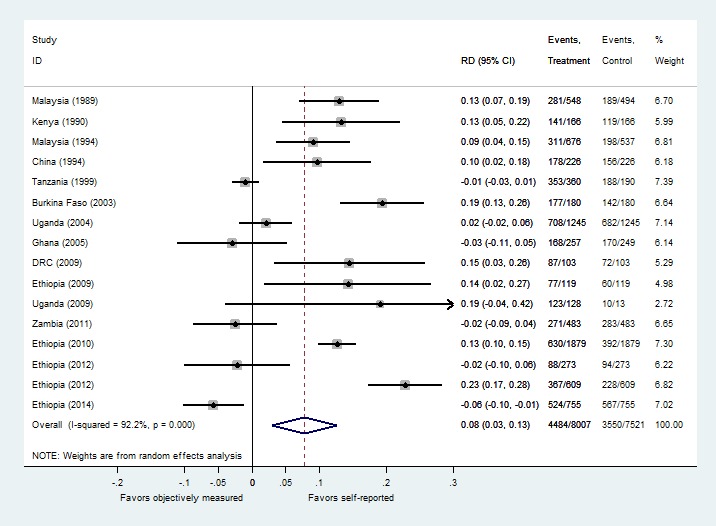
Self-reported ITN use is 8 percentage points (95% confidence interval CI: 3 to 13) higher than objectively measured ITN use, representing a 13.6% overestimation relative to the proportion measured as adherent to ITN use by objective measures. Wide variations in the discrepancies between self-reports and objective measures were unable to be explained using stratified analyses of variables including location, year of publication, seasonality and others.
Self-reports overestimate ITN adherence relative to objectively measured ITN use by 13.6% and do so in an unpredictable manner that raises questions about the reliability of using self-reported ITN use alone as a surveillance tool and a guide for making policy decisions.
全球有34亿面临疟疾风险的人被建议使用经杀虫剂处理的蚊帐(ITN)。政策制定者依靠对ITN使用情况的测量来优化疟疾预防工作。自我报告是评估ITN使用情况最常用的方法,但自我报告可能存在偏差,从而降低其作为ITN依从性指标的可靠性。本荟萃分析比较了自我报告与另外两种更客观的ITN使用测量方法,以探讨自我报告是否高估了实际的ITN依从性。
通过全面检索电子数据库并手工查阅参考文献列表,共筛选出2885条记录,对202篇文章进行了全文阅读。选择了16篇具有可比数据的文章进行荟萃分析。可比数据定义为在相同分析单位、覆盖相同时间段和相同人群的情况下,自我报告的和客观测量的ITN使用情况(观察挂起的ITN或突击检查确认使用情况)。采用随机效应模型确定自我报告的和客观测量的ITN使用情况之间的加权平均风险差异。进行了额外的分层分析以探讨研究的异质性。
自我报告的ITN使用率比客观测量的ITN使用率高8个百分点(95%置信区间CI:3至13),相对于客观测量的ITN依从使用率,高估了13.6%。自我报告与客观测量之间差异的广泛变化无法通过对包括地点、发表年份、季节性等变量的分层分析来解释。
相对于客观测量的ITN使用情况,自我报告高估了ITN依从性13.6%,而且是以一种不可预测的方式,这引发了对于仅将自我报告的ITN使用情况作为监测工具和政策决策指南的可靠性的质疑。