Peptide Drug Innovation, Global Research Center for Innovative Life Science, Hoshi University, Ebara, Shinagawa-ku, Tokyo, 142-8501, Japan.
Laboratory of Regulatory Biology, Graduate School of Science and Engineering, University of Toyama, 3190-Gofuku, Toyama-shi, Toyama, 930-8555, Japan.
J Headache Pain. 2018 Apr 4;19(1):28. doi: 10.1186/s10194-018-0855-1.
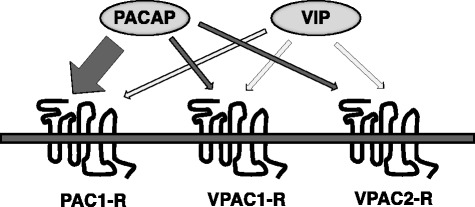
Pituitary adenylate-cyclase-activating polypeptide (PACAP) is a 27- or 38-amino acid neuropeptide, which belongs to the vasoactive intestinal polypeptide (VIP)/glucagon/secretin family. PACAP shows particularly high homology (~ 68%) to VIP. Because of the high homology of the amino acid sequences of PACAP and VIP, these peptides share three class B-G-protein coupled receptors: the PAC1-Receptor (PAC1-R), the VPAC1-Receptor (VPAC1-R) and VPAC2-Receptor (VPAC2-R). These receptors have high homology to each other, and their high homology is utilized for these discoveries. This review provides mainly an overview of the history of the discovery of PACAP and its three receptors.
垂体腺苷酸环化酶激活肽(PACAP)是一种 27 或 38 个氨基酸的神经肽,属于血管活性肠肽(VIP)/胰高血糖素/分泌素家族。PACAP 与 VIP 具有特别高的同源性(~68%)。由于 PACAP 和 VIP 的氨基酸序列高度同源,这些肽共享三种 B 类 G 蛋白偶联受体:PAC1 受体(PAC1-R)、VPAC1 受体(VPAC1-R)和 VPAC2 受体(VPAC2-R)。这些受体彼此之间具有高度的同源性,它们的高度同源性被用于这些发现。这篇综述主要概述了 PACAP 及其三种受体的发现历史。