Department of Gynaecology and Obstetrics, The Second Hospital of Tianjin Medical University, Tianjin 300211, P.R. China.
Mol Med Rep. 2018 Jun;17(6):7497-7504. doi: 10.3892/mmr.2018.8811. Epub 2018 Mar 28.
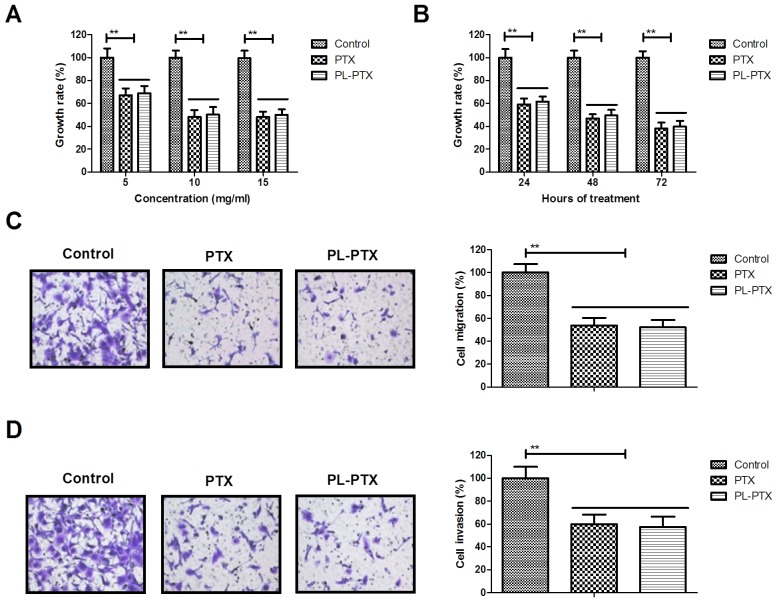
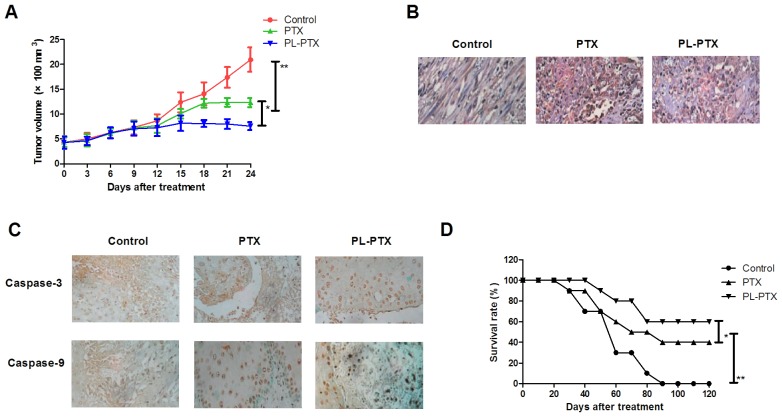
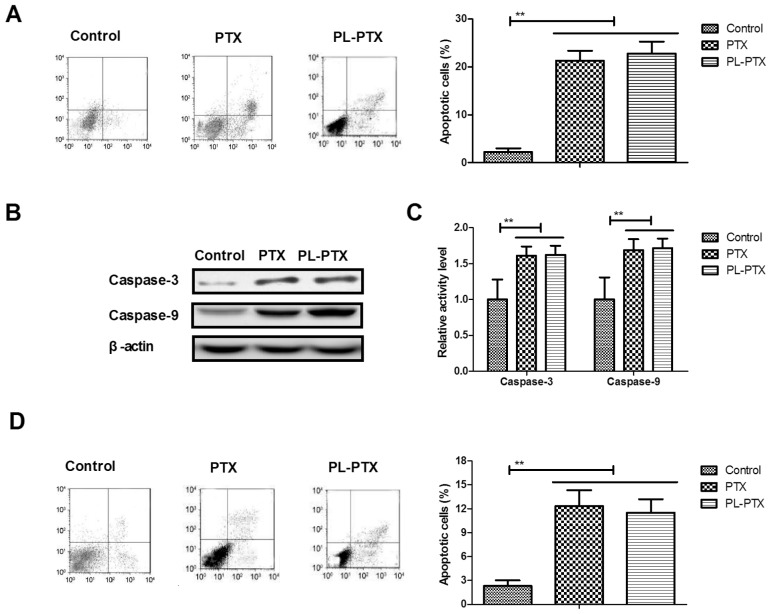
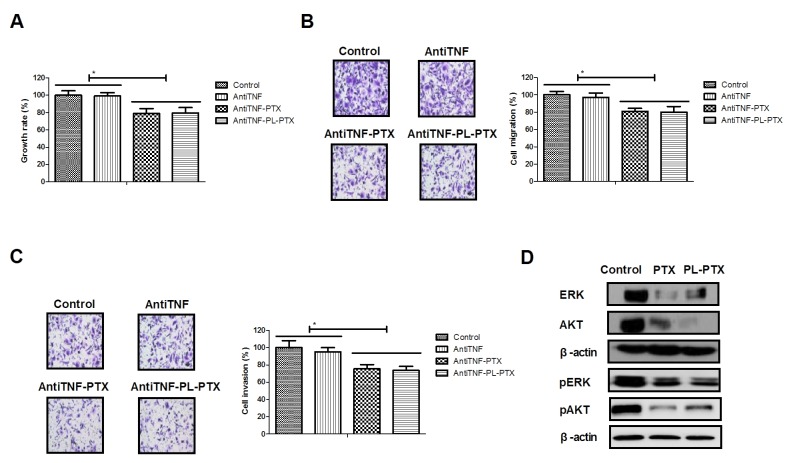
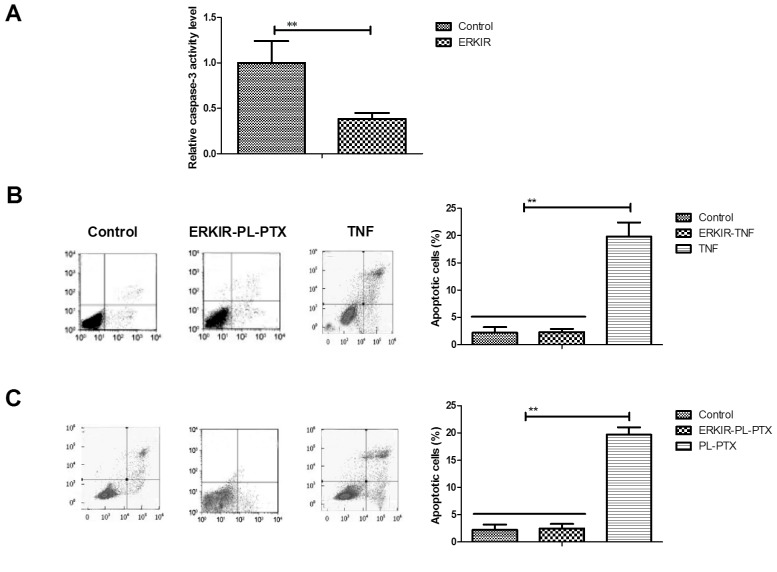
Ovarian cancer is one of the most common gynecological types of cancer and is characterized by a relatively high incidence and high mortality rate. Evidence has demonstrated that paclitaxel (PTX) is an effective therapeutic treatment for human ovarian cancer. In the present study, the inhibitory effects of pegylated liposomal (PL)‑PTX on the growth of ovarian cancer cells were investigated in vitro; a CAOV‑3‑bearing mouse model was established to investigate the in vivo effects of PL‑PTX on ovarian tumor growth. In the present study, the underlying mechanism of tumor necrosis factor (TNF)‑induced inhibition of extracellular signal‑regulated kinase (ERK)/protein kinase B (AKT) signaling pathway mediated by PL‑PTX was analyzed within ovarian cancer cells. The results of the present study revealed that PL‑PTX significantly inhibited the growth and aggressiveness of ovarian cancer cells in vitro and in vivo and apoptotic ability increased upon administration of PL‑PTX. The expression levels of caspase‑3/9 were significantly upregulated within PL‑PTX‑treated ovarian cancer cells. The expression and phosphorylation levels of ERK and AKT were markedly increased in response to PL‑PTX treatment. In addition, the inhibitory effects of PL‑PTX on ovarian cancer cells were eliminated by neutralizing antibodies against TNF. The observations of the present study revealed that PL‑PTX induced ovarian cell apoptosis via the TNF‑dependent pathway, which was significantly inhibited with the employment of antibodies against TNF. In vivo analysis demonstrated that PL‑PTX treatment significantly inhibited ovarian tumor growth and prolonged the survival of tumor bearing mice. In conclusion, the findings of the present study have provided an insight into the potential mechanism of PL‑PTX‑induced apoptosis of ovarian cancer cells. As PL‑PTX has been reported to induce ovarian tumor cell apoptosis via the TNF‑induced ERK/AKT signaling pathway, PL‑PTX may serve as an efficient anticancer drug for the treatment of ovarian cancer.
卵巢癌是最常见的妇科癌症类型之一,其特征是发病率相对较高,死亡率也较高。有证据表明,紫杉醇(PTX)是治疗人类卵巢癌的有效治疗方法。在本研究中,研究人员研究了聚乙二醇化脂质体(PL)-PTX 在体外对卵巢癌细胞生长的抑制作用;建立了 CAOV-3 荷瘤小鼠模型,以研究 PL-PTX 对卵巢肿瘤生长的体内作用。在本研究中,分析了 PL-PTX 通过肿瘤坏死因子(TNF)诱导抑制细胞外信号调节激酶(ERK)/蛋白激酶 B(AKT)信号通路的机制在卵巢癌细胞中。本研究结果表明,PL-PTX 可显著抑制卵巢癌细胞在体内外的生长和侵袭能力,并增加 PL-PTX 给药后的凋亡能力。PL-PTX 处理的卵巢癌细胞中 caspase-3/9 的表达水平明显上调。PL-PTX 处理后 ERK 和 AKT 的表达和磷酸化水平显著增加。此外,TNF 中和抗体消除了 PL-PTX 对卵巢癌细胞的抑制作用。本研究的观察结果表明,PL-PTX 通过 TNF 依赖性途径诱导卵巢细胞凋亡,而 TNF 抗体的应用则显著抑制了该途径。体内分析表明,PL-PTX 治疗可显著抑制卵巢肿瘤生长并延长荷瘤小鼠的存活时间。综上所述,本研究结果为 PL-PTX 诱导卵巢癌细胞凋亡的潜在机制提供了新的见解。由于 PL-PTX 已被报道通过 TNF 诱导的 ERK/AKT 信号通路诱导卵巢肿瘤细胞凋亡,因此 PL-PTX 可能成为治疗卵巢癌的有效抗癌药物。