Department of Transplantation and Pediatric Surgery, Postgraduate School of Medical Sciences, Kumamoto University, Kumamoto, Japan.
Transplantation. 2018 Oct;102(10):1702-1709. doi: 10.1097/TP.0000000000002197.
ABO-incompatible (ABOi) living donor liver transplantation (LDLT) has been performed to compensate for donor shortage. To date, few studies have reported detailed B-cell desensitization protocols and long-term outcomes of ABOi pediatric LDLT.
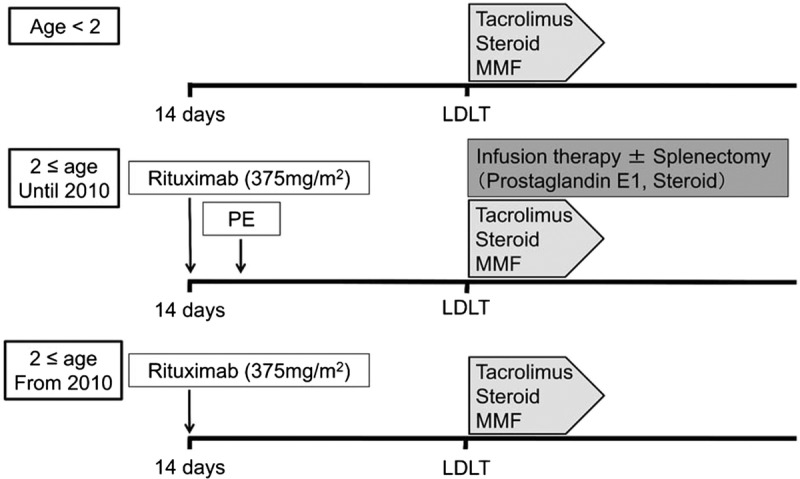
Twenty-nine pediatric ABOi LDLT recipients were retrospectively analyzed. We compared the clinical outcomes between ABOi (n = 29) and non-ABOi (n = 131) pediatric LDLT recipients. Furthermore, we evaluated the safety and efficacy of our rituximab-based regimen for ABOi pediatric LDLT (2 ≤ age < 18; n = 10).
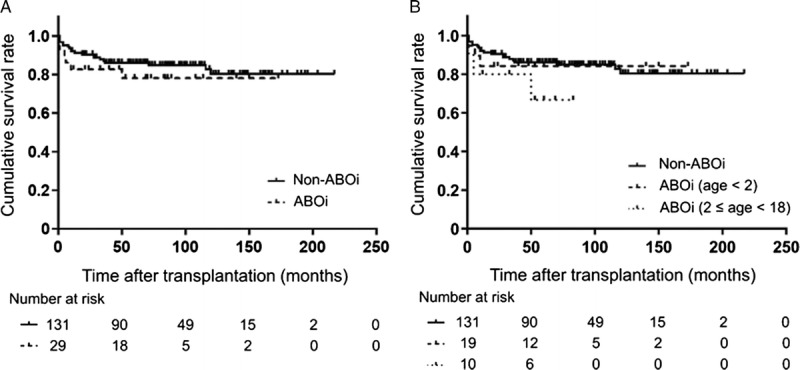
There were no significant differences in the incidence of infection, vascular complications, biliary complications, and acute cellular rejection between ABOi and non-ABOi groups. The cumulative graft survival rate at 1, 3, and 5 years for non-ABOi group were 92.1%, 87.0%, and 86.1%, and those for ABOi group were 82.8%, 82.8%, and 78.2%, respectively. Rituximab-based desensitization protocol could be performed safely, and reduced CD19+ lymphocyte counts effectively. Although rituximab-treated ABOi group showed comparable clinical outcomes and graft survival rate, 2 patients developed antibody-mediated rejection.
ABOi LDLT is a feasible option for pediatric end-stage liver disease patients. However, it should be noted that current desensitization protocol does not completely prevent the onset of antibody-mediated rejection in several cases.
为了弥补供体短缺,已经进行了 ABO 不相容(ABOi)活体供肝移植(LDLT)。迄今为止,很少有研究报道 ABOi 儿科 LDLT 的详细 B 细胞脱敏方案和长期结果。
回顾性分析了 29 例 ABOi 儿科 LDLT 受者。我们比较了 ABOi(n=29)和非 ABOi(n=131)儿科 LDLT 受者的临床结果。此外,我们评估了我们基于利妥昔单抗的方案用于 ABOi 儿科 LDLT(2≤年龄<18;n=10)的安全性和有效性。
ABOi 组和非 ABOi 组在感染、血管并发症、胆道并发症和急性细胞排斥的发生率方面无显著差异。非 ABOi 组的累积移植物 1、3 和 5 年存活率分别为 92.1%、87.0%和 86.1%,ABOi 组分别为 82.8%、82.8%和 78.2%。基于利妥昔单抗的脱敏方案可以安全进行,并有效降低 CD19+淋巴细胞计数。虽然利妥昔单抗治疗的 ABOi 组显示出可比的临床结果和移植物存活率,但有 2 例发生抗体介导的排斥反应。
ABOi LDLT 是儿科终末期肝病患者的一种可行选择。然而,应该注意的是,目前的脱敏方案并不能完全防止在几种情况下发生抗体介导的排斥反应。