Yang Shujuan, Zhai Wenwen, Pei Rong, Jike Chunnong, Nan Lei, Yu Gang, Liao Qiang, Wang Qixing, Liu Danping, Gao Bo, Xiao Lin, Gong Yuhan, Wang Ke, Wang Ju
Department of Health Related Social and Behavioral Science, West China School of Public Health, Sichuan University, Chengdu Liangshan Prefecture Center for Disease Prevention and Control, Xichang, China.
Medicine (Baltimore). 2018 Apr;97(14):e0250. doi: 10.1097/MD.0000000000010250.
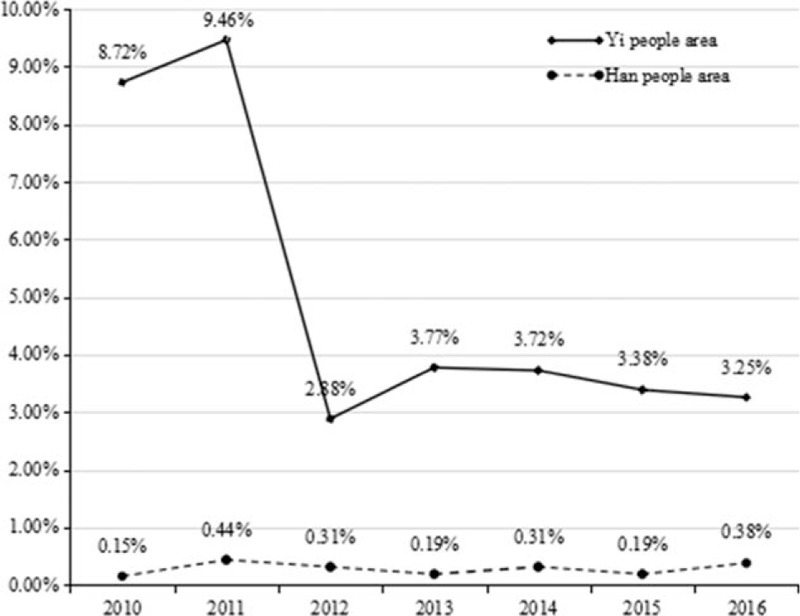
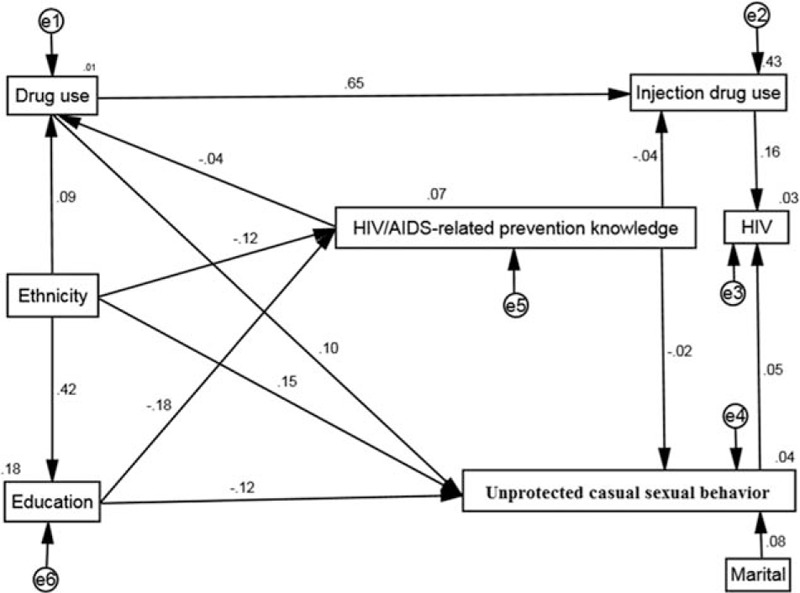
We aimed to evaluate HIV prevalence among residents of Liangshan Prefecture through HIV sentinel surveillance (HSS) data over the period from 2010 to 2016, and investigate risk factors for HIV infection in this population and interactions among them.Two sites (Dechang and Ningnan counties) with majority-Han populations, and 1 site (Butuo) with a majority-Yi population were selected. We used questionnaires to investigate residents' demographic and behavioral characteristics from 2010 to 2016, and performed HIV testing. Multivariate logistic regression and path analysis were undertaken to investigate the interactions and mediating effects among significant risk factors for HIV infection.A total of 5403 community residents in the Yi area and 10,897 community residents in the Han areas were enrolled. HIV prevalence in the Yi area was consistently high, ranging from 9.46% (63/666, 2011) to 2.88% (23/798, 2012) over the period from 2010 to 2016. HIV prevalence in the Han areas ranged from 0.15% (2/1333, 2010) to 0.44% (7/1604, 2011) over the same period. Multivariate logistic regression showed that unprotected casual sexual behavior, male gender, illiteracy, drug use, and injection drug use were positively associated with HIV infection risk in the Yi area. Path analysis of the risk factors revealed that casual sexual behavior (0.051) and injection drug use (0.161) were directly associated with HIV infection. However, marital status (0.004), ethnicity (0.017), education level (-0.004), HIV/AIDS-related prevention knowledge (-0.012), and drug use (0.11) had an indirect influence on HIV infection through casual sexual behavior and injection drug use.The prevalence of HIV is high among residents of majority-Yi areas, and injection drug use and casual sexual behavior are risk factors for infection.
我们旨在通过2010年至2016年期间的艾滋病哨点监测(HSS)数据评估凉山州居民中的艾滋病毒流行情况,并调查该人群中艾滋病毒感染的危险因素及其相互作用。我们选择了两个汉族人口占多数的地点(德昌县和宁南县)以及一个彝族人口占多数的地点(布拖县)。我们使用问卷调查了2010年至2016年居民的人口统计学和行为特征,并进行了艾滋病毒检测。采用多因素logistic回归和路径分析来研究艾滋病毒感染的重要危险因素之间的相互作用和中介效应。彝族地区共纳入5403名社区居民,汉族地区共纳入10897名社区居民。2010年至2016年期间,彝族地区的艾滋病毒流行率一直很高,从2011年的9.46%(63/666)到2012年的2.88%(23/798)不等。同期汉族地区的艾滋病毒流行率从2010年的0.15%(2/1333)到2011年的0.44%(7/1604)不等。多因素logistic回归显示,在彝族地区,无保护的随意性行为、男性、文盲、吸毒和注射吸毒与艾滋病毒感染风险呈正相关。对危险因素的路径分析显示,随意性行为(0.051)和注射吸毒(0.161)与艾滋病毒感染直接相关。然而,婚姻状况(0.004)、民族(0.017)、教育水平(-0.004)、艾滋病毒/艾滋病相关预防知识(-0.012)和吸毒(0.11)通过随意性行为和注射吸毒对艾滋病毒感染有间接影响。彝族人口占多数地区的居民中艾滋病毒流行率很高,注射吸毒和随意性行为是感染的危险因素。