Duffield Callum, Ioannou Christos C
School of Biological Sciences, University of Bristol, Bristol BS8 1TQ, UK.
Behav Ecol. 2017 Sep-Oct;28(5):1283-1292. doi: 10.1093/beheco/arx090. Epub 2017 Jul 27.
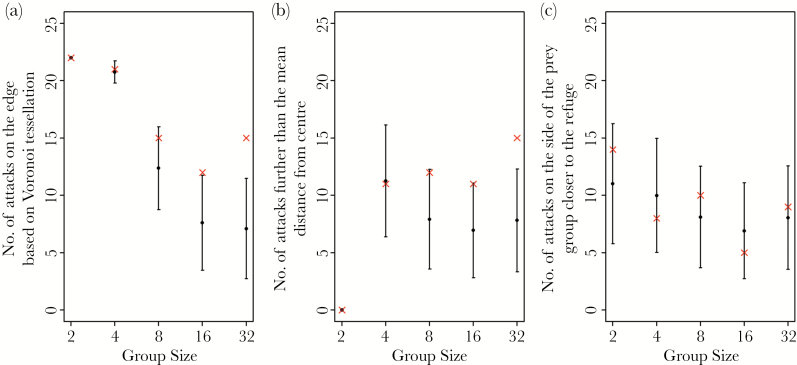
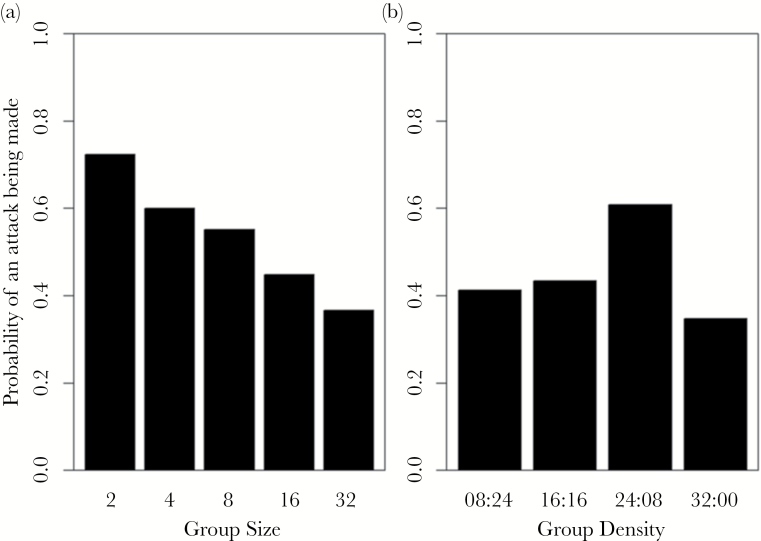
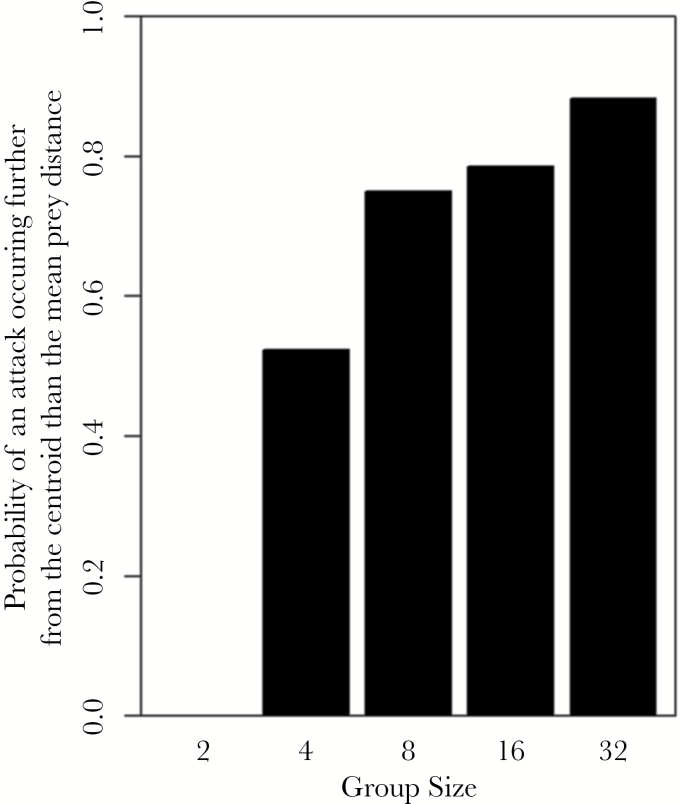
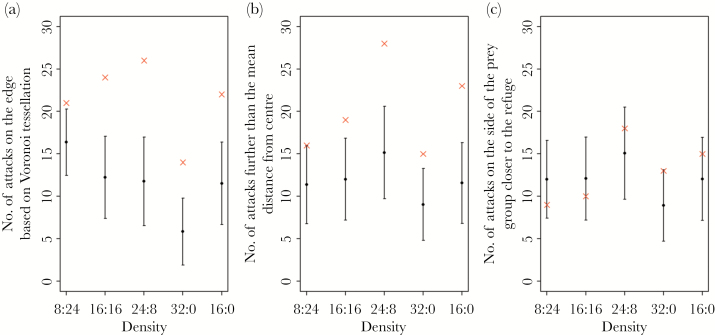
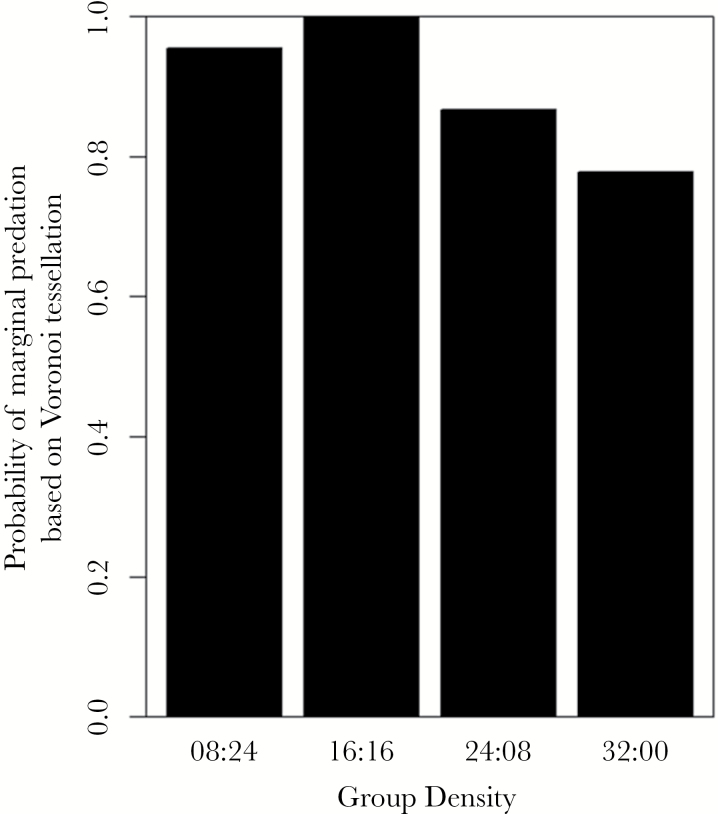
Marginal predation, also known as the edge effect, occurs when aggregations of prey are preferentially targeted on their periphery by predators and has long been established in many taxa. Two main processes have been used to explain this phenomenon, the confusion effect and the encounter rate between predators and prey group edges. However, it is unknown at what size a prey group needs to be before marginal predation is detectable and to what extent each mechanism drives the effect. We conducted 2 experiments using groups of virtual prey being preyed upon by 3-spined sticklebacks () to address these questions. In Experiment 1, we show that group sizes do not need to be large for marginal predation to occur, with this being detectable in groups of 16 or more. In Experiment 2, we find that encounter rate is a more likely explanation for marginal predation than the confusion effect in this system. We find that while confusion does affect predatory behaviors (whether or not predators make an attack), it does not affect marginal predation. Our results suggest that marginal predation is a more common phenomenon than originally thought as it also applies to relatively small groups. Similarly, as marginal predation does not need the confusion effect to occur, it may occur in a wider range of predator-prey species pairings, for example those where the predators search for prey using nonvisual sensory modalities.
边缘捕食,也称为边缘效应,是指猎物聚集时,其边缘优先被捕食者盯上,这种现象在许多生物分类群中早已存在。有两个主要过程被用来解释这一现象,即混淆效应以及捕食者与猎物群体边缘的相遇率。然而,尚不清楚猎物群体需要多大规模才能检测到边缘捕食,以及每种机制在多大程度上驱动了这种效应。我们进行了两项实验,用虚拟猎物群体被三刺鱼捕食来解决这些问题。在实验1中,我们表明,边缘捕食的发生并不需要很大的群体规模,16个或更多个体的群体就能检测到这种现象。在实验2中,我们发现,在这个系统中,相遇率比混淆效应更有可能是边缘捕食的原因。我们发现,虽然混淆确实会影响捕食行为(捕食者是否发动攻击),但它并不影响边缘捕食。我们的结果表明,边缘捕食是一种比原先认为的更为普遍的现象,因为它也适用于相对较小的群体。同样,由于边缘捕食的发生不需要混淆效应,它可能发生在更广泛的捕食者 - 猎物物种配对中,例如捕食者使用非视觉感官模式搜索猎物的情况。