Lemasson Bertrand H, Tanner Colby J, Dimperio Eric
Environmental Laboratory, U.S. Army Engineer Research & Development Center (ERDC), Santa Barbara, California, United States of America.
Department of Ecology, Université de Lausanne, Switzerland.
PLoS Comput Biol. 2016 Feb 25;12(2):e1004708. doi: 10.1371/journal.pcbi.1004708. eCollection 2016 Feb.
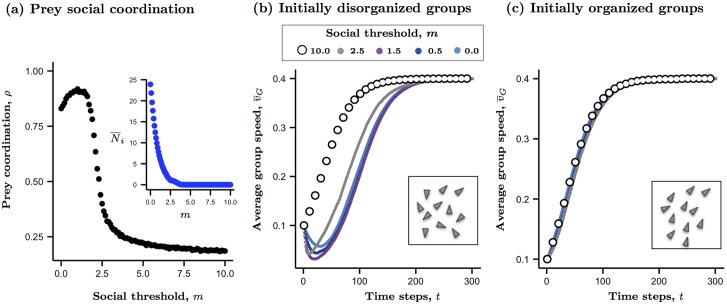
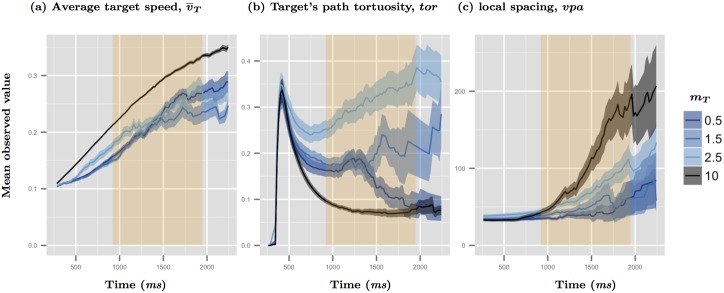
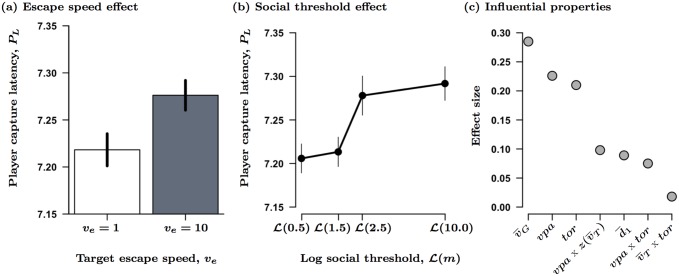
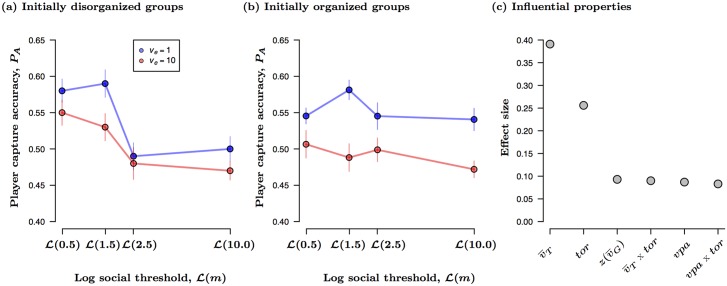
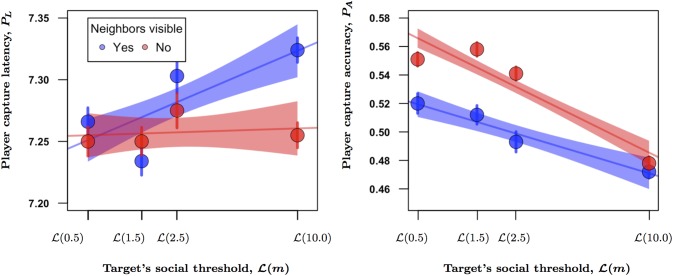
Social animals are capable of enhancing their awareness by paying attention to their neighbors, and prey found in groups can also confuse their predators. Both sides of these sensory benefits have long been appreciated, yet less is known of how the perception of events from the perspectives of both prey and predator can interact to influence their encounters. Here we examined how a visual sensory mechanism impacts the collective motion of prey and, subsequently, how their resulting movements influenced predator confusion and capture ability. We presented virtual prey to human players in a targeting game and measured the speed and accuracy with which participants caught designated prey. As prey paid more attention to neighbor movements their collective coordination increased, yet increases in prey coordination were positively associated with increases in the speed and accuracy of attacks. However, while attack speed was unaffected by the initial state of the prey, accuracy dropped significantly if the prey were already organized at the start of the attack, rather than in the process of self-organizing. By repeating attack scenarios and masking the targeted prey's neighbors we were able to visually isolate them and conclusively demonstrate how visual confusion impacted capture ability. Delays in capture caused by decreased coordination amongst the prey depended upon the collection motion of neighboring prey, while it was primarily the motion of the targets themselves that determined capture accuracy. Interestingly, while a complete loss of coordination in the prey (e.g., a flash expansion) caused the greatest delay in capture, such behavior had little effect on capture accuracy. Lastly, while increases in collective coordination in prey enhanced personal risk, traveling in coordinated groups was still better than appearing alone. These findings demonstrate a trade-off between the sensory mechanisms that can enhance the collective properties that emerge in social animals and the individual group member's predation risk during an attack.
群居动物能够通过关注同伴来提高自身的警觉性,而且群体中的猎物也会让捕食者感到困惑。这些感官益处的两个方面长期以来都为人所知,但对于猎物和捕食者如何从各自角度感知事件并相互作用以影响它们之间的遭遇,我们了解得还比较少。在这里,我们研究了一种视觉感官机制如何影响猎物的集体运动,以及随后它们的运动如何影响捕食者的困惑程度和捕捉能力。我们在一个目标游戏中向人类玩家展示虚拟猎物,并测量参与者捕捉指定猎物的速度和准确性。当猎物更多地关注同伴的运动时,它们的集体协调性会增强,而猎物协调性的提高与攻击速度和准确性的提高呈正相关。然而,虽然攻击速度不受猎物初始状态的影响,但如果猎物在攻击开始时就已经组织好,而不是在自我组织的过程中,那么准确性会显著下降。通过重复攻击场景并遮挡目标猎物的同伴,我们能够在视觉上隔离它们,并最终证明视觉干扰是如何影响捕捉能力的。猎物之间协调性降低导致的捕捉延迟取决于邻近猎物的集体运动,而主要是目标本身的运动决定了捕捉的准确性。有趣的是,虽然猎物完全失去协调性(例如突然散开)会导致最大的捕捉延迟,但这种行为对捕捉准确性的影响很小。最后,虽然猎物集体协调性的提高会增加个体风险,但以协调的群体形式行动仍然比单独出现要好。这些发现表明,在能够增强群居动物集体特性的感官机制与攻击过程中单个群体成员的捕食风险之间存在权衡。