Blázquez Blas, Carmona Manuel, Díaz Eduardo
Department of Microbial and Plant Biotechnology, Centro de Investigaciones Biológicas-Consejo Superior de Investigaciones Científicas, Madrid, Spain.
Front Microbiol. 2018 Mar 22;9:506. doi: 10.3389/fmicb.2018.00506. eCollection 2018.
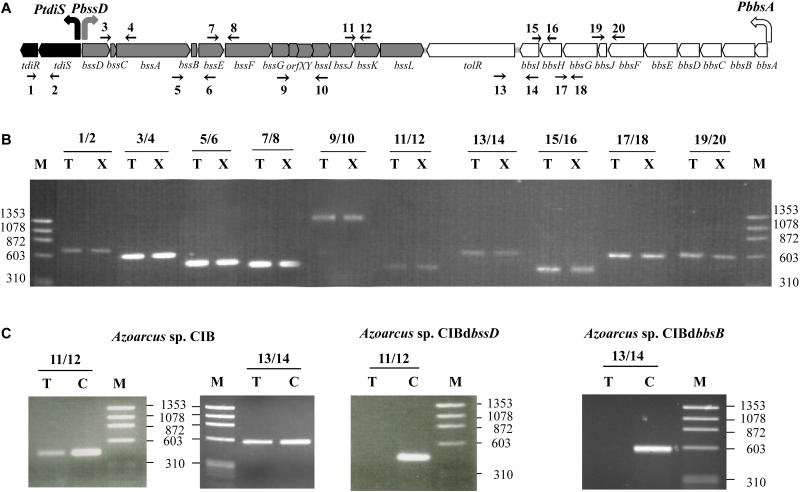
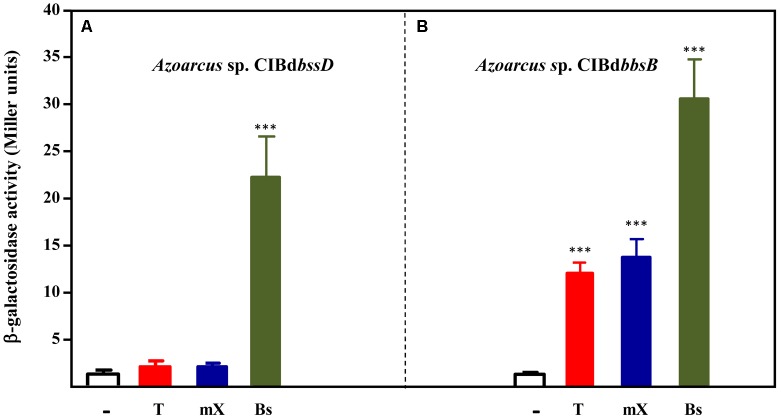
Alkylbenzenes, such as toluene and -xylene, are an important class of contaminant hydrocarbons that are widespread and tend to accumulate in subsurface anoxic environments. The peripheral pathway for the anaerobic oxidation of toluene in bacteria consists of an initial activation catalyzed by a benzylsuccinate synthase (encoded by genes), and a subsequent modified β-oxidation of benzylsuccinate to benzoyl-CoA and succinyl-CoA (encoded by genes). We have shown here that the and genes, which are located within an integrative and conjugative element, are essential for anaerobic degradation of toluene but also for -xylene oxidation in the denitrifying beta-proteobacterium sp. CIB. New insights into the transcriptional organization and regulation of a complete gene cluster for anaerobic catabolism of toluene/-xylene in a single bacterial strain are presented. The and genes are transcriptionally coupled into two large convergent catabolic operons driven by the and promoters, respectively, whose expression is inducible when cells grow anaerobically in toluene or -xylene. An adjacent operon driven by the promoter encodes a putative two-component regulatory system. TdiR behaves as a transcriptional activator of the , , and promoters, being benzylsuccinate/(3-methyl)benzylsuccinate, rather than toluene/-xylene, the inducers that may trigger the TdiS-mediated activation of TdiR. In addition to the TdiSR-based specific control, the expression of the and genes in sp. CIB is under an overimposed regulation that depends on certain environmental factors, such as the presence/absence of oxygen or the availability of preferred carbon sources (catabolite repression). This work paves the way for future strategies toward the reliable assessment of microbial activity in toluene/-xylene contaminated environments.
烷基苯,如甲苯和二甲苯,是一类重要的污染性碳氢化合物,广泛存在且易于在地下缺氧环境中积累。细菌中甲苯厌氧氧化的外周途径包括由苄基琥珀酸合酶(由基因编码)催化的初始激活,以及随后将苄基琥珀酸修饰为苯甲酰辅酶A和琥珀酰辅酶A的β-氧化过程(由基因编码)。我们在此表明,位于整合与接合元件内的基因和基因,不仅对于甲苯的厌氧降解至关重要,对于反硝化β-变形菌CIB菌株中二甲苯的氧化也必不可少。本文介绍了对单个细菌菌株中甲苯/二甲苯厌氧分解代谢完整基因簇的转录组织和调控的新见解。基因和基因转录偶联成两个分别由启动子和启动子驱动的大型反向分解代谢操纵子,当细胞在甲苯或二甲苯中厌氧生长时,其表达是可诱导的。由启动子驱动的相邻操纵子编码一个假定的双组分调节系统。TdiR作为启动子、启动子和启动子的转录激活因子,苄基琥珀酸/(3-甲基)苄基琥珀酸而非甲苯/二甲苯是可能触发TdiS介导的TdiR激活的诱导剂。除了基于TdiSR的特异性控制外, CIB菌株中基因和基因的表达还受到一种叠加调控,该调控取决于某些环境因素,如氧气的存在与否或首选碳源的可用性(分解代谢物阻遏)。这项工作为未来在甲苯/二甲苯污染环境中可靠评估微生物活性的策略铺平了道路。