Wolfson Centre for Age-Related Diseases, King's College London, Guy's Campus, London, SE1 1UL, UK.
Infectology and Clinical Trials Research Department, Bambino Gesu` Children's Hospital, IRCCS, Rome, Italy.
J Neuroinflammation. 2018 Apr 6;15(1):101. doi: 10.1186/s12974-018-1116-6.
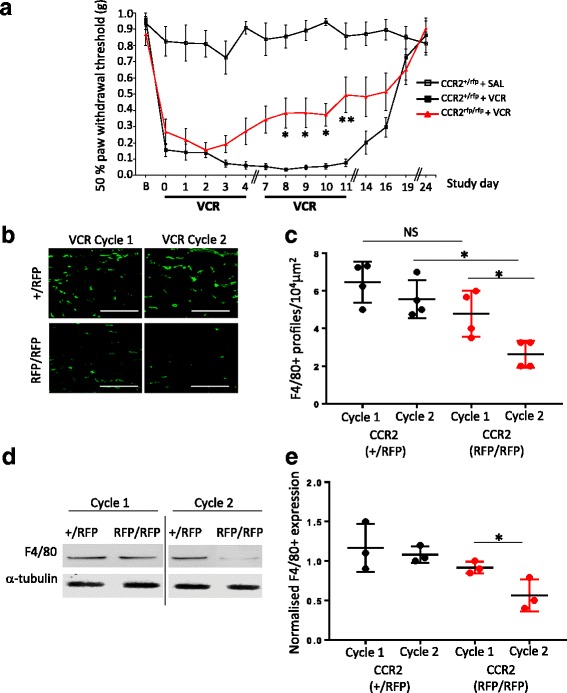
A dose-limiting side effect of chemotherapeutic agents such as vincristine (VCR) is neuropathic pain, which is poorly managed at present. Chemokine-mediated immune cell/neuron communication in preclinical VCR-induced pain forms an intriguing basis for the development of analgesics. In a murine VCR model, CXCR receptor-mediated signalling in monocytes/macrophages in the sciatic nerve orchestrates the development of mechanical hypersensitivity (allodynia). CXCR-deficient mice however still develop allodynia, albeit delayed; thus, additional underlying mechanisms emerge as VCR accumulates. Whilst both patrolling and inflammatory monocytes express CXCR, only inflammatory monocytes express CCR receptors. We therefore assessed the role of CCR in monocytes in later stages of VCR-induced allodynia.
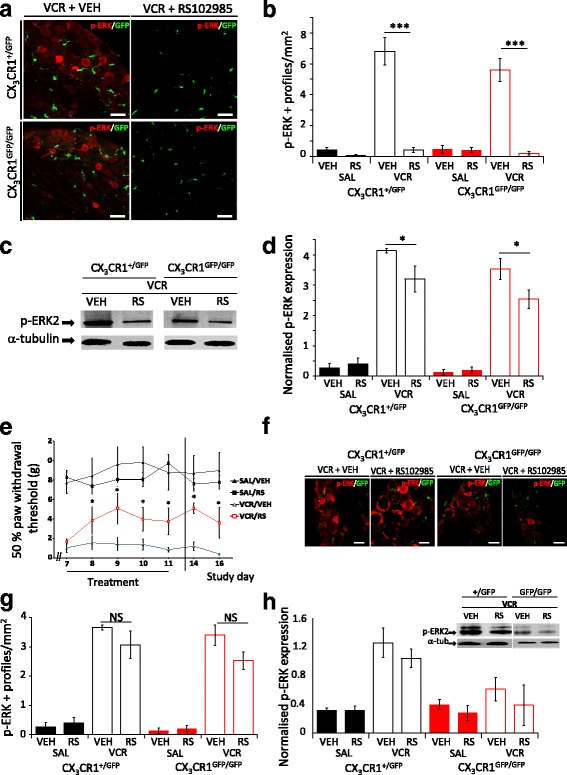
Mechanically evoked hypersensitivity was assessed in VCR-treated CCR- or CXCR-deficient mice. In CXCR-deficient mice, the CCR antagonist, RS-102895, was also administered. Immunohistochemistry and Western blot analysis were employed to determine monocyte/macrophage infiltration into the sciatic nerve as well as neuronal activation in lumbar DRG, whilst flow cytometry was used to characterise monocytes in CXCR-deficient mice. In addition, THP-1 cells were used to assess CXCR-CCR receptor interactions in vitro, with Western blot analysis and ELISA being used to assess expression of CCR and proinflammatory cytokines.
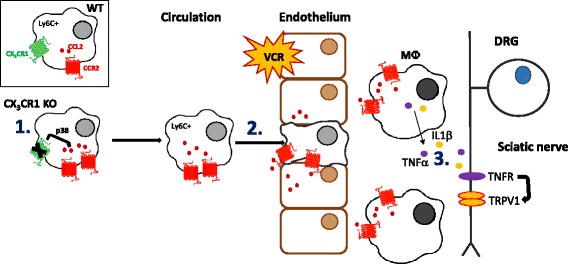
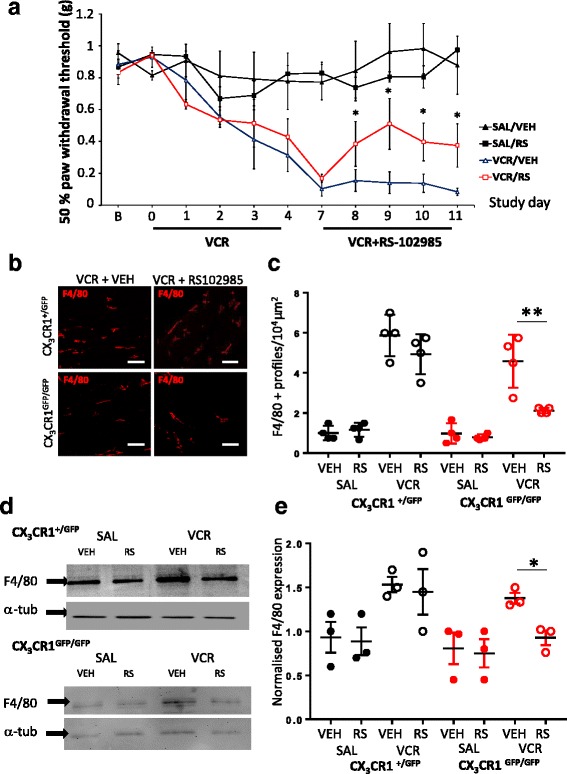
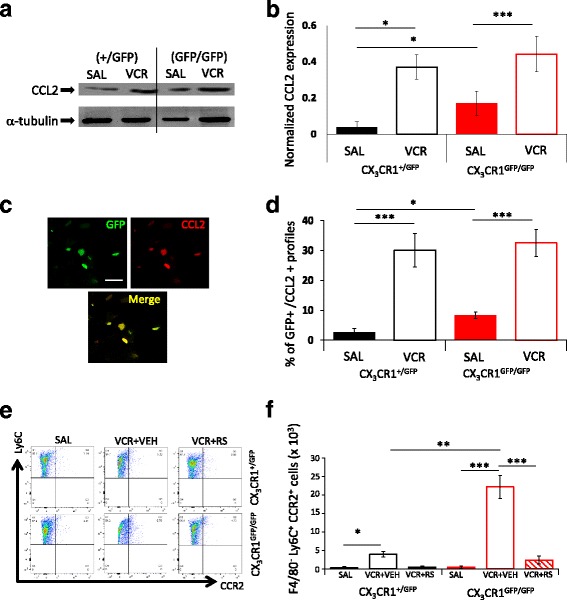
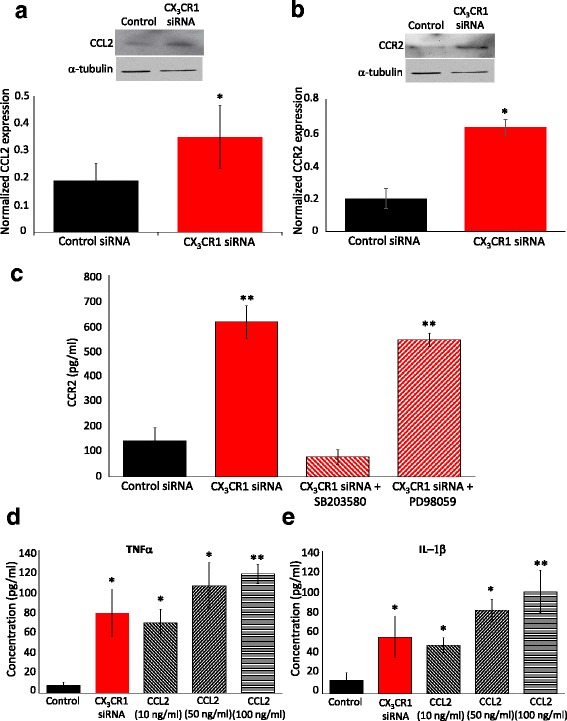
We show that CCR signalling plays a mechanistic role in allodynia that develops in CXCR-deficient mice with increasing VCR exposure. Indeed, the CCR antagonist, RS-102895, proves ineffective in mice possessing functional CXCR receptors but reduces VCR-induced allodynia in CXCR-deficient mice, in which CCR monocytes are elevated by VCR. We suggest that a novel interaction between CXCR and CCR receptors in monocytes accounts for the therapeutic effect of RS-102895 in CXCR-deficient mice. Indeed, we observe that CCR, along with its ligand, CCL, is elevated in the sciatic nerve in CXCR-deficient mice, whilst in THP-1 cells (human monocytes), downregulating CXCR upregulates CCR expression via p38 MAP kinase signalling. We also show that the CXCR-CCR interaction in vitro regulates the release of pronociceptive cytokines TNF-α and IL1β.
Our data suggests that CCL/CCR signalling plays a crucial role in VCR-induced allodynia in CXCR-deficient mice, which arises as a result of an interaction between CXCR and CCR in monocytes.
长春新碱(VCR)等化疗药物的一个剂量限制副作用是神经病理性疼痛,目前对此的治疗效果不佳。在临床前长春新碱诱导疼痛中,趋化因子介导的免疫细胞/神经元通讯为开发镇痛药提供了一个有趣的基础。在 VCR 诱导的疼痛的小鼠模型中,雪旺细胞中的单核细胞/巨噬细胞中的 CXCR 受体介导的信号转导,调节机械性超敏反应(痛觉过敏)的发展。然而,CXCR 缺陷小鼠仍然会出现痛觉过敏,尽管出现得较晚;因此,随着 VCR 的积累,会出现其他潜在的机制。虽然巡逻和炎症性单核细胞都表达 CXCR,但只有炎症性单核细胞表达 CCR 受体。因此,我们评估了 CCR 在 VCR 诱导的痛觉过敏后期的单核细胞中的作用。
在 VCR 处理的 CCR 或 CXCR 缺陷小鼠中评估机械诱发的超敏反应。在 CXCR 缺陷小鼠中,也给予了 CCR 拮抗剂 RS-102895。免疫组织化学和 Western blot 分析用于确定坐骨神经中的单核细胞/巨噬细胞浸润以及腰 DRG 中的神经元激活,而流式细胞术用于表征 CXCR 缺陷小鼠中的单核细胞。此外,使用 THP-1 细胞在体外评估 CXCR-CCR 受体相互作用,使用 Western blot 分析和 ELISA 评估 CCR 和促炎细胞因子的表达。
我们表明,随着 VCR 暴露量的增加,CCR 信号在 CXCR 缺陷小鼠中发展的痛觉过敏中发挥机制作用。事实上,CCR 拮抗剂 RS-102895 在具有功能性 CXCR 受体的小鼠中无效,但在 CCR 单核细胞因 VCR 而升高的 CXCR 缺陷小鼠中可降低 VCR 诱导的痛觉过敏。我们认为,单核细胞中 CXCR 和 CCR 受体之间的新相互作用解释了 RS-102895 在 CXCR 缺陷小鼠中的治疗效果。事实上,我们观察到 CCR 及其配体 CCL 在 CXCR 缺陷小鼠的坐骨神经中升高,而在 THP-1 细胞(人单核细胞)中,下调 CXCR 通过 p38 MAP 激酶信号转导上调 CCR 表达。我们还表明,体外的 CXCR-CCR 相互作用调节促伤害性细胞因子 TNF-α和 IL1β的释放。
我们的数据表明,CCL/CCR 信号在 CXCR 缺陷小鼠的 VCR 诱导的痛觉过敏中发挥关键作用,这是由于 CXCR 和 CCR 在单核细胞中的相互作用所致。