Division of Clinical Genetics, Department of Laboratory Medicine, Lund University, Lund, Sweden.
Array and Analysis Facility, Department of Medical Sciences, Uppsala University, Uppsala, Sweden.
Leukemia. 2018 Oct;32(10):2117-2125. doi: 10.1038/s41375-018-0092-2. Epub 2018 Mar 12.
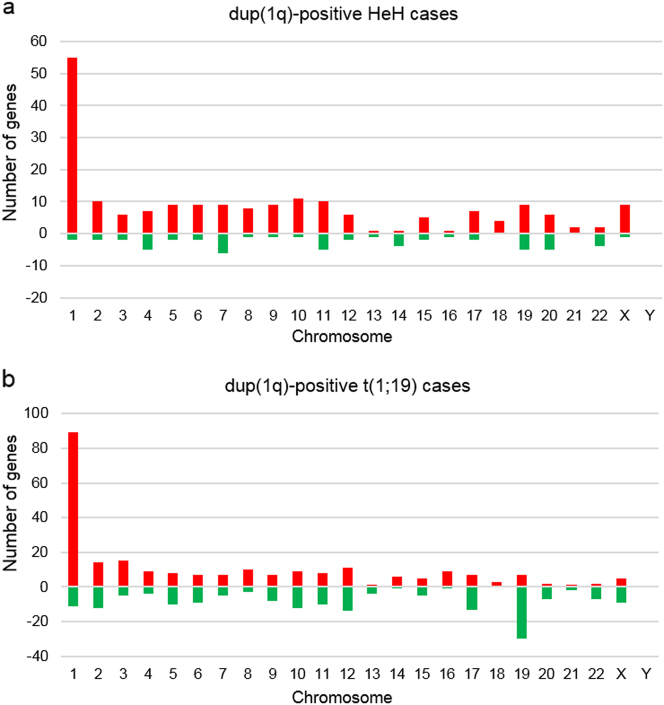
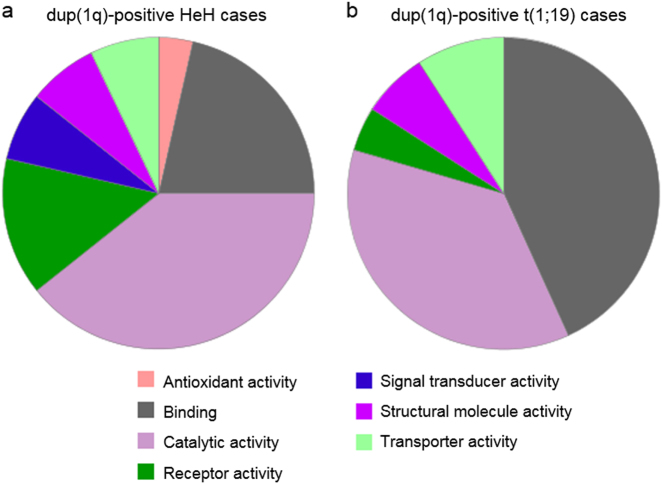
High-throughput sequencing was applied to investigate the mutation/methylation patterns on 1q and gene expression profiles in pediatric B-cell precursor acute lymphoblastic leukemia (BCP ALL) with/without (w/wo) dup(1q). Sequencing of the breakpoint regions and all exons on 1q in seven dup(1q)-positive cases revealed non-synonymous somatic single nucleotide variants (SNVs) in BLZF1, FMN2, KCNT2, LCE1C, NES, and PARP1. Deep sequencing of these in a validation cohort w (n = 17)/wo (n = 94) dup(1q) revealed similar SNV frequencies in the two groups (47% vs. 35%; P = 0.42). Only 0.6% of the 36,259 CpGs on 1q were differentially methylated between cases w (n = 14)/wo (n = 13) dup(1q). RNA sequencing of high hyperdiploid (HeH) and t(1;19)(q23;p13)-positive cases w (n = 14)/wo (n = 52) dup(1q) identified 252 and 424 differentially expressed genes, respectively; only seven overlapped. Of the overexpressed genes in the HeH and t(1;19) groups, 23 and 31%, respectively, mapped to 1q; 60-80% of these encode nucleic acid/protein binding factors or proteins with catalytic activity. We conclude that the pathogenetically important consequence of dup(1q) in BCP ALL is a gene-dosage effect, with the deregulated genes differing between genetic subtypes, but involving similar molecular functions, biological processes, and protein classes.
高通量测序被应用于研究伴有/不伴有(w/wo)dup(1q)的小儿 B 细胞前体急性淋巴细胞白血病(BCP ALL)中 1q 的突变/甲基化模式和基因表达谱。在 7 例 dup(1q)-阳性病例中,对断点区域和 1q 上的所有外显子进行测序,发现 BLZF1、FMN2、KCNT2、LCE1C、NES 和 PARP1 中存在非 synonymous体细胞单核苷酸变异(SNVs)。在验证队列中对这些基因进行深度测序(w [n=17]/wo [n=94] dup(1q)),发现两组 SNV 频率相似(47% vs. 35%;P=0.42)。在 w(n=14)/wo(n=13)dup(1q)病例之间,1q 上的 36259 个 CpG 中仅有 0.6%存在差异甲基化。在高超二倍体(HeH)和 t(1;19)(q23;p13)阳性病例中,w(n=14)/wo(n=52)dup(1q)的 RNA 测序分别鉴定出 252 和 424 个差异表达基因,仅有 7 个基因重叠。在 HeH 和 t(1;19)组中过表达的基因中,分别有 23%和 31%映射到 1q;其中 60-80%编码核酸/蛋白结合因子或具有催化活性的蛋白质。我们得出结论,dup(1q)在 BCP ALL 中的重要致病后果是基因剂量效应,不同遗传亚型的失调基因不同,但涉及相似的分子功能、生物学过程和蛋白质类别。