Department of Hematology and Oncology, Charité, University Hospital Berlin, Campus Benjamin Franklin, 12203, Berlin, Germany.
German Cancer Research Center (DKFZ), 69120, Heidelberg, Germany.
J Hematol Oncol. 2019 Jan 14;12(1):8. doi: 10.1186/s13045-018-0692-3.
Long non-coding RNAs (lncRNAs) have emerged as a novel class of RNA due to its diverse mechanism in cancer development and progression. However, the role and expression pattern of lncRNAs in molecular subtypes of B cell acute lymphoblastic leukemia (BCP-ALL) have not yet been investigated. Here, we assess to what extent lncRNA expression and DNA methylation is driving the progression of relapsed BCP-ALL subtypes and we determine if the expression and DNA methylation profile of lncRNAs correlates with established BCP-ALL subtypes.
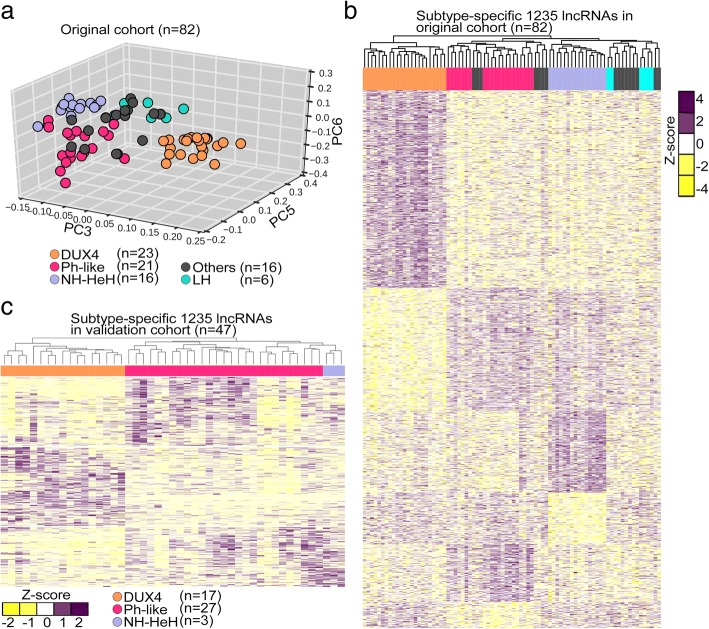
We performed RNA sequencing and DNA methylation (Illumina Infinium microarray) of 40 diagnosis and 42 relapse samples from 45 BCP-ALL patients in a German cohort and quantified lncRNA expression. Unsupervised clustering was applied to ascertain and confirm that the lncRNA-based classification of the BCP-ALL molecular subtypes is present in both our cohort and an independent validation cohort of 47 patients. A differential expression and differential methylation analysis was applied to determine the subtype-specific, relapse-specific, and differentially methylated lncRNAs. Potential functions of subtype-specific lncRNAs were determined by using co-expression-based analysis on nearby (cis) and distally (trans) located protein-coding genes.
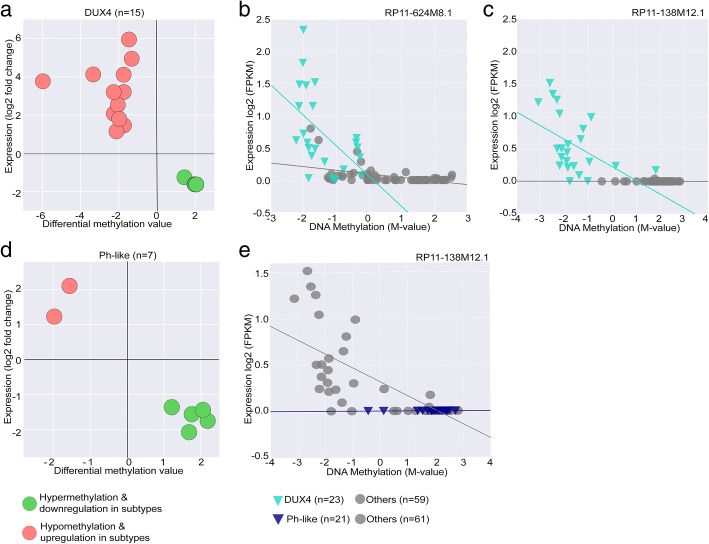
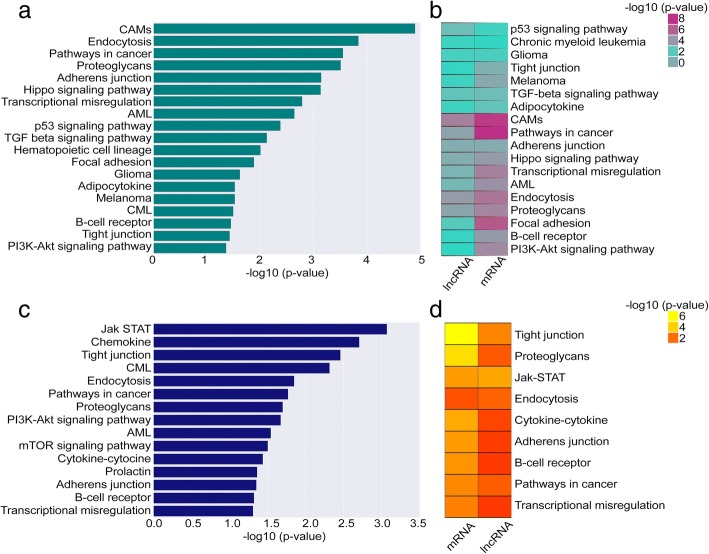
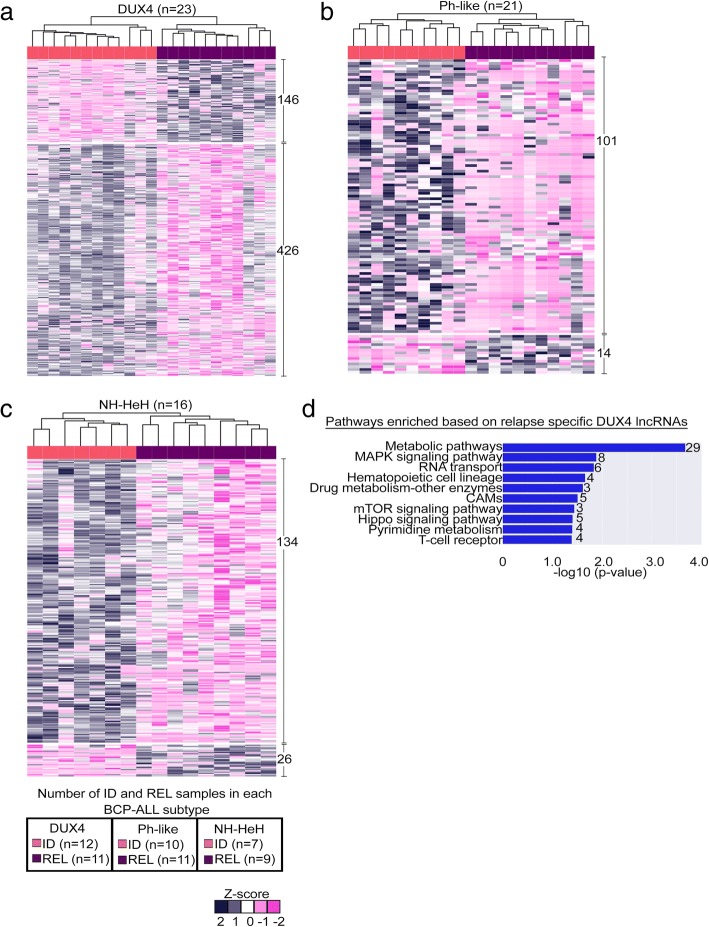
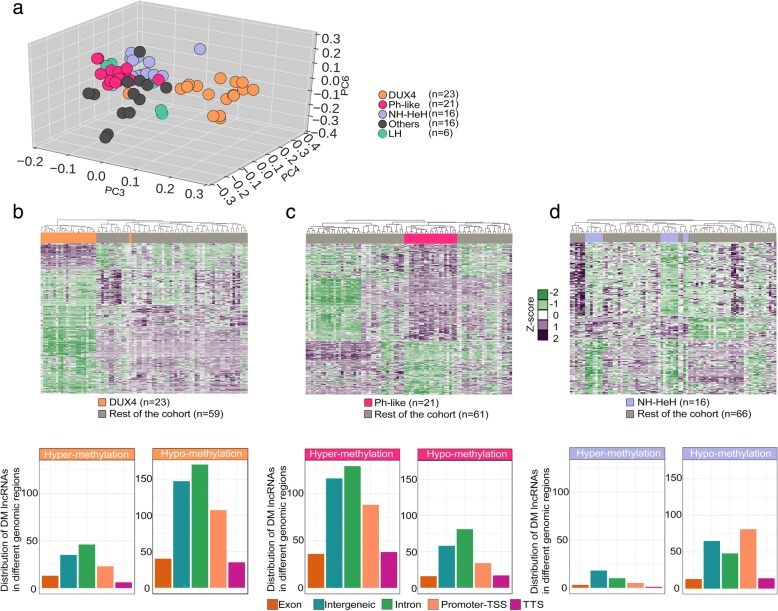
Using an integrative Bioinformatics analysis, we developed a comprehensive catalog of 1235 aberrantly dysregulated BCP-ALL subtype-specific and 942 relapse-specific lncRNAs and the methylation profile of three subtypes of BCP-ALL. The 1235 subtype-specific lncRNA signature represented a similar classification of the molecular subtypes of BCP-ALL in the independent validation cohort. We identified a strong correlation between the DUX4-specific lncRNAs and genes involved in the activation of TGF-β and Hippo signaling pathways. Similarly, Ph-like-specific lncRNAs were correlated with genes involved in the activation of PI3K-AKT, mTOR, and JAK-STAT signaling pathways. Interestingly, the relapse-specific lncRNAs correlated with the activation of metabolic and signaling pathways. Finally, we found 23 promoter methylated lncRNAs epigenetically facilitating their expression levels.
Here, we describe a set of subtype-specific and relapse-specific lncRNAs from three major BCP-ALL subtypes and define their potential functions and epigenetic regulation. The subtype-specific lncRNAs are reproducible and can effectively stratify BCP-ALL subtypes. Our data uncover the diverse mechanism of action of lncRNAs in BCP-ALL subtypes defining which lncRNAs are involved in the pathogenesis of disease and are relevant for the stratification of BCP-ALL subtypes.
长链非编码 RNA(lncRNA)因其在癌症发展和进展中的多种机制而成为一种新型 RNA。然而,lncRNA 在 B 细胞急性淋巴细胞白血病(BCP-ALL)分子亚型中的作用和表达模式尚未得到研究。在这里,我们评估了 lncRNA 表达和 DNA 甲基化在多大程度上驱动复发 BCP-ALL 亚型的进展,并确定 lncRNA 的表达和 DNA 甲基化谱是否与已建立的 BCP-ALL 亚型相关。
我们对来自德国队列的 45 例 BCP-ALL 患者的 40 例诊断和 42 例复发样本进行了 RNA 测序和 DNA 甲基化(Illumina Infinium 微阵列),并定量了 lncRNA 的表达。应用无监督聚类来确定和确认 lncRNA 基于 BCP-ALL 分子亚型的分类在我们的队列和 47 例患者的独立验证队列中均存在。应用差异表达和差异甲基化分析来确定亚型特异性、复发特异性和差异甲基化的 lncRNAs。通过对附近(顺式)和远端(反式)定位的蛋白质编码基因进行基于共表达的分析,确定了亚型特异性 lncRNA 的潜在功能。
使用综合生物信息学分析,我们开发了一个全面的目录,其中包含 1235 个异常失调的 BCP-ALL 亚型特异性和 942 个复发特异性 lncRNA 以及三种 BCP-ALL 亚型的甲基化谱。在独立的验证队列中,1235 个亚型特异性 lncRNA 特征代表了 BCP-ALL 分子亚型的相似分类。我们发现 DUX4 特异性 lncRNA 与参与 TGF-β 和 Hippo 信号通路激活的基因之间存在很强的相关性。同样,Ph-like 特异性 lncRNA 与参与 PI3K-AKT、mTOR 和 JAK-STAT 信号通路激活的基因相关。有趣的是,复发特异性 lncRNA 与代谢和信号通路的激活相关。最后,我们发现 23 个启动子甲基化的 lncRNA 通过表观遗传调节其表达水平。
在这里,我们描述了三种主要 BCP-ALL 亚型中的一组亚型特异性和复发特异性 lncRNA,并定义了它们的潜在功能和表观遗传调控。亚型特异性 lncRNA 是可重复的,可以有效地对 BCP-ALL 亚型进行分层。我们的数据揭示了 lncRNA 在 BCP-ALL 亚型中的多种作用机制,确定了哪些 lncRNA 参与疾病的发病机制,并且与 BCP-ALL 亚型的分层相关。