Frank Reidy Research Center for Bioelectrics, Old Dominion University, Norfolk, VA 23508, USA.
Frank Reidy Research Center for Bioelectrics, Old Dominion University, Norfolk, VA 23508, USA.
Bioelectrochemistry. 2018 Aug;122:123-133. doi: 10.1016/j.bioelechem.2018.03.014. Epub 2018 Mar 29.
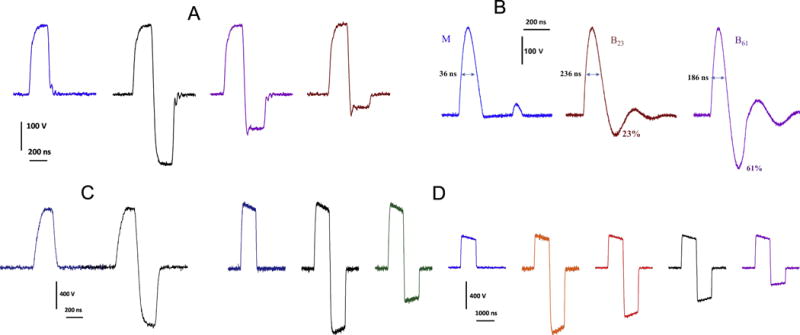
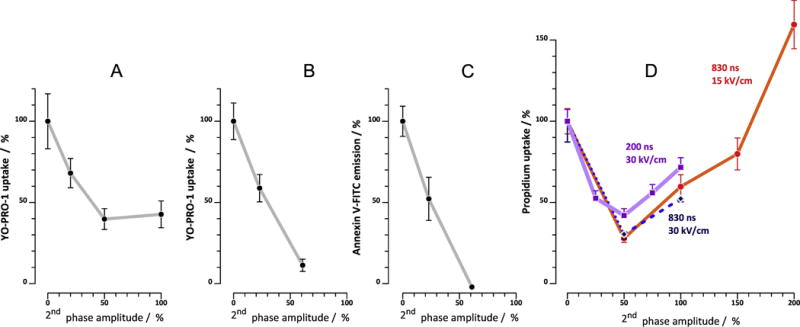
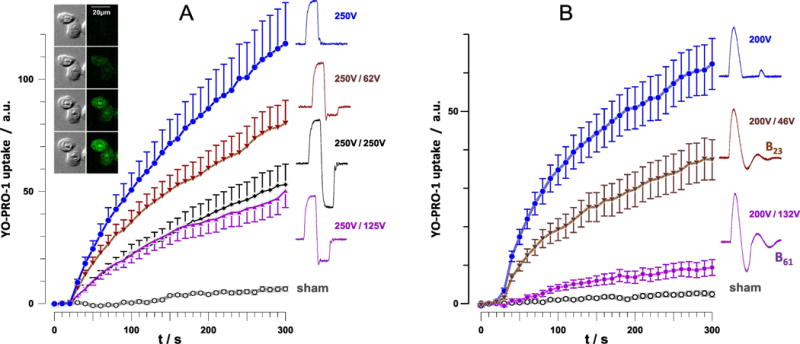
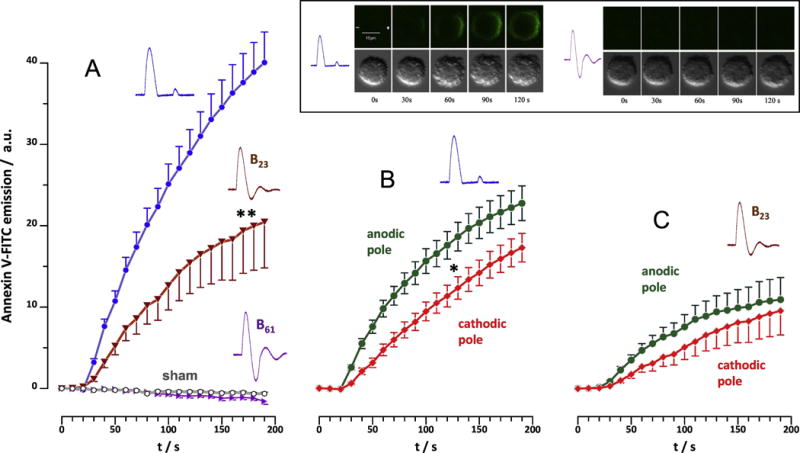
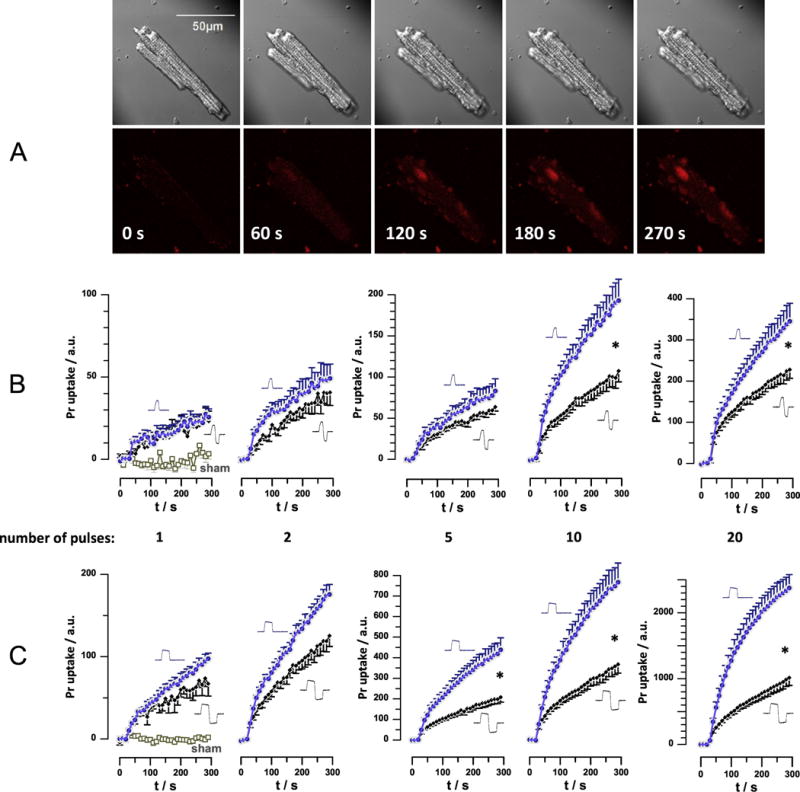
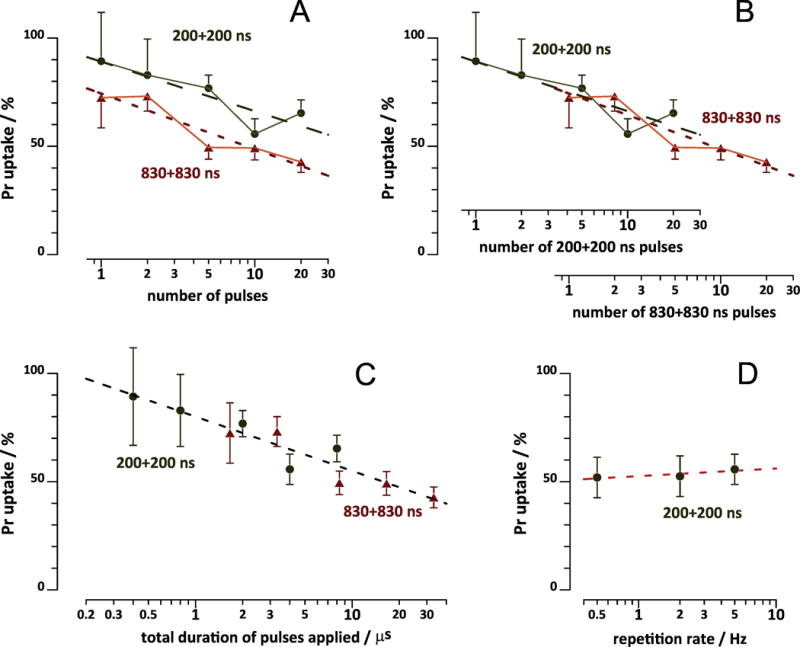
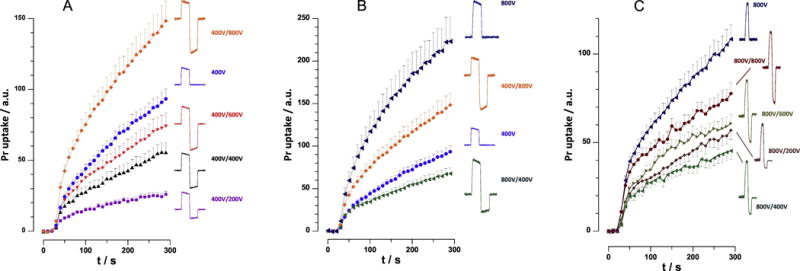
Bipolar cancellation refers to a phenomenon when applying a second electric pulse reduces ("cancels") cell membrane damage by a preceding electric pulse of the opposite polarity. Bipolar cancellation is a reason why bipolar nanosecond electric pulses (nsEP) cause weaker electroporation than just a single unipolar phase of the same pulse. This study was undertaken to explore the dependence of bipolar cancellation on nsEP parameters, with emphasis on the amplitude ratio of two opposite polarity phases of a bipolar pulse. Individual cells (CHO, U937, or adult mouse ventricular cardiomyocytes (VCM)) were exposed to either uni- or bipolar trapezoidal nsEP, or to nanosecond electric field oscillations (NEFO). The membrane injury was evaluated by time-lapse confocal imaging of the uptake of propidium (Pr) or YO-PRO-1 (YP) dyes and by phosphatidylserine (PS) externalization. Within studied limits, bipolar cancellation showed little or no dependence on the electric field intensity, pulse repetition rate, chosen endpoint, or cell type. However, cancellation could increase for larger pulse numbers and/or for longer pulses. The sole most critical parameter which determines bipolar cancellation was the phase ratio: maximum cancellation was observed with the 2nd phase of about 50% of the first one, whereas a larger 2nd phase could add a damaging effect of its own. "Swapping" the two phases, i.e., delivering the smaller phase before the larger one, reduced or eliminated cancellation. These findings are discussed in the context of hypothetical mechanisms of bipolar cancellation and electroporation by nsEP.
双相消弭是指当应用第二个电脉冲时,会降低(“消弭”)前一个相反极性电脉冲对细胞膜的损伤。双相消弭是双相纳秒电脉冲(nsEP)引起的电穿孔比单个相同脉冲的单相电穿孔弱的原因之一。本研究旨在探讨双相消弭与 nsEP 参数的关系,重点研究双相脉冲两个相反极性相位的幅度比。将单个细胞(CHO、U937 或成年小鼠心室肌细胞(VCM))暴露于单相反相梯形 nsEP 或纳秒电脉冲振荡(NEFO)。通过荧光染料碘化丙啶(Pr)或 YO-PRO-1(YP)摄取的时间 lapse 共聚焦成像和磷脂酰丝氨酸(PS)外排来评估细胞膜损伤。在研究范围内,双相消弭与电场强度、脉冲重复率、选择的终点或细胞类型几乎没有或没有关系。然而,随着脉冲数的增加和/或脉冲长度的增加,消弭可能会增加。唯一决定双相消弭的关键参数是相位比:第二个相位约为第一个相位的 50%时观察到最大消弭,而较大的第二个相位本身可能会增加损伤效应。“交换”两个相位,即先施加较小的相位然后施加较大的相位,可以减少或消除消弭。这些发现将在双相消弭和 nsEP 致电穿孔的假设机制背景下进行讨论。