Jung Nam-Chul, Lee Jun-Ho, Chung Kwang-Hoe, Kwak Yi Sub, Lim Dae-Seog
Department of Biotechnology, CHA University, Seongnam, Gyeonggi-do 13488, Republic of Korea; Pharos Vaccine Inc., Seongnam, Gyeonggi-do 13215, Republic of Korea.
Department of Biotechnology, CHA University, Seongnam, Gyeonggi-do 13488, Republic of Korea.
Transl Oncol. 2018 Jun;11(3):686-690. doi: 10.1016/j.tranon.2018.03.007. Epub 2018 Apr 6.
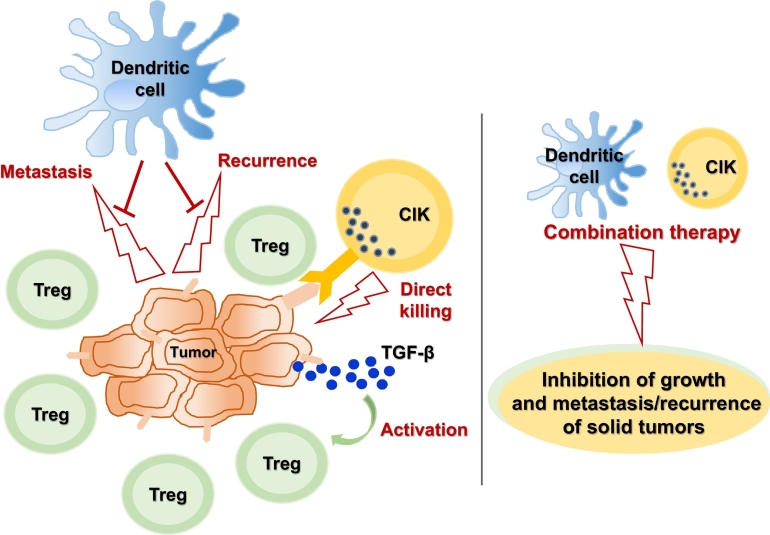
As a treatment for solid tumors, dendritic cell (DC)-based immunotherapy has not been as effective as expected. Here, we review the reasons underlying the limitations of DC-based immunotherapy for solid tumors and ask what can be done to improve immune cell-based cancer therapies. Several reports show that, rather than a lack of immune induction, the limited efficacy of DC-based immunotherapy in cases of renal cell carcinoma (RCC) likely results from inhibition of immune responses by tumor-secreted TGF-β and an increase in the number of regulatory T (Treg) cells in and around the solid tumor. Indeed, unlike DC therapy for solid tumors, cytotoxic T lymphocyte (CTL) responses induced by DC therapy inhibit tumor recurrence after surgery; CTL responses also limit tumor metastasis induced by additional tumor-challenge in RCC tumor-bearing mice. Here, we discuss the mechanisms underlying the poor efficacy of DC-based therapy for solid tumors and stress the need for new and improved DC immunotherapies and/or combination therapies with killer cells to treat resistant solid tumors.
作为实体瘤的一种治疗方法,基于树突状细胞(DC)的免疫疗法并未达到预期的效果。在此,我们回顾基于DC的实体瘤免疫疗法存在局限性的潜在原因,并探讨如何改进基于免疫细胞的癌症治疗方法。多项报告显示,在肾细胞癌(RCC)病例中,基于DC的免疫疗法疗效有限,并非是由于缺乏免疫诱导,而是可能源于肿瘤分泌的转化生长因子-β(TGF-β)对免疫反应的抑制以及实体瘤内部和周围调节性T(Treg)细胞数量的增加。事实上,与实体瘤的DC疗法不同,DC疗法诱导的细胞毒性T淋巴细胞(CTL)反应可抑制手术后的肿瘤复发;CTL反应还能限制RCC荷瘤小鼠因额外肿瘤攻击而导致的肿瘤转移。在此,我们讨论基于DC的实体瘤治疗疗效不佳的潜在机制,并强调需要新的、改进的DC免疫疗法和/或与杀伤细胞的联合疗法来治疗难治性实体瘤。