Karanth Harish, Murali Sumesh, Koteshwar Reshma, Shetty Vasanth, Adappa Karunakara
Department of Anaesthesiology, A J Institute of Medical Sciences, Mangalore, Karnataka, India.
Department of Anaesthesiology, Saveetha Medical College, Chennai, Tamil Nadu, India.
Anesth Essays Res. 2018 Jan-Mar;12(1):98-102. doi: 10.4103/aer.AER_206_17.
Colonoscopy is a mildly painful procedure requiring conscious sedation. Though propofol is a widely used anesthetic agent in day-care procedures due to its rapid onset and quick recovery has a drawback of requiring resuscitation maneuvers more often than the conventional methods. Dexmedetomidine, a newly introduced, highly selective α-adrenergic receptor agonist possessing hypnotic, sedative, anxiolytic, sympatholytic, and analgesic properties with impressive safety margin, needs to be explored for use in conscious sedation for colonoscopy procedure among South Indian population.
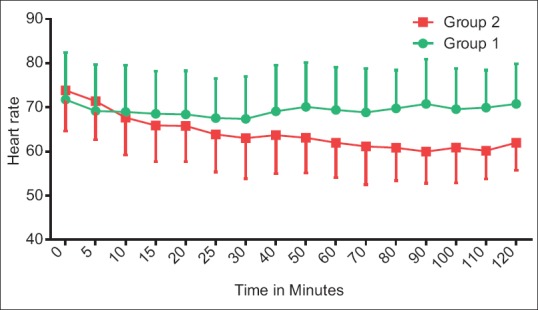
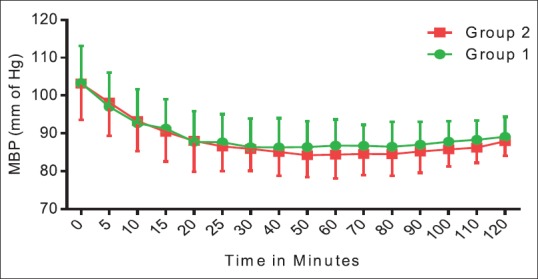
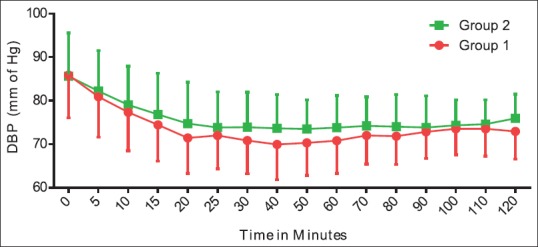
A prospective randomized comparative study was conducted on patients aged between 25 and 60 years with the American Society of Anesthesiologist physical status classes I and II posted for colonoscopy under monitored anesthesia care. Study group was randomly divided into two groups and administered propofol and dexmedetomidine. The primary outcome variable was assessments of sedation scores between the two groups. Secondary outcome variables were pain score assessments, hemodynamic comparisons, and adverse events among the two groups. Appropriate statistical tests were applied to compare the findings.
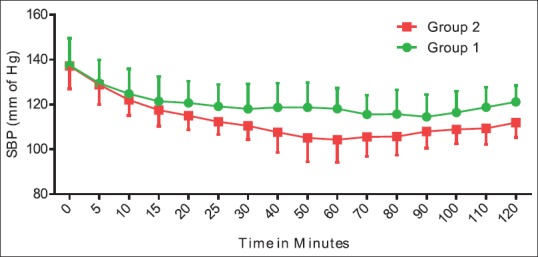
After comparisons between the two groups, we found that patients on dexmedetomidine had similar sedation score as that of patients on propofol. However, there was a significantly higher incidence of systemic hypotension. Requirement of rescue analgesia and adverse events and other hemodynamic fluctuation were similar in both the groups.
We conclude that dexmedetomidine has similar efficacy as propofol for conscious sedation required during colonoscopy. Occurrence of systolic hypotension was, however, significantly more among the group receiving dexmedetomidine.
结肠镜检查是一种会引起轻度疼痛的操作,需要进行清醒镇静。尽管丙泊酚因其起效迅速和恢复快,在日间手术中是一种广泛使用的麻醉剂,但它存在一个缺点,即与传统方法相比,需要更频繁地进行复苏操作。右美托咪定是一种新引入的、具有催眠、镇静、抗焦虑、抗交感神经和镇痛特性且安全边际令人印象深刻的高选择性α-肾上腺素能受体激动剂,需要探讨其在印度南部人群结肠镜检查清醒镇静中的应用。
对年龄在25至60岁、美国麻醉医师协会身体状况分级为I级和II级、计划在麻醉监护下进行结肠镜检查的患者进行了一项前瞻性随机对照研究。研究组被随机分为两组,分别给予丙泊酚和右美托咪定。主要结局变量是两组之间镇静评分的评估。次要结局变量是疼痛评分评估、血流动力学比较以及两组之间的不良事件。应用适当的统计检验来比较研究结果。
两组比较后,我们发现使用右美托咪定的患者镇静评分与使用丙泊酚的患者相似。然而,系统性低血压的发生率显著更高。两组在抢救镇痛需求、不良事件以及其他血流动力学波动方面相似。
我们得出结论,右美托咪定在结肠镜检查所需的清醒镇静方面与丙泊酚具有相似的疗效。然而,接受右美托咪定的组中收缩期低血压的发生率显著更高。