Department of Chemistry, College of Natural Sciences, Seoul National University, Seoul 08826, Korea.
Department of Pharmacy, Dongguk University, Goyang 10326, Korea.
Mol Cells. 2018 Apr 30;41(4):331-341. doi: 10.14348/molcells.2018.2313. Epub 2018 Apr 5.
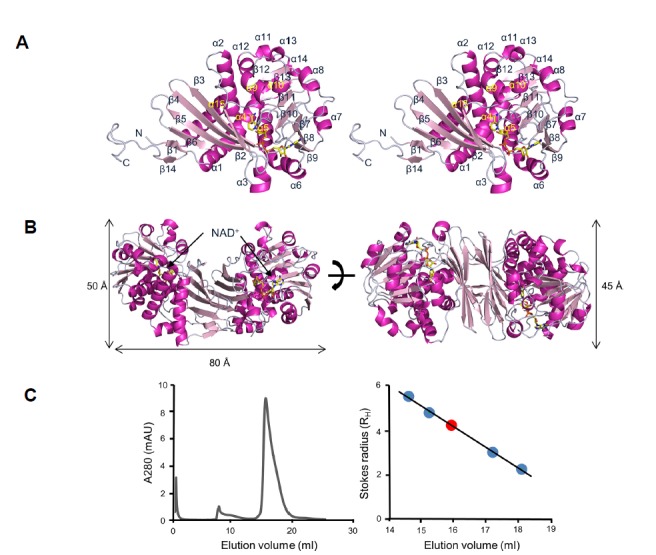
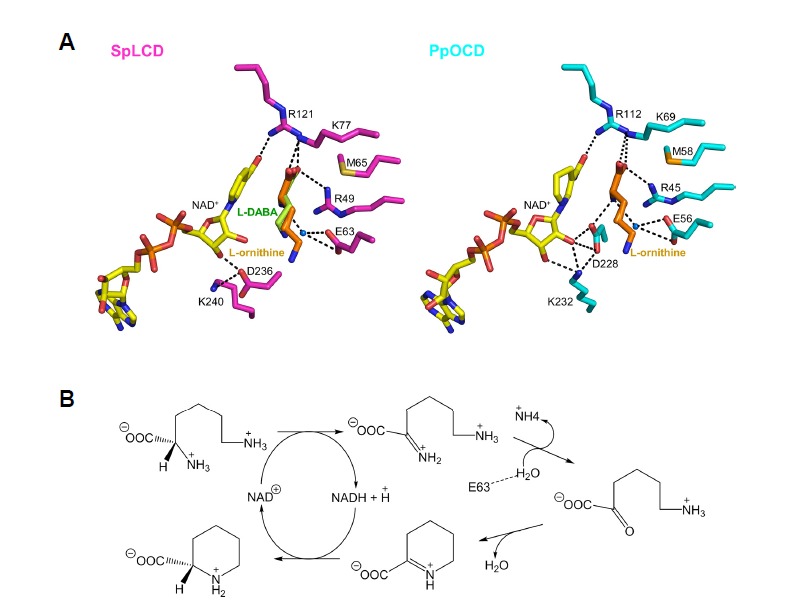
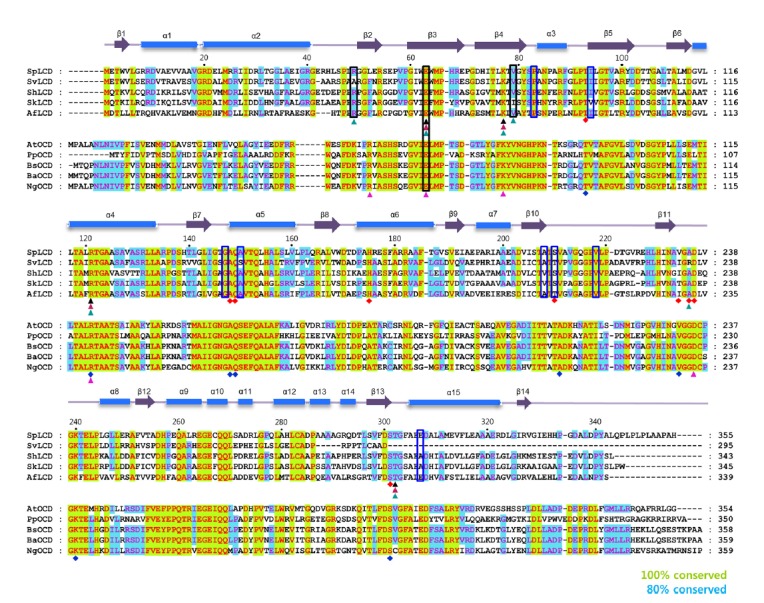
L-pipecolic acid is a non-protein amino acid commonly found in plants, animals, and microorganisms. It is a well-known precursor to numerous microbial secondary metabolites and pharmaceuticals, including anticancer agents, immunosuppressants, and several antibiotics. Lysine cyclodeaminase (LCD) catalyzes β-deamination of L-lysine into L-pipecolic acid using β-nicotinamide adenine dinucleotide as a cofactor. Expression of a human homolog of LCD, μ-crystallin, is elevated in prostate cancer patients. To understand the structural features and catalytic mechanisms of LCD, we determined the crystal structures of LCD (SpLCD) in (i) a binary complex with NAD, (ii) a ternary complex with NAD and L-pipecolic acid, (iii) a ternary complex with NAD and L-proline, and (iv) a ternary complex with NAD and L-2,4-diamino butyric acid. The overall structure of SpLCD was similar to that of ornithine cyclodeaminase from . In addition, SpLCD recognized L-lysine, L-ornithine, and L-2,4-diamino butyric acid despite differences in the active site, including differences in hydrogen bonding by Asp236, which corresponds with Asp228 from ornithine cyclodeaminase. The substrate binding pocket of SpLCD allowed substrates smaller than lysine to bind, thus enabling binding to ornithine and L-2,4-diamino butyric acid. Our structural and biochemical data facilitate a detailed understanding of substrate and product recognition, thus providing evidence for a reaction mechanism for SpLCD. The proposed mechanism is unusual in that NAD is initially converted into NADH and then reverted back into NAD at a late stage of the reaction.
L-哌可酸是一种常见于植物、动物和微生物中的非蛋白氨基酸。它是许多微生物次生代谢物和药物的前体,包括抗癌剂、免疫抑制剂和几种抗生素。赖氨酸环脒酶 (LCD) 以 β-烟酰胺腺嘌呤二核苷酸为辅因子催化 L-赖氨酸的 β-脱氨作用生成 L-哌可酸。LCD 的人同源物 μ-晶体蛋白在前列腺癌患者中的表达升高。为了了解 LCD 的结构特征和催化机制,我们测定了 SpLCD(来自 Sphaerotilus natans)的晶体结构:(i)与 NAD 的二元复合物,(ii)与 NAD 和 L-哌可酸的三元复合物,(iii)与 NAD 和 L-脯氨酸的三元复合物,以及(iv)与 NAD 和 L-2,4-二氨基丁酸的三元复合物。SpLCD 的整体结构与来自 Arthrobacter ureafaciens 的鸟氨酸环脒酶相似。此外,尽管活性位点存在差异,包括 Asp236 的氢键不同,与来自 Arthrobacter ureafaciens 的鸟氨酸环脒酶的 Asp228 对应,SpLCD 仍能识别 L-赖氨酸、L-鸟氨酸和 L-2,4-二氨基丁酸。SpLCD 的底物结合口袋允许小于赖氨酸的底物结合,从而能够结合鸟氨酸和 L-2,4-二氨基丁酸。我们的结构和生化数据有助于详细了解底物和产物的识别,从而为 SpLCD 的反应机制提供了证据。所提出的机制不寻常之处在于 NAD 最初转化为 NADH,然后在反应的后期再转化回 NAD。