Centre for HIV and STI's, National Institute for Communicable Diseases, Johannesburg, Gauteng, South Africa.
Faculty of Health Sciences, University of the Witwatersrand, Johannesburg, Gauteng, South Africa.
PLoS Pathog. 2018 Apr 9;14(4):e1006987. doi: 10.1371/journal.ppat.1006987. eCollection 2018 Apr.
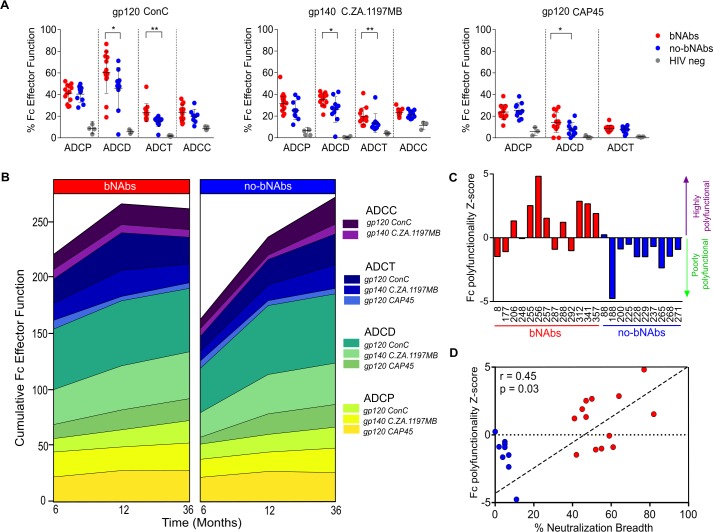
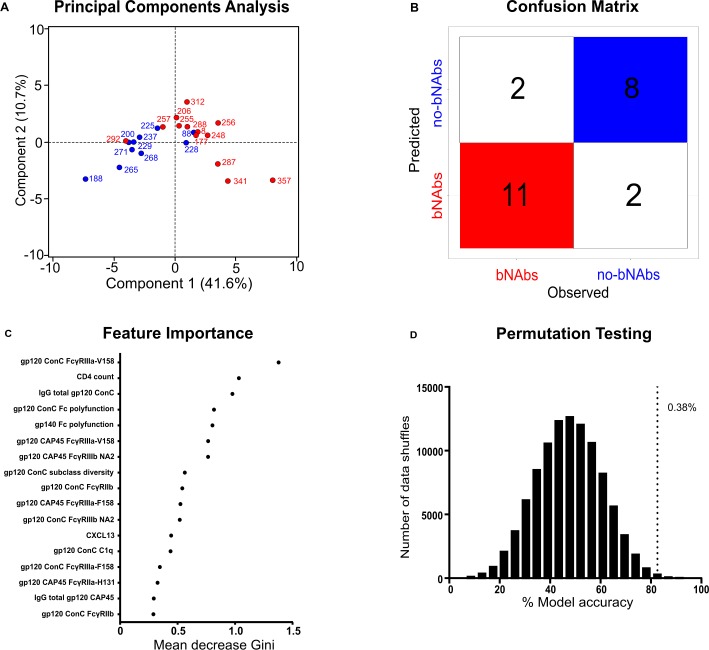
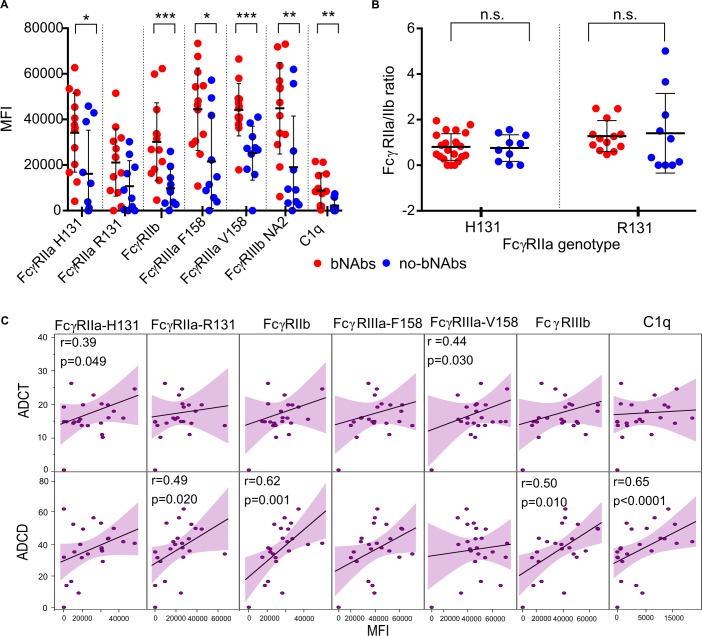
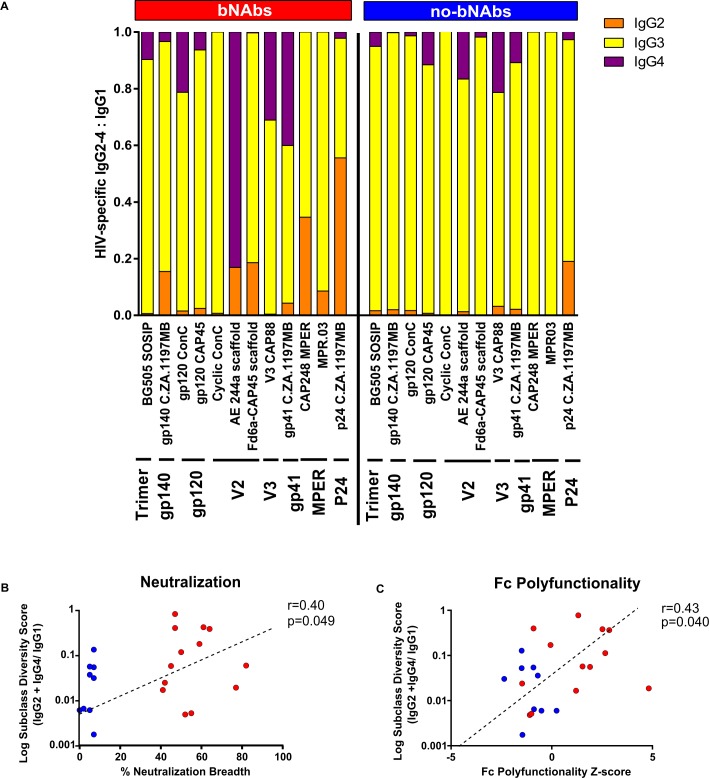
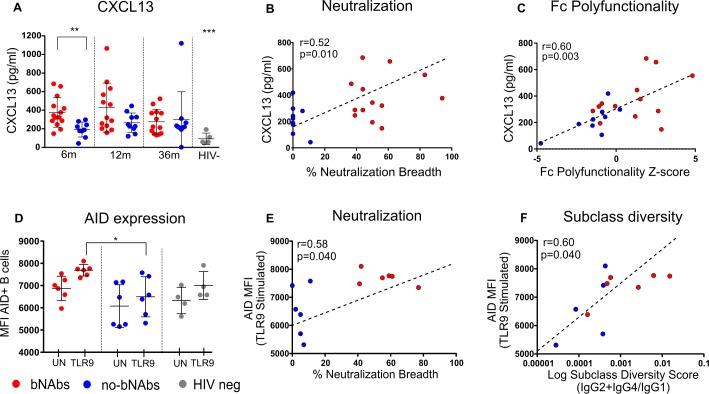
While the induction of broadly neutralizing antibodies (bNAbs) is a major goal of HIV vaccination strategies, there is mounting evidence to suggest that antibodies with Fc effector function also contribute to protection against HIV infection. Here we investigated Fc effector functionality of HIV-specific IgG plasma antibodies over 3 years of infection in 23 individuals, 13 of whom developed bNAbs. Antibody-dependent cellular phagocytosis (ADCP), complement deposition (ADCD), cellular cytotoxicity (ADCC) and cellular trogocytosis (ADCT) were detected in almost all individuals with levels of activity increasing over time. At 6 months post-infection, individuals with bNAbs had significantly higher levels of ADCD and ADCT that correlated with antibody binding to C1q and FcγRIIa respectively. In addition, antibodies from individuals with bNAbs showed more IgG subclass diversity to multiple HIV antigens which also correlated with Fc polyfunctionality. Germinal center activity represented by CXCL13 levels and expression of activation-induced cytidine deaminase (AID) was found to be associated with neutralization breadth, Fc polyfunctionality and IgG subclass diversity. Overall, multivariate analysis by random forest classification was able to group bNAb individuals with 85% sensitivity and 80% specificity based on the properties of their antibody Fc early in HIV infection. Thus, the Fc effector function profile predicted the development of neutralization breadth in this cohort, suggesting that intrinsic immune factors within the germinal center provide a mechanistic link between the Fc and Fab of HIV-specific antibodies.
虽然诱导广泛中和抗体(bNAbs)是 HIV 疫苗接种策略的主要目标,但越来越多的证据表明,具有 Fc 效应功能的抗体也有助于预防 HIV 感染。在这里,我们研究了 23 名感染者 3 年内 HIV 特异性 IgG 血浆抗体的 Fc 效应功能,其中 13 名感染者产生了 bNAbs。在几乎所有个体中都检测到了抗体依赖性细胞吞噬作用(ADCP)、补体沉积(ADCD)、细胞细胞毒性(ADCC)和细胞 trogocytosis(ADCT),其活性水平随时间增加而增加。在感染后 6 个月时,具有 bNAbs 的个体具有显著更高水平的 ADCD 和 ADCT,这分别与抗体与 C1q 和 FcγRIIa 的结合相关。此外,来自具有 bNAbs 的个体的抗体对多种 HIV 抗原表现出更多的 IgG 亚类多样性,这也与 Fc 多功能性相关。通过 CXCL13 水平和激活诱导胞苷脱氨酶(AID)的表达来代表生发中心活性,发现与中和广度、Fc 多功能性和 IgG 亚类多样性相关。总体而言,通过随机森林分类的多元分析能够基于感染早期 HIV 抗体 Fc 的特性,以 85%的敏感性和 80%的特异性将 bNAb 个体分组。因此,Fc 效应功能谱预测了该队列中中和广度的发展,表明生发中心内的固有免疫因素为 HIV 特异性抗体的 Fc 和 Fab 之间提供了一种机制联系。