Icahn School of Medicine at Mount Sinai, Departments of Psychiatry and Neuroscience, New York, NY, USA.
Icahn School of Medicine at Mount Sinai, Departments of Psychiatry and Neuroscience, New York, NY, USA; James J. Peters VA Medical Center, Bronx, NY, USA; Brigham and Women's Hospital, Department of Psychiatry, Boston, MA, USA.
J Affect Disord. 2018 Aug 1;235:7-14. doi: 10.1016/j.jad.2018.03.013. Epub 2018 Mar 29.
Schizophrenia (SZ) studies suggest that neurocognition predicts functional outcome and that social cognition mediates this relationship. Bipolar disorder (BD) patients also have cognitive, social, and functional impairments but the relationship among these factors in BD is not well established. We assessed whether social cognition modulates the influence of neurocognition on community functioning in BD, as found in SZ.
200 BD patients and 49 healthy controls (HC) were administered and compared on a battery of tests assessing neurocognition, social cognition, and community functioning. We conducted a series of regression analyses to investigate potential mediation or moderation of social cognition on the relationship between neurocognition and community functioning.
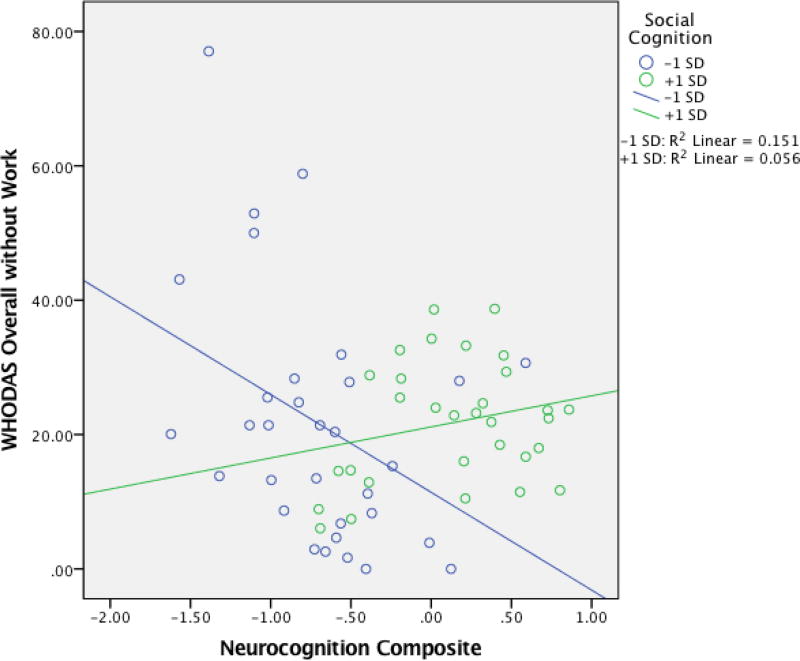
BD patients performed worse on neurocognitive domains of processing speed, attention, verbal learning, and global neurocognition. Also, BD patients performed worse on theory of mind, the social cognition composite score, and community functioning. Neurocognition did not significantly predict functional outcome in our BD sample. However, we found a moderating effect of social cognition: among patients with poor social cognition, better neurocognition was associated with better community functioning, a relationship not seen in BD patients with good social cognition.
The study was limited by a relatively small HC group and assessing one subtype of functioning status.
The relationship between neurocognition and community functioning in BD may be dependent on social cognition status, implying the presence of social cognitive heterogeneity. Results may be relevant to choosing proper treatment interventions depending on the patient's social cognitive level.
精神分裂症(SZ)研究表明,神经认知预测功能结果,而社会认知则调节这种关系。双相情感障碍(BD)患者也存在认知、社会和功能障碍,但在 BD 中这些因素之间的关系尚未得到很好的确定。我们评估了社会认知是否调节了神经认知对 BD 患者社区功能的影响,就像在 SZ 中发现的那样。
我们对 200 名 BD 患者和 49 名健康对照(HC)进行了一系列测试,这些测试评估了神经认知、社会认知和社区功能。我们进行了一系列回归分析,以研究社会认知对神经认知和社区功能之间关系的潜在调节或中介作用。
BD 患者在处理速度、注意力、言语学习和整体神经认知等神经认知领域的表现较差。此外,BD 患者在心理理论、社会认知综合评分和社区功能方面的表现也较差。神经认知在我们的 BD 样本中并没有显著预测功能结果。然而,我们发现社会认知存在调节作用:在社会认知较差的患者中,较好的神经认知与较好的社区功能相关,而在社会认知较好的 BD 患者中则没有这种关系。
该研究受到 HC 组相对较小和评估一种功能状态亚型的限制。
BD 中神经认知与社区功能之间的关系可能取决于社会认知状态,这表明存在社会认知异质性。结果可能与根据患者的社会认知水平选择适当的治疗干预措施有关。