Division of Neuropathology, Institute of Pathology, Faculty of Medicine, University of Debrecen, Nagyerdei krt. 98., Debrecen, H-4032, Hungary.
Department of Basic and Clinical Neuroscience, Institute of Psychiatry Psychology and Neuroscience, King's College London, London, UK.
Mol Brain. 2018 Apr 10;11(1):20. doi: 10.1186/s13041-018-0363-x.
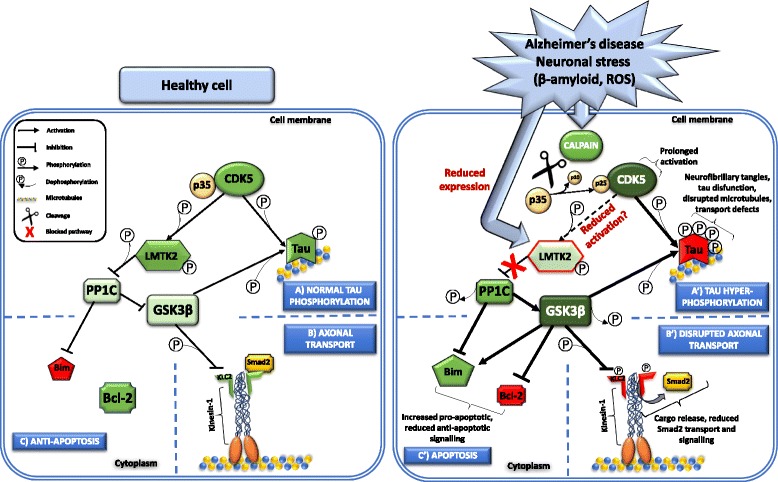
Neurodegenerative disorders are frequent, incurable diseases characterised by abnormal protein accumulation and progressive neuronal loss. Despite their growing prevalence, the underlying pathomechanism remains unclear. Lemur tyrosine kinase 2 (LMTK2) is a member of a transmembrane serine/threonine-protein kinase family. Although it was described more than a decade ago, our knowledge on LMTK2's biological functions is still insufficient. Recent evidence has suggested that LMTK2 is implicated in neurodegeneration. After reviewing the literature, we identified three LMTK2-mediated mechanisms which may contribute to neurodegenerative processes: disrupted axonal transport, tau hyperphosphorylation and enhanced apoptosis. Moreover, LMTK2 gene expression is decreased in an Alzheimer's disease mouse model. According to these features, LMTK2 might be a promising therapeutic target in near future. However, further investigations are required to clarify the exact biological functions of this unique protein.
神经退行性疾病是常见的、无法治愈的疾病,其特征是异常蛋白积累和进行性神经元丧失。尽管它们的患病率不断上升,但潜在的发病机制仍不清楚。Lemur 酪氨酸激酶 2(LMTK2)是跨膜丝氨酸/苏氨酸蛋白激酶家族的一员。尽管它在十多年前就被描述过,但我们对 LMTK2 生物学功能的了解仍然不足。最近的证据表明,LMTK2 与神经退行性变有关。在回顾文献后,我们确定了三种可能导致神经退行性过程的 LMTK2 介导的机制:轴突运输中断、tau 过度磷酸化和增强的细胞凋亡。此外,阿尔茨海默病小鼠模型中的 LMTK2 基因表达减少。根据这些特征,LMTK2 可能是未来有希望的治疗靶点。然而,需要进一步的研究来阐明这种独特蛋白质的确切生物学功能。