Guo Tong, Noble Wendy, Hanger Diane P
Department of Basic and Clinical Neuroscience, Institute of Psychiatry, Psychology & Neuroscience, King's College London, London, SE5 9NU, UK.
Acta Neuropathol. 2017 May;133(5):665-704. doi: 10.1007/s00401-017-1707-9. Epub 2017 Apr 6.
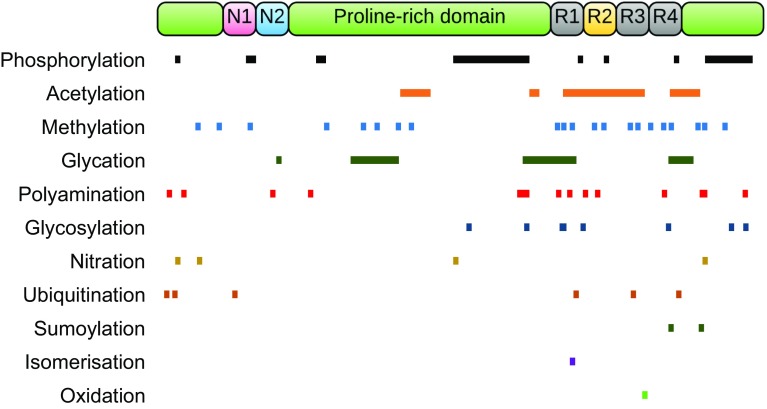
Tau is well established as a microtubule-associated protein in neurons. However, under pathological conditions, aberrant assembly of tau into insoluble aggregates is accompanied by synaptic dysfunction and neural cell death in a range of neurodegenerative disorders, collectively referred to as tauopathies. Recent advances in our understanding of the multiple functions and different locations of tau inside and outside neurons have revealed novel insights into its importance in a diverse range of molecular pathways including cell signalling, synaptic plasticity, and regulation of genomic stability. The present review describes the physiological and pathophysiological properties of tau and how these relate to its distribution and functions in neurons. We highlight the post-translational modifications of tau, which are pivotal in defining and modulating tau localisation and its roles in health and disease. We include discussion of other pathologically relevant changes in tau, including mutation and aggregation, and how these aspects impinge on the propensity of tau to propagate, and potentially drive neuronal loss, in diseased brain. Finally, we describe the cascade of pathological events that may be driven by tau dysfunction, including impaired axonal transport, alterations in synapse and mitochondrial function, activation of the unfolded protein response and defective protein degradation. It is important to fully understand the range of neuronal functions attributed to tau, since this will provide vital information on its involvement in the development and pathogenesis of disease. Such knowledge will enable determination of which critical molecular pathways should be targeted by potential therapeutic agents developed for the treatment of tauopathies.
Tau蛋白作为神经元中与微管相关的蛋白已被广泛认可。然而,在病理条件下,tau蛋白异常组装成不溶性聚集体会伴随着一系列神经退行性疾病中的突触功能障碍和神经细胞死亡,这些疾病统称为tau蛋白病。我们对tau蛋白在神经元内外的多种功能和不同定位的理解取得了最新进展,揭示了其在包括细胞信号传导、突触可塑性和基因组稳定性调控等多种分子途径中的重要性的新见解。本综述描述了tau蛋白的生理和病理生理特性,以及这些特性如何与其在神经元中的分布和功能相关。我们强调了tau蛋白的翻译后修饰,这在定义和调节tau蛋白的定位及其在健康和疾病中的作用方面至关重要。我们还讨论了tau蛋白的其他与病理相关的变化,包括突变和聚集,以及这些方面如何影响tau蛋白在患病大脑中传播的倾向,并可能导致神经元丢失。最后,我们描述了可能由tau蛋白功能障碍驱动的一系列病理事件,包括轴突运输受损、突触和线粒体功能改变、未折叠蛋白反应激活和蛋白质降解缺陷。充分了解归因于tau蛋白的神经元功能范围很重要,因为这将提供有关其参与疾病发展和发病机制的重要信息。这些知识将有助于确定潜在治疗药物针对tau蛋白病治疗应靶向的关键分子途径。