Karaman Tugba, Ozsoy Asker Zeki, Karaman Serkan, Dogru Serkan, Tapar Hakan, Sahin Aynur, Dogru Hatice, Suren Mustafa
Gaziosmanpasa University, School of Medicine, Department of Anesthesiology and Reanimation, Tokat, Turquia.
Gaziosmanpasa University, School of Medicine, Department of Gynecology and Obstetric, Tokat, Turquia.
Braz J Anesthesiol. 2018 May-Jun;68(3):285-291. doi: 10.1016/j.bjan.2017.12.005. Epub 2018 Apr 7.
A transversus abdominis plane block is a peripheral block method that has been used successfully for pain relief after total abdominal hysterectomy. However, the effects of the combination of the transversus abdominis plane block and general anesthesia on analgesic and anesthetic requirements remain unclear. This randomized placebo-controlled study is aimed to evaluate the effects of transversus abdominis plane block on analgesic and anesthetic consumption during total abdominal hysterectomy under general anesthesia.
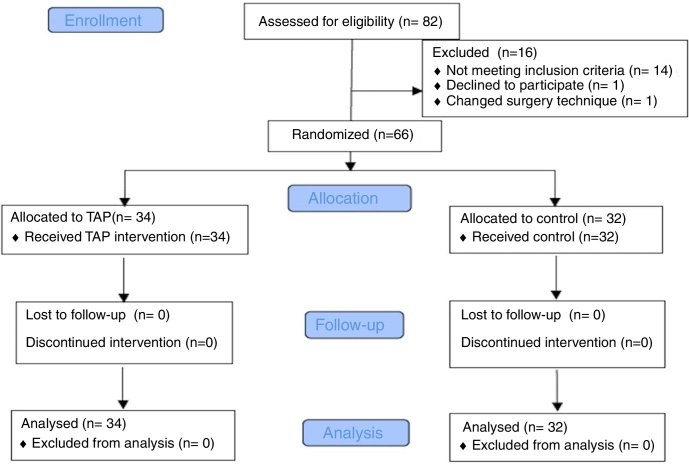
Sixty-six women undergoing total abdominal hysterectomy were randomized into two groups to receive general anesthesia alone (control group) or with transversus abdominis plane block using 20 mL of 0.25% bupivacaine (transversus abdominis plane group). Intraoperative remifentanil and sevoflurane consumption were recorded. We also evaluated the postoperative pain, nausea, quality of recovery scores and rescue analgesic requirement during postoperative 24 hours.
The total remifentanil and sevoflurane consumption is significantly lower in transversus abdominis plane group; respectively mean (SD) 0.130 (0.25) vs. 0.094 (0.02) mcg.kg.min; < 0.01 and 0.295 (0.05) vs. 0.243 (0.06) mL.min; < 0.01. In the postoperative period, pain scores were significantly reduced in transversus abdominis plane group soon after surgery; median (range) 6 (2–10) vs. 3 (0–5); < 0.001, at 2 h (5 [3–9] vs. 2.5 [0–6]; < 0.001), at 6 h (4 [2–7] vs. 3[0–6], < 0.001), at 12 h (3.5 [1–6] vs. 2 [1–5]; = 0.003). The patients in the transversus abdominis plane group had significantly higher QoR-40 scores 190.5 (175–197) vs. 176.5 (141–187); < 0.001).
Combining transversus abdominis plane block with general anesthesia can provide reduced opioid and anesthetic consumption and can improve postoperative pain and quality of recovery scores in patients undergoing total abdominal hysterectomy.
腹横肌平面阻滞是一种外周阻滞方法,已成功用于全腹子宫切除术后的疼痛缓解。然而,腹横肌平面阻滞与全身麻醉联合应用对镇痛和麻醉需求的影响尚不清楚。这项随机安慰剂对照研究旨在评估腹横肌平面阻滞对全身麻醉下全腹子宫切除术期间镇痛和麻醉药物用量的影响。
66例行全腹子宫切除术的女性被随机分为两组,分别接受单纯全身麻醉(对照组)或联合使用20 mL 0.25%布比卡因进行腹横肌平面阻滞(腹横肌平面组)。记录术中瑞芬太尼和七氟醚的用量。我们还评估了术后24小时内的疼痛、恶心、恢复质量评分及补救性镇痛需求。
腹横肌平面组瑞芬太尼和七氟醚的总用量显著更低;分别为平均(标准差)0.130(0.25)与0.094(0.02)微克·千克·分钟;P<0.01,以及0.295(0.05)与0.243(0.06)毫升·分钟;P<0.01。术后,腹横肌平面组术后不久疼痛评分显著降低;中位数(范围)6(2 - 10)与3(0 - 5);P<0.001,2小时时(5[3 - 9]与2.5[0 - 6];P<0.001),6小时时(4[2 - 7]与3[0 - 6],P<0.001),12小时时(3.5[1 - 6]与2[1 - 5];P = 0.003)。腹横肌平面组患者的QoR - 40评分显著更高,190.5(175 - 197)与176.5(141 - 187);P<0.001)。
腹横肌平面阻滞与全身麻醉联合应用可减少阿片类药物和麻醉药物的用量,并可改善全腹子宫切除患者的术后疼痛及恢复质量评分。