Zheng Haoli, Lu Xinbo, Huang Daqiang
Center for Economic Behavior and Decision-Making, Neuro & Behavior EconLab (NBEL), Zhejiang University of Finance and Economics, Hangzhou, China.
Interdisciplinary Center for Social Sciences, Zhejiang University, Hangzhou, China.
Front Neurosci. 2018 Mar 26;12:193. doi: 10.3389/fnins.2018.00193. eCollection 2018.
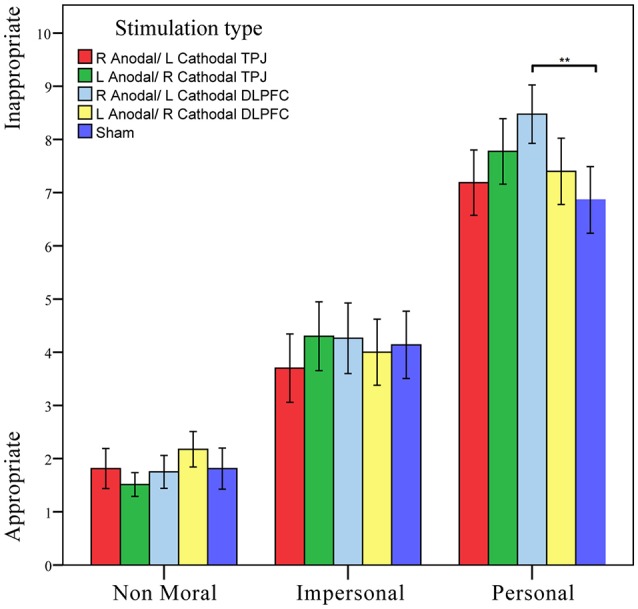
The profound nature of moral judgment has been discussed and debated for centuries. When facing the trade-off between pursuing moral rights and seeking better consequences, most people make different moral choices between two kinds of dilemmas. Such differences were explained by the dual-process theory involving an automatic emotional response and a controlled application of utilitarian decision-rules. In neurocognitive studies, the bilateral dorsolateral prefrontal cortex (DLPFC) has been demonstrated to play an important role in cognitive "rational" control processes in moral dilemmas. However, the profile of results across studies is not entirely consistent. Although one transcranial magnetic stimulation (TMS) study revealed that disrupting the right DLPFC led to less utilitarian responses, other TMS studies indicated that inhibition of the right DLPFC led to more utilitarian choices. Moreover, the right temporoparietal junction (TPJ) is essential for its function of integrating belief and intention in moral judgment, which is related to the emotional process according to the dual-process theory. Relatively few studies have reported the causal relationship between TPJ and participants' moral responses, especially in moral dilemmas. In the present study, we aimed to demonstrate a direct link between the neural and behavioral results by application of transcranial direct current stimulation (tDCS) in the bilateral DLPFC or TPJ of our participants. We observed that activating the right DLPFC as well as inhibiting the left DLPFC led to less utilitarian judgments, especially in moral-personal conditions, indicating that the right DLPFC plays an essential role, not only through its function of moral reasoning but also through its information integrating process in moral judgments. It was also revealed that altering the excitability of the bilateral TPJ using tDCS negligibly altered the moral response in non-moral, moral-impersonal and moral-personal dilemmas, indicating that bilateral TPJ may have little influence over moral judgments in moral dilemmas.
道德判断的深刻本质已经被讨论和辩论了几个世纪。当面临追求道德权利和寻求更好结果之间的权衡时,大多数人在两种困境中会做出不同的道德选择。这种差异由涉及自动情感反应和功利主义决策规则的受控应用的双过程理论来解释。在神经认知研究中,双侧背外侧前额叶皮层(DLPFC)已被证明在道德困境中的认知“理性”控制过程中发挥重要作用。然而,各研究结果的情况并不完全一致。尽管一项经颅磁刺激(TMS)研究表明,破坏右侧DLPFC会导致较少的功利主义反应,但其他TMS研究表明,抑制右侧DLPFC会导致更多的功利主义选择。此外,右侧颞顶联合区(TPJ)对于其在道德判断中整合信念和意图的功能至关重要,根据双过程理论,这与情感过程相关。相对较少的研究报告了TPJ与参与者道德反应之间的因果关系,特别是在道德困境中。在本研究中,我们旨在通过对参与者的双侧DLPFC或TPJ应用经颅直流电刺激(tDCS)来证明神经和行为结果之间的直接联系。我们观察到,激活右侧DLPFC以及抑制左侧DLPFC会导致较少的功利主义判断,特别是在道德-个人情境中,这表明右侧DLPFC不仅通过其道德推理功能,而且通过其在道德判断中的信息整合过程发挥着至关重要的作用。研究还表明,使用tDCS改变双侧TPJ的兴奋性对非道德、道德-非个人和道德-个人困境中的道德反应影响可忽略不计,这表明双侧TPJ可能对道德困境中的道德判断影响很小。