
通过CXCR2转导改善肿瘤腹水淋巴细胞向卵巢癌微环境的迁移。
Improved migration of tumor ascites lymphocytes to ovarian cancer microenvironment by CXCR2 transduction.
作者信息
Idorn Manja, Olsen Maria, Halldórsdóttir Hólmfrídur Rósa, Skadborg Signe Koggersbøl, Pedersen Magnus, Høgdall Claus, Høgdall Estrid, Met Özcan, Thor Straten Per
机构信息
Center for Cancer Immune Therapy (CCIT), Department of Hematology, Herlev University Hospital, Herlev ringvej 75, Herlev, Denmark.
Department of Oncology, Herlev University Hospital, Herlev ringvej 75, Herlev, Denmark.
出版信息
Oncoimmunology. 2017 Dec 26;7(4):e1412029. doi: 10.1080/2162402X.2017.1412029. eCollection 2018.
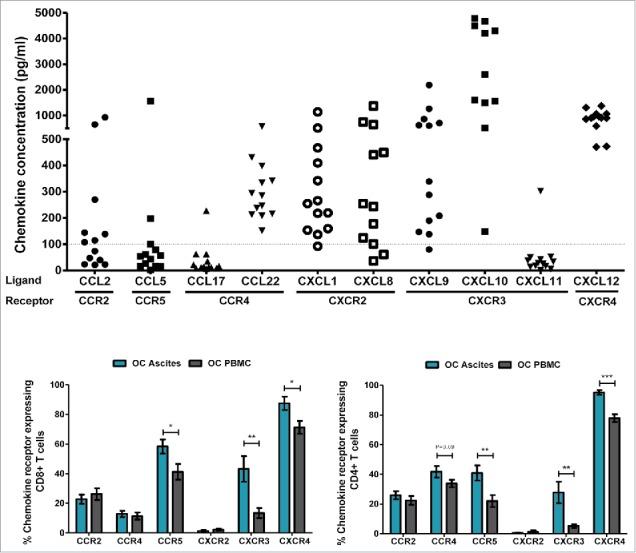
Chemokines are essential mediators of cellular trafficking, interactions and tumor development. Though adoptive cell therapy (ACT) has been a tremendous success in the treatment of metastatic melanoma (MM), a major obstacle for successful ACT, is limited homing of effector T cells to immune suppressive tumor sites. We hypothesized that equipping T cells with chemokine receptors matching the chemokines of the tumor microenvironment, could improve tumor homing of T cells. T cells from malignant ascites (n = 13); blood from ovarian cancer (OC) patients (n = 14); and healthy donors (n = 13) were analyzed by flow cytometry. We found that FoxP3 regulatory T cells accumulation in patients with OC associates with CCR4 expression. We characterized a chemokine profile of ascites chemokines, and expression of corresponding receptors on circulating T cells and tumor ascites lymphocytes (TALs). CCL22, CXCL9, CXCL10 and CXCL12 associated with enrichment of CCR4, CCR5, CXCR3 and CXCR4 T cells in ascites. Circulating T cells and TALs however did not express CXCR2, identifying CXCR2 as candidate for chemokine receptor transduction. TALs readily expressed IFNγ and TNFα upon stimulation despite the frequency decreasing with in vitro expansion. Lentiviral transduction of TALs (n = 4) with chemokine receptor CXCR2 significantly increased transwell migration of TALs towards rhIL8 and autologous ascites. The majority of expanded and transduced TALs were of a T effector memory subtype. This proof of concept study shows that chemokine receptor engineering with CXCR2 is feasible and improves homing of transduced TALs towards the OC microenvironment.
趋化因子是细胞运输、相互作用及肿瘤发展的重要介质。尽管过继性细胞疗法(ACT)在转移性黑色素瘤(MM)治疗中取得了巨大成功,但ACT成功的一个主要障碍是效应T细胞向免疫抑制肿瘤部位的归巢受限。我们推测,为T细胞配备与肿瘤微环境趋化因子相匹配的趋化因子受体,可能会改善T细胞的肿瘤归巢。通过流式细胞术分析了来自恶性腹水的T细胞(n = 13)、卵巢癌(OC)患者的血液(n = 14)以及健康供体的血液(n = 13)。我们发现,OC患者中FoxP3调节性T细胞的积累与CCR4表达相关。我们对腹水趋化因子的趋化因子谱以及循环T细胞和肿瘤腹水淋巴细胞(TALs)上相应受体的表达进行了表征。CCL22、CXCL9、CXCL10和CXCL12与腹水中CCR4、CCR5、CXCR3和CXCR4 T细胞的富集相关。然而,循环T细胞和TALs不表达CXCR2,这表明CXCR2是趋化因子受体转导的候选对象。尽管随着体外扩增频率降低,但TALs在受到刺激后仍能迅速表达IFNγ和TNFα。用趋化因子受体CXCR2对TALs(n = 4)进行慢病毒转导,显著增加了TALs向rhIL8和自体腹水的transwell迁移。大多数扩增和转导的TALs属于T效应记忆亚型。这项概念验证研究表明,用CXCR2进行趋化因子受体工程是可行的,并且可以改善转导的TALs向OC微环境的归巢。




 Zotero 插件