Department of Plant Biology, University of Illinois Urbana-Champaign, Urbana, Illinois 61801, USA.
Institute of Arctic Biology, University of Alaska Fairbanks, Fairbanks, Alaska 99775, USA.
Sci Data. 2018 Apr 10;5:180058. doi: 10.1038/sdata.2018.58.
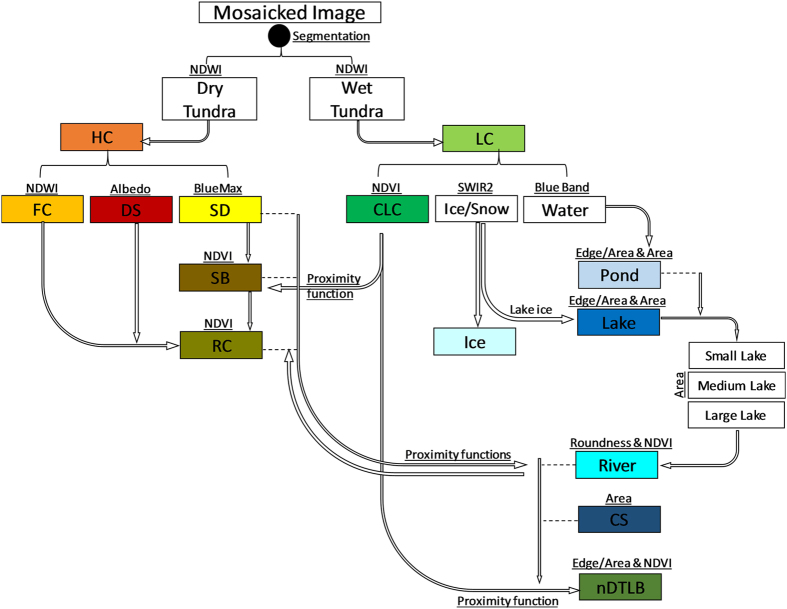
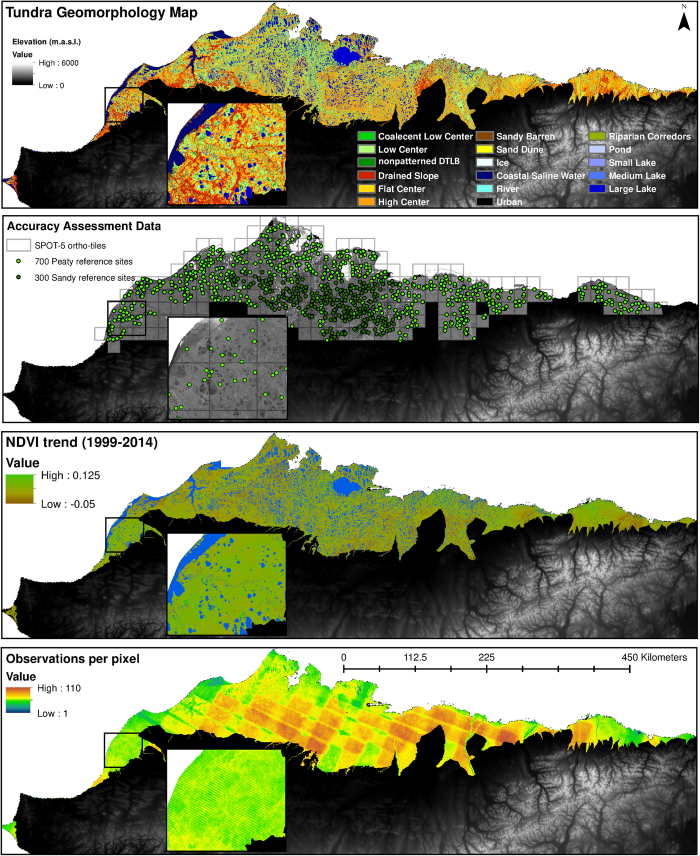
Arctic tundra landscapes are composed of a complex mosaic of patterned ground features, varying in soil moisture, vegetation composition, and surface hydrology over small spatial scales (10-100 m). The importance of microtopography and associated geomorphic landforms in influencing ecosystem structure and function is well founded, however, spatial data products describing local to regional scale distribution of patterned ground or polygonal tundra geomorphology are largely unavailable. Thus, our understanding of local impacts on regional scale processes (e.g., carbon dynamics) may be limited. We produced two key spatiotemporal datasets spanning the Arctic Coastal Plain of northern Alaska (~60,000 km) to evaluate climate-geomorphological controls on arctic tundra productivity change, using (1) a novel 30 m classification of polygonal tundra geomorphology and (2) decadal-trends in surface greenness using the Landsat archive (1999-2014). These datasets can be easily integrated and adapted in an array of local to regional applications such as (1) upscaling plot-level measurements (e.g., carbon/energy fluxes), (2) mapping of soils, vegetation, or permafrost, and/or (3) initializing ecosystem biogeochemistry, hydrology, and/or habitat modeling.
北极冻原景观由复杂的图案地面特征镶嵌而成,这些特征在小空间尺度(10-100m)上表现出土壤湿度、植被组成和地表水文学的变化。微地形及其相关地貌形态对影响生态系统结构和功能的重要性是有充分依据的,然而,描述图案地面或多边形冻原地貌的局部到区域尺度分布的空间数据产品在很大程度上是不可用的。因此,我们对局部对区域尺度过程(例如碳动态)的影响的理解可能是有限的。我们制作了两个关键的时空数据集,涵盖了阿拉斯加北部北极沿海平原(约 60,000km),以评估气候地貌学对北极冻原生产力变化的控制作用,使用了(1)一种新的 30m 多边形冻原地貌分类,以及(2)利用陆地卫星档案(1999-2014 年)评估地表绿色度的十年趋势。这些数据集可以轻松地在各种局部到区域应用中进行集成和调整,例如(1)放大斑块尺度的测量(例如碳/能量通量),(2)绘制土壤、植被或永久冻土图,以及/或(3)初始化生态系统生物地球化学、水文学和/或栖息地模型。