Institute of Genomic and Personalized Medicine, College of Life Science, Huazhong University of Science and Technology, Wuhan, Hubei, China.
Wuhan Women and Children Hospital, Wuhan, Hubei, China.
PLoS One. 2018 Apr 10;13(4):e0195740. doi: 10.1371/journal.pone.0195740. eCollection 2018.
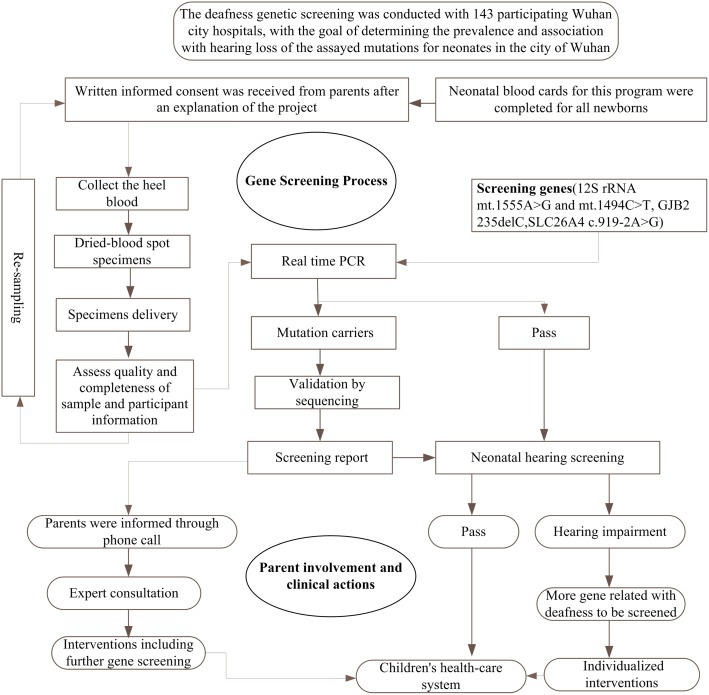
Almost one third of the three million people in China suffering severe deafness are children, and 50% of these cases are believed to have genetic components to their etiology. Newborn hearing genetic screening can complement Universal Neonatal Hearing Screening for the diagnosis of congenital hearing loss as well as identifying children at risk for late-onset and progressive hearing impairment. The aim of this joint academic and Ministry of Health project was to prototype a cost effective newborn genetic screen in a community health setting on a city-wide level, and to ascertain the prevalence of variation at loci that have been associated with non-syndromic hearing loss. With the participation of 143 local hospitals in the city of Wuhan, China we screened 142,417 neonates born between May 2014 and Dec. 2015. The variants GJB2 c.235delC, SLC26A4 c.919-2A>G, and mitochondrial variants m.1555A>G and m.1494C>T were assayed using real time PCR. Newborns found to carry a variant were re-assayed by sequencing in duplicate. Within a subset of 707 newborns we assayed using real-time PCR and ARMS-PCR to compare cost, sensitivity and operating procedure. The most frequent hearing loss associated allele detected in this population was the 235delC variant in GJB2 gene. In total, 4289 (3.01%) newborns were found to carry at least one allele of either GJB2 c.235delC, SLC26A4 c.919-2A>G or two assayed MT-RNR1 variants. There was complete accordance between the real-time PCR and the ARMS PCR, though the real-time PCR had a much lower failure rate. Real-time PCR had a lower cost and operating time than ARMS PCR. Ongoing collaboration with the participating hospitals will determine the specificity and sensitivity of the association of the variants with hearing loss at birth and arising in early childhood, allowing an estimation of the benefits of newborn hearing genetic screening in a large-scale community setting.
中国有 300 万重度耳聋患者,其中近三分之一为儿童,而这些病例中有 50%被认为具有遗传因素。新生儿听力基因筛查可与普遍新生儿听力筛查相结合,用于诊断先天性听力损失,并识别有迟发性和进行性听力障碍风险的儿童。本联合学术和卫生部项目的目的是在社区卫生环境中为城市范围内的新生儿进行具有成本效益的基因筛查,并确定与非综合征性听力损失相关的基因座变异的流行率。在中国武汉市,有 143 家当地医院参与,我们筛查了 2014 年 5 月至 2015 年 12 月期间出生的 142417 名新生儿。使用实时 PCR 检测 GJB2 c.235delC、SLC26A4 c.919-2A>G 和线粒体变体 m.1555A>G 和 m.1494C>T。发现携带变体的新生儿通过重复测序进行重新检测。在 707 名新生儿的子集中,我们使用实时 PCR 和 ARMS-PCR 进行了检测,以比较成本、灵敏度和操作程序。在该人群中检测到的最常见的听力损失相关等位基因是 GJB2 基因中的 235delC 变体。总共有 4289 名(3.01%)新生儿携带 GJB2 c.235delC、SLC26A4 c.919-2A>G 或两个检测的 MT-RNR1 变体的至少一个等位基因。实时 PCR 和 ARMS-PCR 之间完全一致,尽管实时 PCR 的失败率要低得多。实时 PCR 的成本和操作时间都低于 ARMS-PCR。与参与医院的持续合作将确定变体与出生时和幼儿期听力损失的关联的特异性和敏感性,从而可以估计大规模社区环境中新生儿听力基因筛查的益处。