Head and Neck Oncology Program, Dana-Farber Cancer Institute, Boston.
The Tisch Cancer Institute, Division of Hematology and Medical Oncology, Icahn School of Medicine at Mount Sinai, New York City, USA.
Ann Oncol. 2018 May 1;29(5):1130-1140. doi: 10.1093/annonc/mdy102.
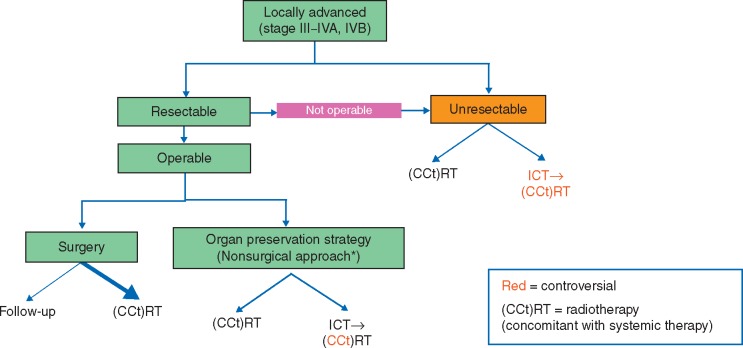
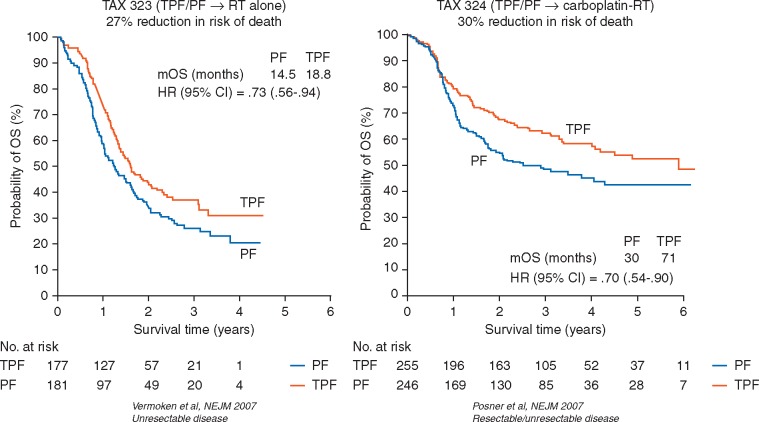
The value of induction chemotherapy (ICT) remains under investigation despite decades of research. New advancements in the field, specifically regarding the induction regimen of choice, have reignited interest in this approach for patients with locally advanced squamous cell carcinoma of the head and neck (LA SCCHN). Sufficient evidence has accumulated regarding the benefits and superiority of TPF (docetaxel, cisplatin, and fluorouracil) over the chemotherapy doublet cisplatin and fluorouracil. We therefore sought to collate and interpret the available data and further discuss the considerations for delivering ICT safely and optimally selecting suitable post-ICT regimens.
We nonsystematically reviewed published phase III clinical trials on TPF ICT in a variety of LA SCCHN patient populations conducted between 1990 and 2017.
TPF may confer survival and organ preservation benefits in a subgroup of patients with functionally inoperable or poor-prognosis LA SCCHN. Additionally, patients with operable disease or good prognosis (who are not candidates for organ preservation) may benefit from TPF induction in terms of reducing local and distant failure rates and facilitating treatment deintensification in selected populations. The safe administration of TPF requires treatment by a multidisciplinary team at an experienced institution. The management of adverse events associated with TPF and post-ICT radiotherapy-based treatment is crucial. Finally, post-ICT chemotherapy alternatives to cisplatin concurrent with radiotherapy (i.e. cetuximab or carboplatin plus radiotherapy) appear promising and must be investigated further.
TPF is an evidence-based ICT regimen of choice in LA SCCHN and confers benefits in suitable patients when it is administered safely by an experienced multidisciplinary team and paired with the optimal post-ICT regimen, for which, however, no consensus currently exists.
尽管已经进行了数十年的研究,但诱导化疗(ICT)的价值仍在研究中。该领域的新进展,特别是关于首选诱导方案的进展,重新激发了人们对局部晚期头颈部鳞状细胞癌(LA SCCHN)患者采用这种方法的兴趣。已经积累了足够的证据,证明 TPF(多西他赛、顺铂和氟尿嘧啶)在化疗双联顺铂和氟尿嘧啶方面具有优势和优越性。因此,我们试图整理和解释现有的数据,并进一步讨论安全和优化地提供 ICT 以及选择合适的 ICT 后方案的注意事项。
我们对 1990 年至 2017 年间发表的各种 LA SCCHN 患者人群中使用 TPF ICT 的 III 期临床试验进行了非系统性综述。
TPF 可能为功能不可切除或预后不良的 LA SCCHN 患者亚组提供生存和器官保存获益。此外,对于可手术或预后良好的患者(不适合器官保存的患者),TPF 诱导可能会降低局部和远处失败率,并在选定人群中有助于治疗减量化。TPF 的安全给药需要在经验丰富的机构中由多学科团队进行治疗。管理与 TPF 相关的不良事件以及基于 ICT 放疗的治疗至关重要。最后,与放疗联合使用的 ICT 后化疗替代方案顺铂(即西妥昔单抗或卡铂加放疗)似乎很有前途,需要进一步研究。
TPF 是 LA SCCHN 的循证 ICT 首选方案,在由经验丰富的多学科团队安全给药并与最佳 ICT 后方案联合使用时,适合某些患者,但是目前尚未达成共识。