Dou Yaling, Lv Yali, Zhou Xiaojin, He Linfu, Liu Lihong, Li Pengfei, Sun Yulong, Wang Minghui, Gao Meijuan, Wang Chong
Department of Clinical Laboratory, Peking Union Medical College Hospital, Chinese Academy of Medical Sciences, Peking Union Medical College, Beijing, People's Republic of China.
Department of Pharmacy, Beijing Chao-Yang Hospital, Capital Medical University, Beijing, People's Republic of China.
Onco Targets Ther. 2018 Mar 28;11:1743-1756. doi: 10.2147/OTT.S149204. eCollection 2018.
Members of the cystatin family have increasingly been proven to be involved in several tumors, including gastric cancer (GC) and colorectal cancer (CRC). Cystatin S (CST4) was found to be upregulated at the gene expression level in GC cells, making it a potential novel biomarker for the early diagnosis of gastrointestinal cancer.
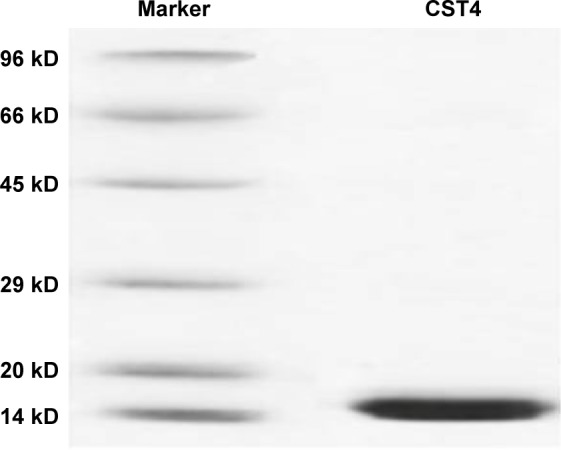
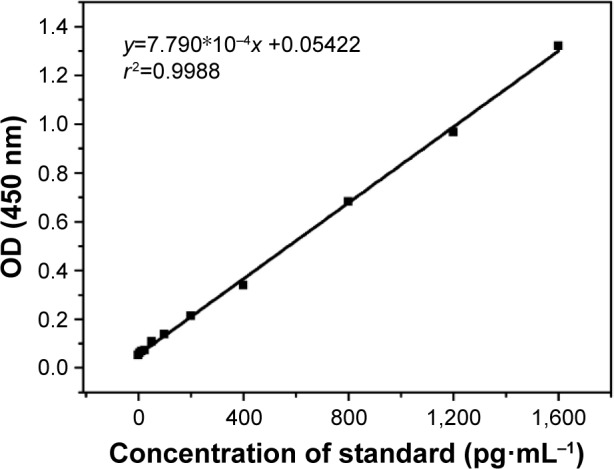
Quantitative real-time polymerase chain reaction and Western blotting analysis were used to explore CST4 expression in gastrointestinal cancer tissues and cell lines. We purified CST4 recombinant protein and generated anti-CST4 monoclonal antibodies to develop an antibody-sandwich enzyme-linked immunosorbent assay (ELISA) analysis system for blood CST4 detection. The performance and clinical efficacy of the detection method were evaluated using a training set and validation set, respectively.
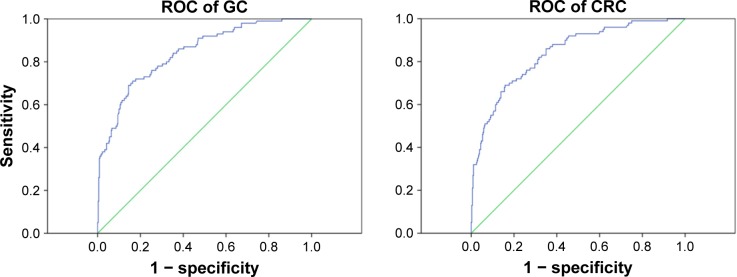
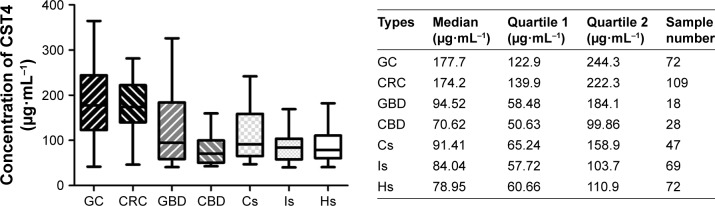
According to the quantitative real-time polymerase chain reaction and Western blotting results, -mRNA expression and protein expression were upregulated in gastrointestinal cancer tissues and cell lines. The ELISA detection system for CST4 showed significantly better sensitivities of 69.0% and 69.0% and specificities of 85.6% and 83.6% for GC and CRC, respectively, than other common clinical biomarkers, carcinoembryonic antigen, CA19-9, CA125, and CA72-4. Clinical verification experiments using GC and CRC validation sets also found distinguishable CST4 median concentrations (177.7 pg·mL and 174.2 pg·mL respectively) and high positive detection rates (72.3% and 88.4% respectively), further confirming the specificity and sensitivity of this method.
We validated the overexpression of CST4 in gastrointestinal cancer tissues and cell lines and developed an antibody-sandwich ELISA analysis system for blood CST4 detection, which exhibited high specificity and sensitivity. Novel blood biomarkers of CST4 have enormous potential in terms of clinical diagnostic value in GC and CRC.
越来越多的证据表明,胱抑素家族成员参与了包括胃癌(GC)和结直肠癌(CRC)在内的多种肿瘤。研究发现,胱抑素S(CST4)在GC细胞的基因表达水平上上调,这使其成为胃肠道癌早期诊断的潜在新型生物标志物。
采用定量实时聚合酶链反应和蛋白质免疫印迹分析,探讨CST4在胃肠道癌组织和细胞系中的表达情况。我们纯化了CST4重组蛋白,并制备了抗CST4单克隆抗体,以开发用于血液CST4检测的抗体夹心酶联免疫吸附测定(ELISA)分析系统。分别使用训练集和验证集评估该检测方法的性能和临床疗效。
根据定量实时聚合酶链反应和蛋白质免疫印迹结果,胃肠道癌组织和细胞系中的mRNA表达和蛋白质表达均上调。与其他常见临床生物标志物癌胚抗原、CA19-9、CA125和CA72-4相比,CST4的ELISA检测系统对GC和CRC的敏感性分别显著提高至69.0%和69.0%,特异性分别为85.6%和83.6%。使用GC和CRC验证集进行的临床验证实验还发现,CST4的中位浓度有明显差异(分别为177.7 pg·mL和174.2 pg·mL),阳性检测率较高(分别为72.3%和88.4%),进一步证实了该方法的特异性和敏感性。
我们验证了CST4在胃肠道癌组织和细胞系中的过表达,并开发了用于血液CST4检测的抗体夹心ELISA分析系统,该系统具有高特异性和敏感性。CST4作为新型血液生物标志物在GC和CRC的临床诊断价值方面具有巨大潜力。