Van Damme Axel, Declercq Tom, Lemey Lieve, Tandt Hannelore, Petrovic Mirko
Faculty of Medicine and Health Sciences, Ghent University, Ghent, Belgium.
Department of General Practice and Primary Health Care, Ghent University, Ghent, Belgium.
Int J Gen Med. 2018 Mar 29;11:113-120. doi: 10.2147/IJGM.S154876. eCollection 2018.
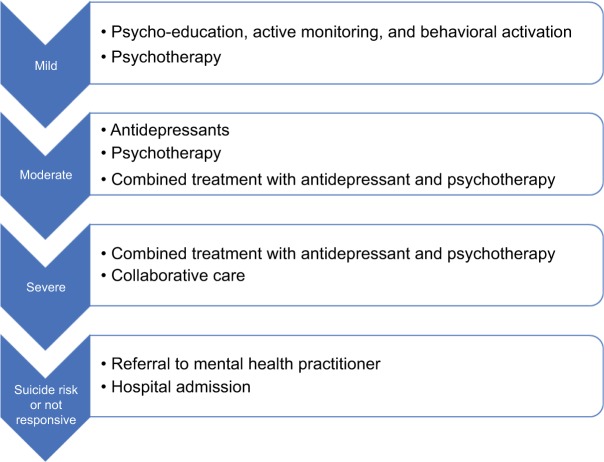
Late-life depression (LLD) is both a prevalent and life-threatening disorder, affecting up to 13.3% of the elderly population. LLD can be difficult to identify because patients mainly consult their general practitioner (GP) for somatic complaints. Moreover, patients may be hesitant to express the problem to their GP. Increased vigilance on the part of the GP can only benefit older people with depression. To recognize the risk of LLD, screening tools are provided in addition to treatment options for LLD. This review aims to provide the GP with guidance in recognizing and treating LLD. It tries to connect mainstream etiologies of LLD (e.g., vascular, inflammation, hypothalamo-pituitary-adrenal axis) with risk factors and current therapies. Therefore, we provide a basis to the GP for decision-making when choosing an appropriate therapy for LLD.
老年期抑郁症(LLD)是一种既普遍又危及生命的疾病,影响着高达13.3%的老年人口。LLD可能难以识别,因为患者主要因躯体不适而咨询他们的全科医生(GP)。此外,患者可能会犹豫是否向他们的全科医生表达这个问题。全科医生提高警惕只会使患有抑郁症的老年人受益。为了识别LLD的风险,除了提供LLD的治疗选择外,还提供了筛查工具。本综述旨在为全科医生识别和治疗LLD提供指导。它试图将LLD的主流病因(如血管性、炎症、下丘脑-垂体-肾上腺轴)与风险因素和当前疗法联系起来。因此,我们为全科医生在为LLD选择合适疗法时的决策提供了依据。