1Department of Otolaryngology, University of Colorado Anschutz Medical Campus, 12700 E19th Avenue, Aurora, CO 80045 USA.
2Laboratory of Precision Oncology, China Medical University School of Pharmacy, No. 77 Puhe Road, Shenyang, 110122 China.
Clin Epigenetics. 2018 Apr 3;10:43. doi: 10.1186/s13148-018-0470-7. eCollection 2018.
To identify aberrant promoter methylation of genomic loci encoding microRNA (mgmiR) in head and neck squamous cell carcinoma (HNSCC) and to evaluate a biomarker panel of mgmiRs to improve the diagnostic accuracy of HNSCC in tissues and saliva.
Methylation of promoter regions of mgmiR candidates was initially screened using HNSCC and control cell lines and further selected using HNSCC and control tissues by quantitative methylation-specific PCR (qMS-PCR). We then examined a panel of seven mgmiRs for validation in an expanded cohort including 189 HNSCC and 92 non-HNSCC controls. Saliva from 86 pre-treatment HNSCC patients and 108 non-HNSCC controls was also examined using this panel of seven mgmiRs to assess the potentials of clinical utilization.
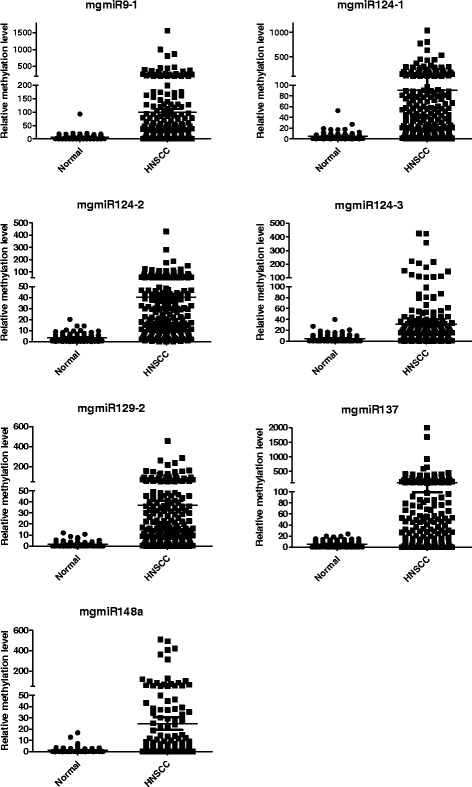
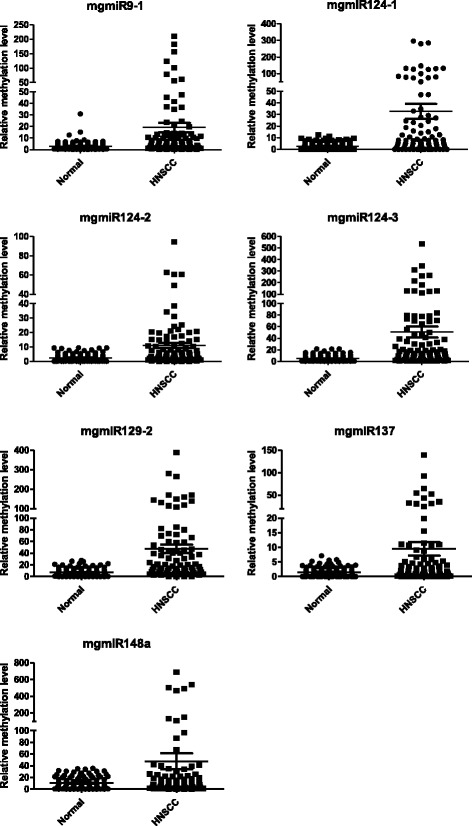
Among the 315 screened mgmiRs, 12 mgmiRs were significantly increased in HNSCC cell lines compared to control cell lines. Seven out of the 12 mgmiRs, i.e., mgmiR9-1, mgmiR124-1, mgmiR124-2, mgmiR124-3, mgmiR129-2, mgmiR137, and mgmiR148a, were further found to significantly increase in HNSCC tumor tissues compared to control tissues. Using multivariable logistic regression with dichotomized variables, a combination of the seven mgmiRs had sensitivity and specificity of 92.6 and 92.4% in tissues and 76.7 and 86.1% in saliva, respectively. Area under the receiver operating curve for this panel was 0.97 in tissue and 0.93 in saliva. This model was validated by independent bootstrap validation and random forest analysis.
mgmiR biomarkers represent a novel and promising screening tool, and the seven-mgmiR panel is able to robustly detect HNSCC in both patient tissue and saliva.
鉴定头颈部鳞状细胞癌(HNSCC)中编码 microRNA(mgmiR)的基因组基因座的异常启动子甲基化,并评估一组 mgmiR 生物标志物,以提高组织和唾液中 HNSCC 的诊断准确性。
使用 HNSCC 和对照细胞系初步筛选 mgmiR 候选物启动子区域的甲基化,然后使用 HNSCC 和对照组织通过定量甲基化特异性 PCR(qMS-PCR)进一步选择。然后,我们在包括 189 例 HNSCC 和 92 例非 HNSCC 对照的扩展队列中验证了一组七个 mgmiR。还使用该七个 mgmiR 组来评估 86 例 HNSCC 患者的治疗前唾液和 108 例非 HNSCC 对照的临床应用潜力。
在筛选的 315 个 mgmiR 中,与对照细胞系相比,12 个 mgmiR 在 HNSCC 细胞系中显著增加。在 HNSCC 肿瘤组织中进一步发现这 12 个 mgmiR 中有 7 个,即 mgmiR9-1、mgmiR124-1、mgmiR124-2、mgmiR124-3、mgmiR129-2、mgmiR137 和 mgmiR148a,与对照组织相比显著增加。使用二分类变量的多变量逻辑回归,七种 mgmiR 的组合在组织中的灵敏度和特异性分别为 92.6%和 92.4%,在唾液中的灵敏度和特异性分别为 76.7%和 86.1%。该面板的受试者工作特征曲线下面积在组织中为 0.97,在唾液中为 0.93。该模型通过独立的自举验证和随机森林分析进行了验证。
mgmiR 生物标志物代表了一种新颖且有前途的筛查工具,七个-mgmiR 组能够在患者组织和唾液中可靠地检测到 HNSCC。