Allinson Leesa G, Denehy Linda, Doyle Lex W, Eeles Abbey L, Dawson Jennifer A, Lee Katherine J, Spittle Alicia J
Victorian Infant Brain Studies, Murdoch Children's Research Institute, Parkville, Victoria, Australia.
Department of Physiotherapy, School of Health Sciences, University of Melbourne, Melbourne, Victoria, Australia.
BMJ Paediatr Open. 2017 Nov 25;1(1):e000025. doi: 10.1136/bmjpo-2017-000025. eCollection 2017.
To compare the physiological stress responses of infants born <30 weeks' gestational age when undergoing clustered nursing cares with standardised neurobehavioural assessments in neonatal nurseries.
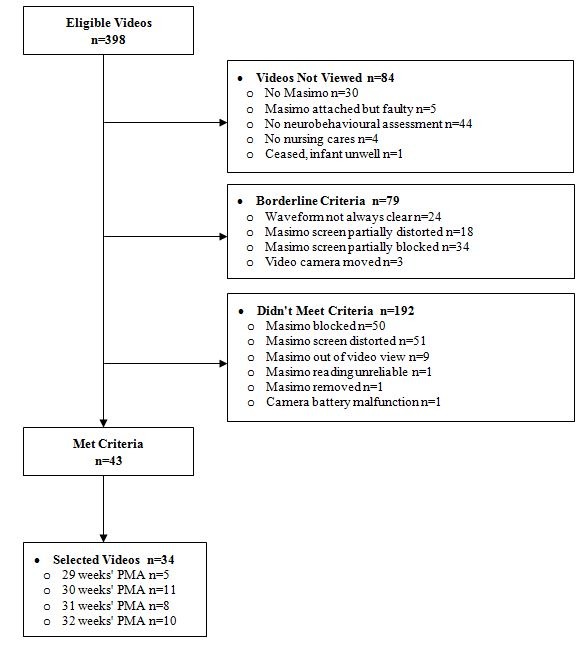
DESIGN/METHODS: Thirty-four infants born <30 weeks' gestation were recruited from a tertiary neonatal intensive care unit. Heart rate (HR) and oxygen saturation were recorded during clustered nursing cares and during standardised neurobehavioural assessments (including the General Movements Assessment, Hammersmith Neonatal Neurological Examination and Premie-Neuro Assessment). Two assessors extracted HR and oxygen saturations at 5 s intervals, with HR instability defined either as tachycardia (HR >180 beats per minute (bpm)) or bradycardia (HR <100 bpm). Oxygen desaturations were defined as SpO<90%. Physiological stability was compared between nursing cares and neurobehavioural assessments using linear (for continuous outcomes) and logistic (HR instability and oxygen desaturation) regression.
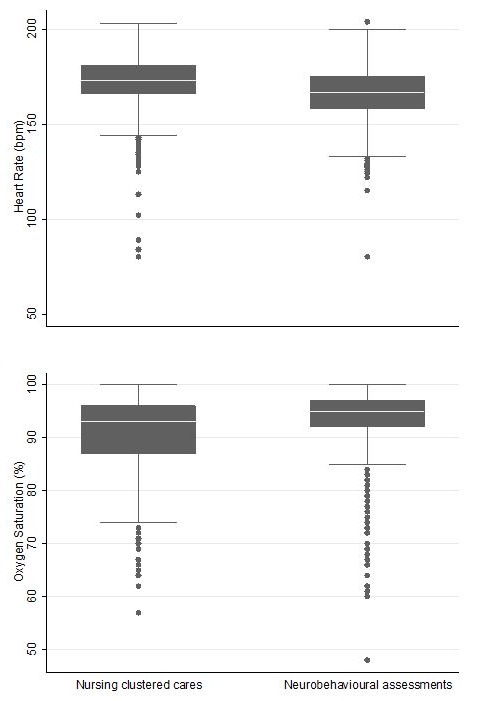
Compared with clustered nursing cares HR was lower (mean difference -5.9 bpm; 95% CI -6.5 to 5.3; P<0.001) and oxygen saturation higher (mean difference 2.4%; 95% CI 2.1% to 2.6%; P<0.001) during standardised neurobehavioural assessments. Compared with clustered nursing cares neurobehavioural assessments were also associated with reduced odds of tachycardia (OR 0.44, 95% CI 0.22 to 0.86), HR instability (OR 0.43, 95% CI 0.22 to 0.85) and oxygen desaturation (OR 0.43, 95% CI 0.26 to 0.70).
Standardised neurobehavioural assessments are associated with less physiological stress than clustered nursing cares in infants aged 29-32 weeks' postmenstrual age, and are therefore possible without causing undue physiological disturbance in medically stable infants.
比较孕周小于30周的婴儿在新生儿重症监护病房接受集束式护理和标准化神经行为评估时的生理应激反应。
设计/方法:从一家三级新生儿重症监护病房招募了34名孕周小于30周的婴儿。在集束式护理期间和标准化神经行为评估(包括全身运动评估、哈默史密斯新生儿神经检查和早产儿神经评估)期间记录心率(HR)和血氧饱和度。两名评估人员每隔5秒提取一次HR和血氧饱和度,HR不稳定定义为心动过速(HR>180次/分钟(bpm))或心动过缓(HR<100 bpm)。血氧饱和度下降定义为SpO<90%。使用线性回归(用于连续结果)和逻辑回归(HR不稳定和血氧饱和度下降)比较护理和神经行为评估之间的生理稳定性。
与集束式护理相比,在标准化神经行为评估期间,HR较低(平均差异-5.9 bpm;95%CI -6.5至5.3;P<0.001),血氧饱和度较高(平均差异2.4%;95%CI 2.1%至2.6%;P<0.001)。与集束式护理相比,神经行为评估还与心动过速(OR 0.44,95%CI 0.22至0.86)、HR不稳定(OR 0.43,95%CI 0.22至0.85)和血氧饱和度下降(OR 0.43,95%CI 0.26至0.70)的几率降低相关。
在月经龄29 - 32周的婴儿中,标准化神经行为评估比集束式护理引起的生理应激更少,因此在医学状况稳定的婴儿中进行评估不会引起过度的生理干扰。