Applied BioMath, Lincoln, Massachusetts, USA.
Alexion Pharmaceuticals, Inc., New Haven, Connecticut, USA.
CPT Pharmacometrics Syst Pharmacol. 2018 Jun;7(6):404-412. doi: 10.1002/psp4.12301. Epub 2018 Apr 26.
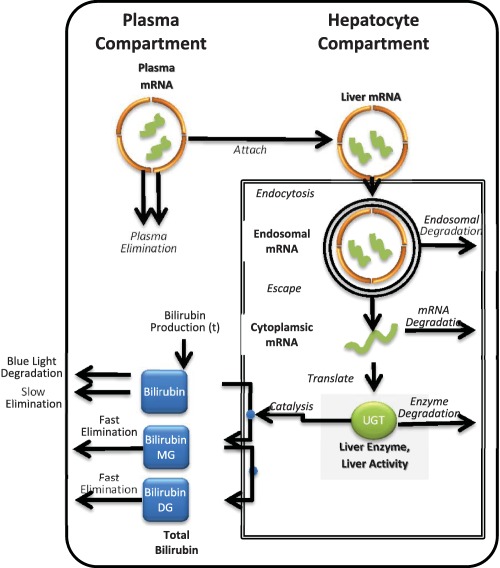
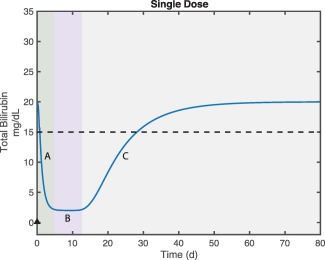
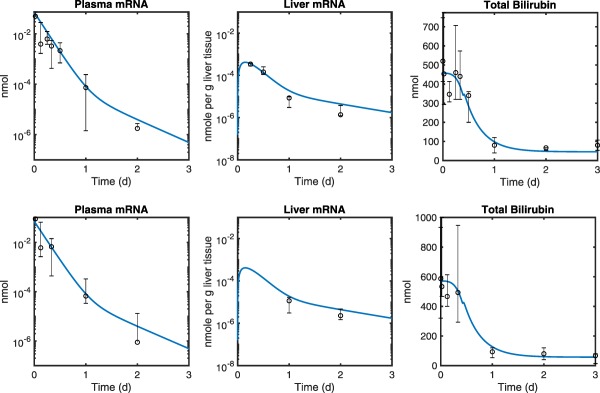
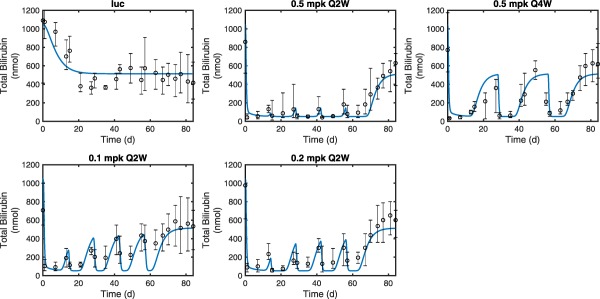
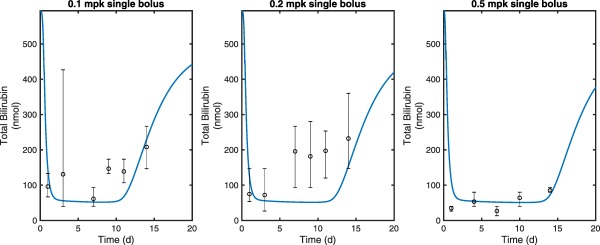
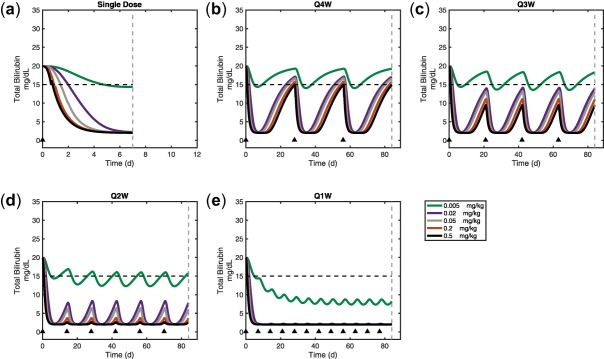
Crigler-Najjar syndrome type 1 (CN1) is an autosomal recessive disease caused by a marked decrease in uridine-diphosphate-glucuronosyltransferase (UGT1A1) enzyme activity. Delivery of hUGT1A1-modRNA (a modified messenger RNA encoding for UGT1A1) as a lipid nanoparticle is anticipated to restore hepatic expression of UGT1A1, allowing normal glucuronidation and clearance of bilirubin in patients. To support translation from preclinical to clinical studies, and first-in-human studies, a quantitative systems pharmacology (QSP) model was developed. The QSP model was calibrated to plasma and liver mRNA, and total serum bilirubin in Gunn rats, an animal model of CN1. This QSP model adequately captured the observed plasma and liver biomarker behavior across a range of doses and dose regimens in Gunn rats. First-in-human dose projections made using the translated model indicated that 0.5 mg/kg Q4W dose should provide a clinically meaningful and sustained reduction of >5 mg/dL in total bilirubin levels.
克里格勒-纳贾尔综合征 1 型(CN1)是一种常染色体隐性遗传病,由尿苷二磷酸葡萄糖醛酸基转移酶(UGT1A1)酶活性显著下降引起。预计将 hUGT1A1-modRNA(一种编码 UGT1A1 的修饰信使 RNA)作为脂质纳米颗粒递送至肝脏,将恢复 UGT1A1 的肝表达,使患者的胆红素能够正常进行葡萄糖醛酸化和清除。为了支持从临床前研究到临床研究以及首次人体研究的转化,开发了定量系统药理学(QSP)模型。该 QSP 模型经过校准,可用于血浆和肝脏 mRNA 以及 Gunn 大鼠(CN1 的动物模型)的总血清胆红素。该 QSP 模型充分捕捉了在 Gunn 大鼠中观察到的各种剂量和剂量方案下的血浆和肝脏生物标志物行为。使用转化模型进行的首次人体剂量预测表明,每 4 周 0.5mg/kg 的剂量应能使总胆红素水平持续显著降低 >5mg/dL。