Australian Research Council Centre of Excellence for Coral Reef Studies, James Cook University, Townsville, Queensland, Australia.
Department of Biology, Stanford University, Stanford, California, United States of America.
PLoS One. 2018 Apr 11;13(4):e0194465. doi: 10.1371/journal.pone.0194465. eCollection 2018.
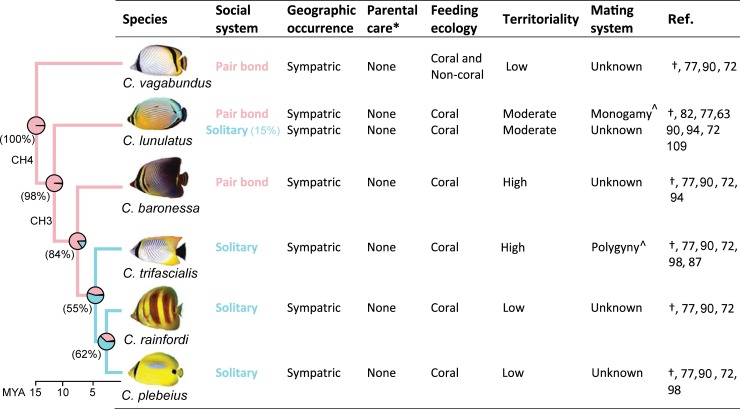
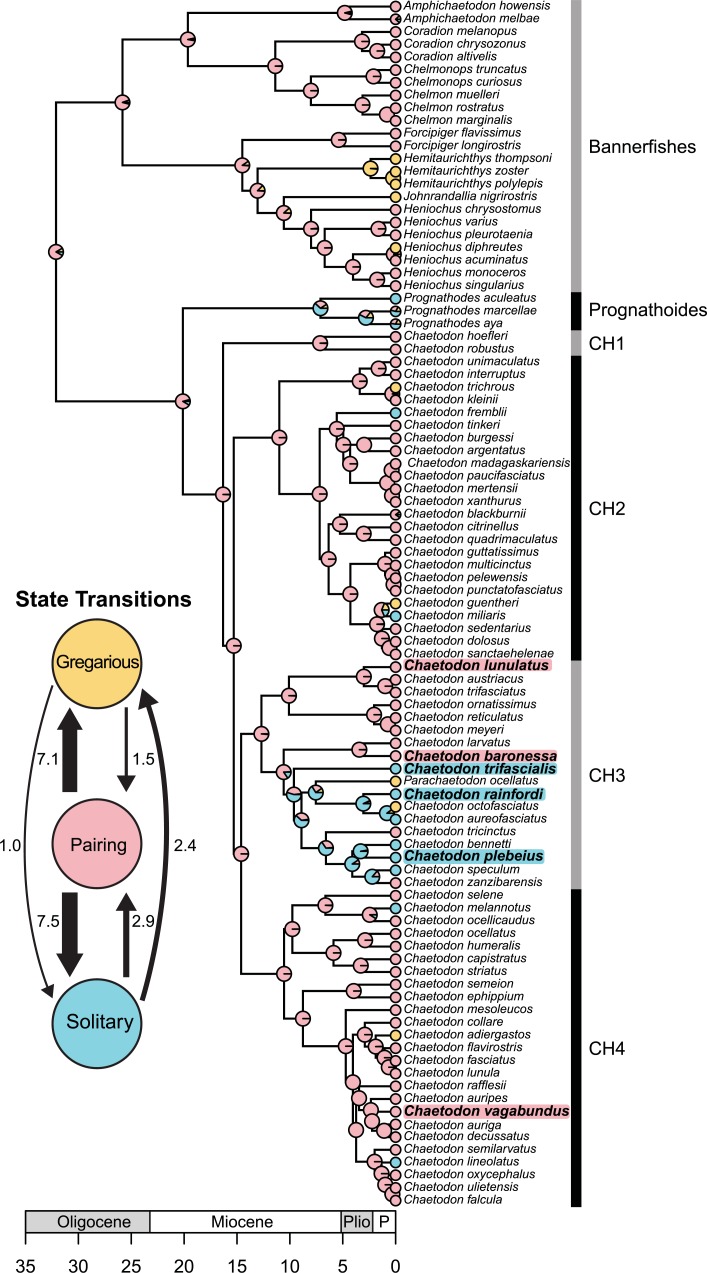
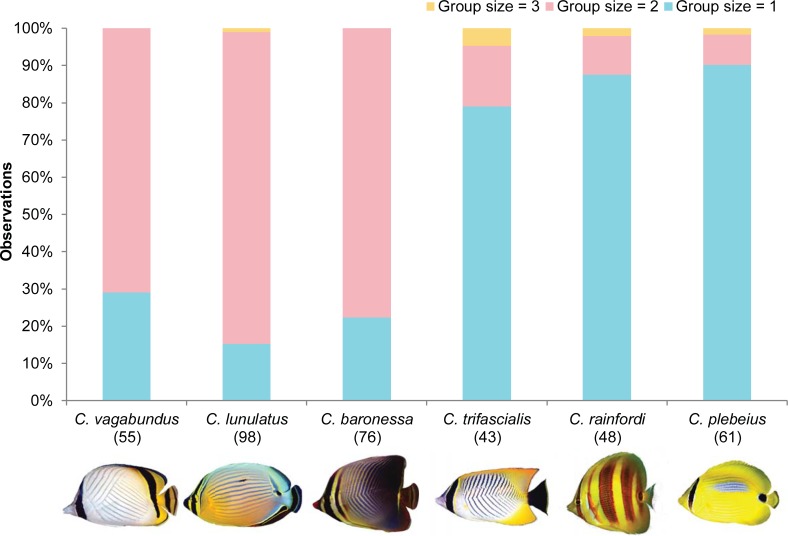
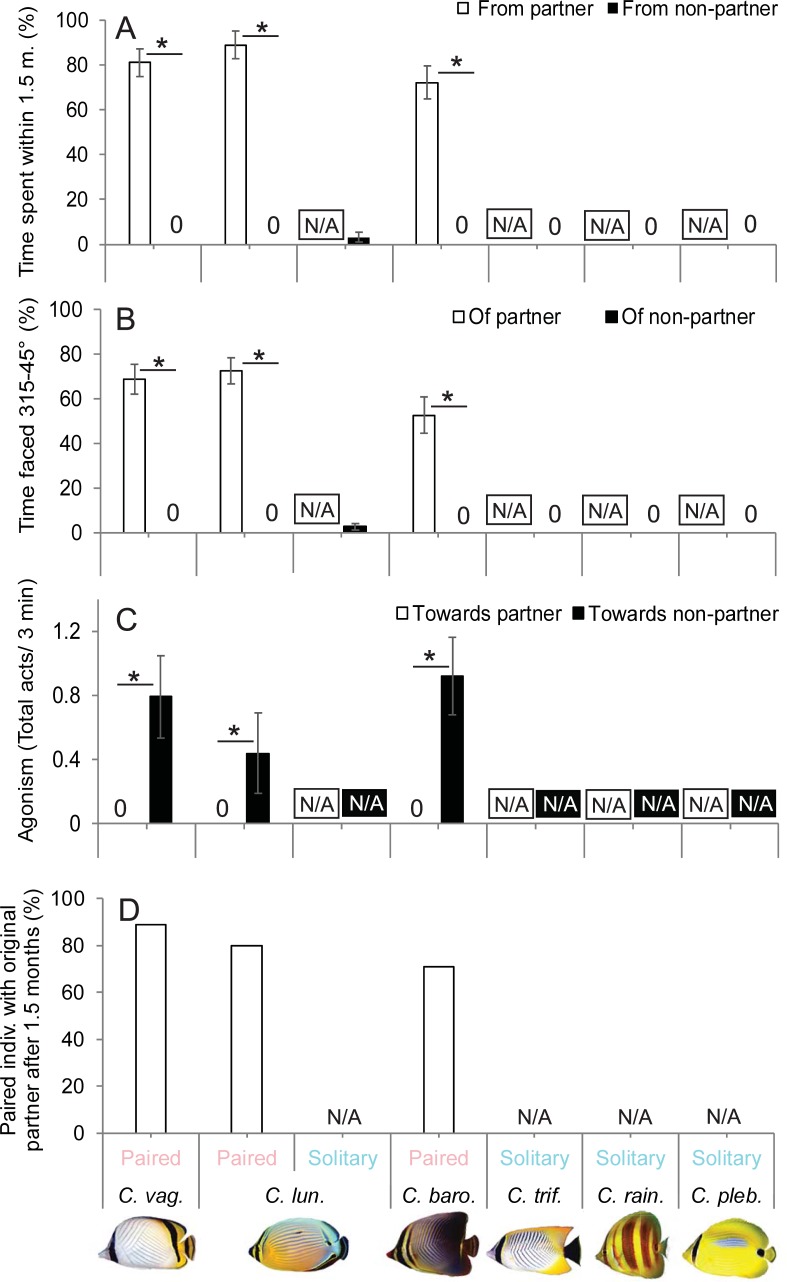
For many animals, affiliative relationships such as pair bonds form the foundation of society and are highly adaptive. Animal systems amenable for comparatively studying pair bonding are important for identifying underlying biological mechanisms, but mostly exist in mammals. Better establishing fish systems will enable comparison of pair bonding mechanisms across taxonomically distant lineages that may reveal general underlying mechanistic principles. We examined the utility of wild butterflyfishes (f: Chaetodontidae; g: Chaetodon) for comparatively studying pair bonding. Using stochastic character mapping, we provide the first analysis of the evolutionary history of butterflyfish sociality, revealing that pairing is ancestral, with at least seven independent transitions to gregarious grouping and solitary behavior since the late Miocene. We then formally verified social systems in six sympatric and wide-spread species representing a clade with one ancestrally reconstructed transition from paired to solitary grouping at Lizard Island, Australia. In situ observations of the size, selective affiliation and aggression, fidelity, and sex composition of social groups confirmed that Chaetodon baronessa, C. lunulatus, and C. vagabundus are predominantly pair bonding, whereas C. rainfordi, C. plebeius, and C. trifascialis are predominantly solitary. Even in the predominantly pair bonding species, C. lunulatus, a proportion of adults (15%) are solitary. Importantly, inter- and intra-specific differences in social systems do not co-vary with other previously established attributes, including parental care. Hence, the proposed butterflyfish populations are promising for inter- and intra-species comparative analyses of pair bonding and its mechanistic underpinnings. Avenues for further developing the system are proposed, including determining whether the aforementioned utility of these species applies across their geographic disruptions.
对于许多动物来说,亲善关系(如伴侣关系)构成了社会的基础,并且具有高度的适应性。适用于比较研究伴侣关系的动物系统对于识别潜在的生物学机制非常重要,但这些系统大多存在于哺乳动物中。更好地建立鱼类系统将使我们能够比较跨分类群的伴侣关系机制,这可能揭示出一般潜在的机械原理。我们研究了野生蝴蝶鱼(f:Chaetodontidae;g:Chaetodon)在比较研究伴侣关系方面的应用。使用随机特征映射,我们首次分析了蝴蝶鱼社会性的进化历史,揭示了配对是祖先的,至少有七个独立的过渡到群体聚集和独居行为自上新世以来。然后,我们正式验证了六种共生且分布广泛的物种的社会系统,这些物种代表了一个在澳大利亚蜥蜴岛从配对到独居的祖先重建过渡的分支。对社会群体的大小、选择性联盟和攻击、忠诚度以及性别组成的现场观察证实,Chaetodon baronessa、C. lunulatus 和 C. vagabundus 主要是伴侣关系,而 C. rainfordi、C. plebeius 和 C. trifascialis 主要是独居。即使在主要是伴侣关系的物种中,C. lunulatus 也有一部分(15%)是独居的。重要的是,社会系统的种间和种内差异与其他先前建立的属性(包括亲代照顾)不相关。因此,拟议的蝴蝶鱼种群有望用于伴侣关系及其机制基础的种间和种内比较分析。提出了进一步发展该系统的途径,包括确定这些物种的上述用途是否适用于其地理分布的中断。