Department of Integrative Biology, University of Texas at Austin, Austin, TX, 78712, USA.
Present Address: Department of Biology, Duke University, Durham, NC, 27708, USA.
BMC Genomics. 2021 May 31;22(1):399. doi: 10.1186/s12864-021-07720-0.
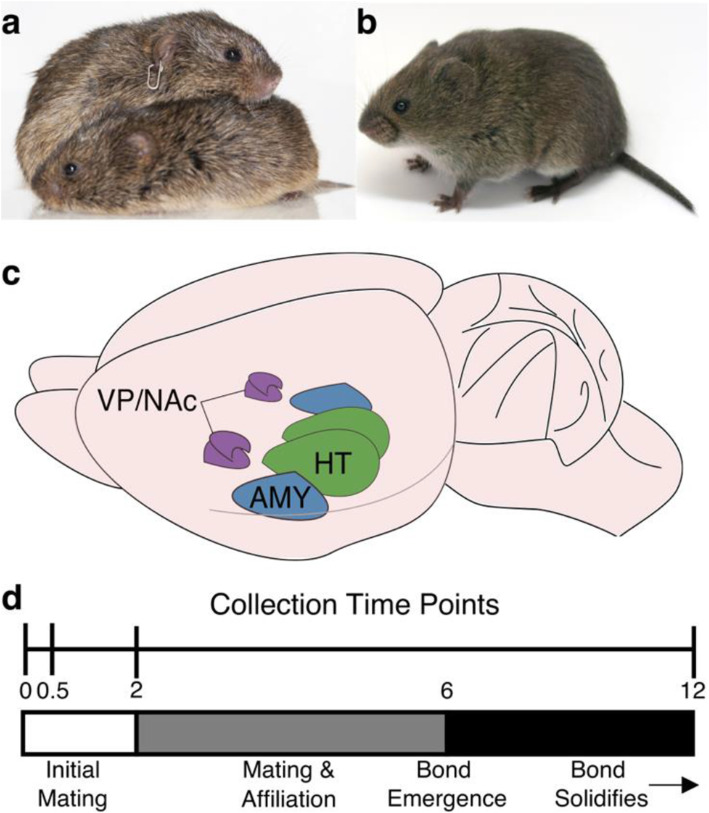
Pair bonding with a reproductive partner is rare among mammals but is an important feature of human social behavior. Decades of research on monogamous prairie voles (Microtus ochrogaster), along with comparative studies using the related non-bonding meadow vole (M. pennsylvanicus), have revealed many of the neural and molecular mechanisms necessary for pair-bond formation in that species. However, these studies have largely focused on just a few neuromodulatory systems. To test the hypothesis that neural gene expression differences underlie differential capacities to bond, we performed RNA-sequencing on tissue from three brain regions important for bonding and other social behaviors across bond-forming prairie voles and non-bonding meadow voles. We examined gene expression in the amygdala, hypothalamus, and combined ventral pallidum/nucleus accumbens in virgins and at three time points after mating to understand species differences in gene expression at baseline, in response to mating, and during bond formation.
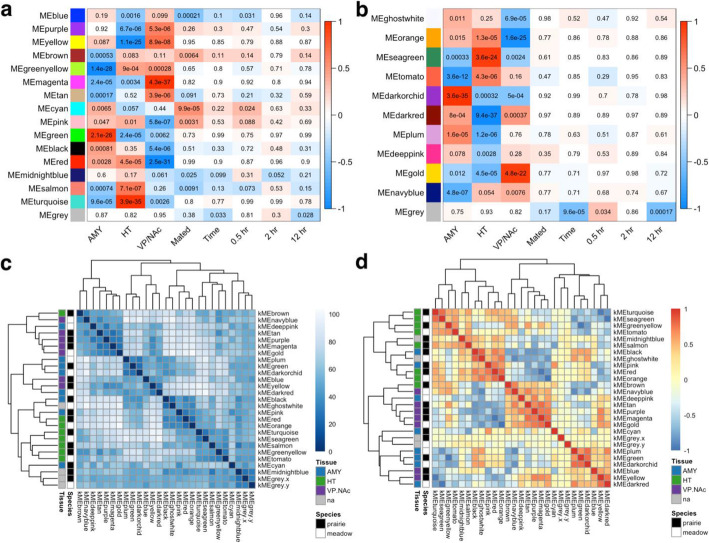
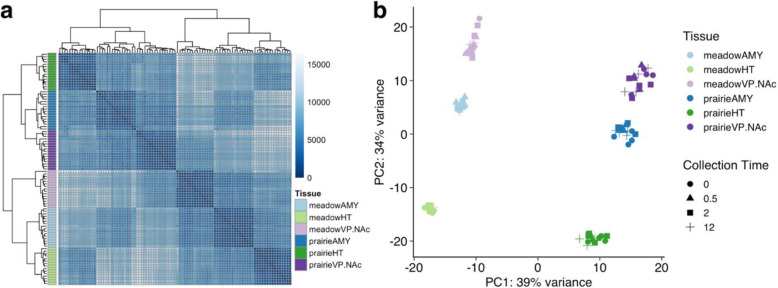
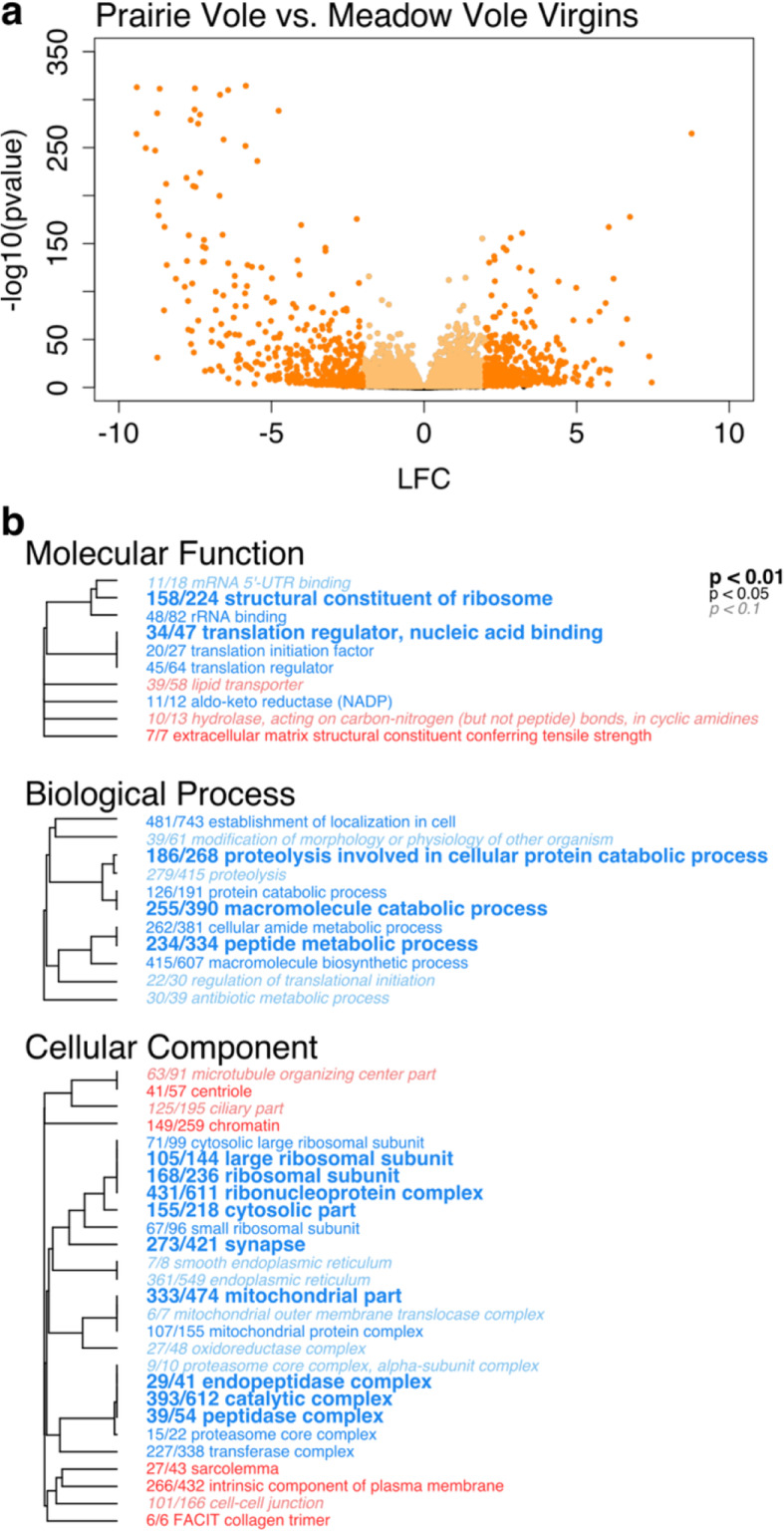
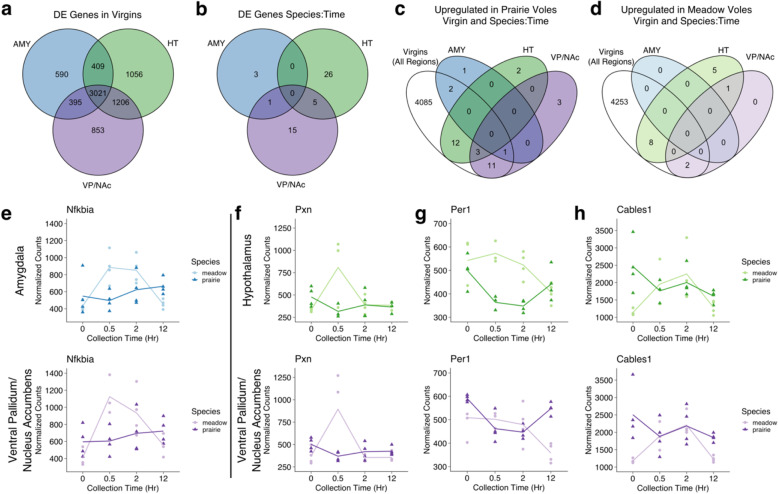
We first identified species and brain region as the factors most strongly associated with gene expression in our samples. Next, we found gene categories related to cell structure, translation, and metabolism that differed in expression across species in virgins, as well as categories associated with cell structure, synaptic and neuroendocrine signaling, and transcription and translation that varied among the focal regions in our study. Additionally, we identified genes that were differentially expressed across species after mating in each of our regions of interest. These include genes involved in regulating transcription, neuron structure, and synaptic plasticity. Finally, we identified modules of co-regulated genes that were strongly correlated with brain region in both species, and modules that were correlated with post-mating time points in prairie voles but not meadow voles.
These results reinforce the importance of pre-mating differences that confer the ability to form pair bonds in prairie voles but not promiscuous species such as meadow voles. Gene ontology analysis supports the hypothesis that pair-bond formation involves transcriptional regulation, and changes in neuronal structure. Together, our results expand knowledge of the genes involved in the pair bonding process and open new avenues of research in the molecular mechanisms of bond formation.
在哺乳动物中,与繁殖伴侣形成配对关系是罕见的,但这是人类社会行为的一个重要特征。几十年来,对一夫一妻制的草原田鼠(Microtus ochrogaster)的研究,以及使用相关的非结合草地田鼠(M. pennsylvanicus)进行的比较研究,揭示了该物种形成配对关系所需的许多神经和分子机制。然而,这些研究主要集中在少数几个神经调制系统上。为了检验这样一种假设,即神经基因表达的差异是形成配对关系的能力差异的基础,我们对三个对形成配对关系和其他社会行为很重要的大脑区域的组织进行了 RNA 测序,这些组织来自于形成配对关系的草原田鼠和非结合草地田鼠。我们在处女鼠和交配后三个时间点检查了杏仁核、下丘脑和腹侧苍白球/伏隔核的基因表达,以了解在基线、对交配的反应和在配对关系形成过程中,物种间基因表达的差异。
我们首先确定了物种和大脑区域是与我们样本中基因表达最密切相关的因素。接下来,我们发现了在处女鼠中,与细胞结构、翻译和代谢相关的基因类别在物种间存在差异,以及与细胞结构、突触和神经内分泌信号、转录和翻译相关的类别在我们研究的焦点区域中存在差异。此外,我们还发现了在每个感兴趣的区域中,在交配后,物种间存在差异表达的基因。这些基因包括参与调节转录、神经元结构和突触可塑性的基因。最后,我们发现了在两个物种中与大脑区域强烈相关的共调控基因模块,以及在草原田鼠中与交配后时间点相关但在草地田鼠中不相关的模块。
这些结果强化了在草原田鼠中形成配对关系的能力的预先交配差异的重要性,而在像草地田鼠这样的滥交物种中则没有这种差异。基因本体论分析支持这样一种假设,即配对关系的形成涉及转录调节和神经元结构的变化。总的来说,我们的研究结果扩展了参与配对关系形成过程的基因的知识,并为形成关系的分子机制的研究开辟了新的途径。