Department of Radiology, Osaka University Graduate School of Medicine, Suita, Osaka, Japan.
Department of Neurosurgery, Osaka University Graduate School of Medicine, Suita, Osaka, Japan.
PLoS One. 2018 Apr 11;13(4):e0195099. doi: 10.1371/journal.pone.0195099. eCollection 2018.
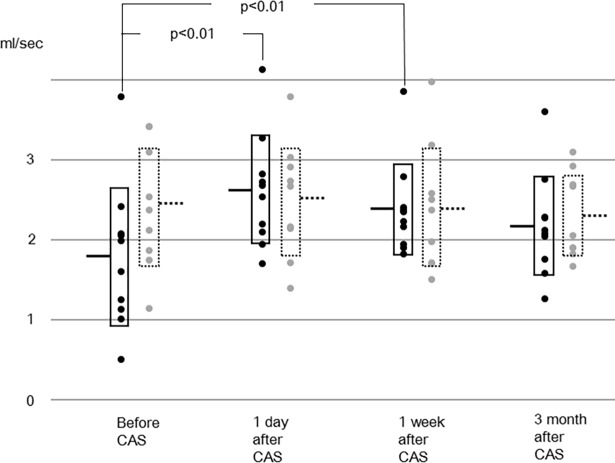
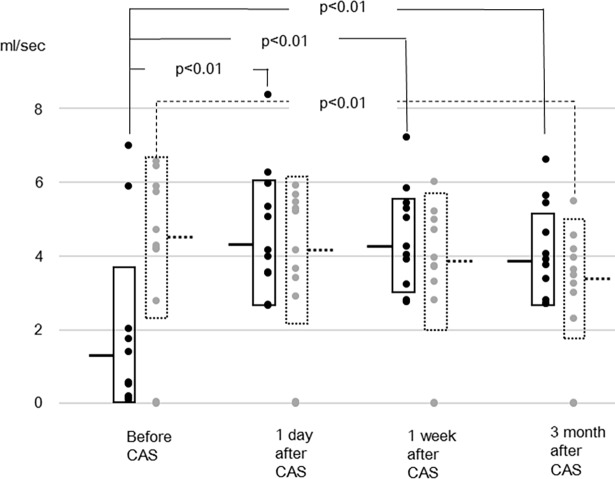
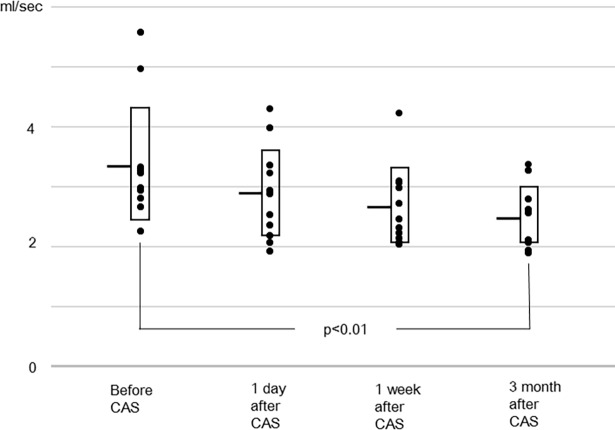
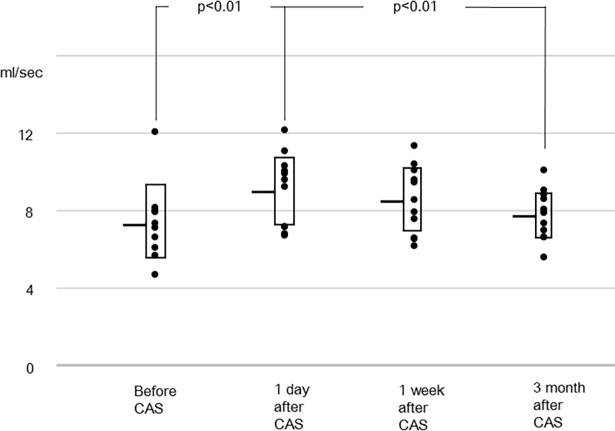
After carotid artery stenting, the procurement of information about blood flow redistribution among brain-feeding arteries and its time trend is essential to understanding a patient's physiological background and to determine their care regimen. Cerebral blood flow has been measured twice following carotid artery stenting in few previous studies, with some discrepancies in the results. The purpose of this study was to measure cerebral blood flow at multiple time points after carotid artery stenting, and to elucidate the time trend of cerebral blood flow and redistribution among arteries. Blood flow rates in 11 subjects were measured preoperatively, at one day, one week, and about three months, respectively after carotid artery stenting by using phase-contrast magnetic resonance imaging. The target vessels were the bilateral internal carotid arteries, the basilar artery, and the bilateral middle cerebral arteries. Lumen was semi-automatically defined using an algorithm utilizing pulsatility. The results showed that blood flow rates in the stented internal carotid artery and the ipsilateral middle cerebral artery increased following carotid artery stenting. Blood flow rates in the contralateral internal carotid artery and the basilar artery gradually declined, and they were lower than the preoperative values at three months after stenting. The sum of blood flow rates of the bilateral internal carotid arteries and the basilar artery increased after carotid artery stenting, and then decreased over the next three months. There was no significant change in the blood flow rate in the contralateral middle cerebral artery. From these results, it was concluded that redistribution among the bilateral internal carotid arteries and the basilar artery occurs after carotid artery stenting, and that it takes months thereafter to reach another equilibrium.
在颈动脉支架置入术后,了解脑供血动脉之间的血流再分布及其时间趋势对于理解患者的生理背景和确定其护理方案至关重要。在之前的一些研究中,仅对颈动脉支架置入术后的少数患者进行了两次脑血流测量,结果存在一些差异。本研究的目的是在颈动脉支架置入术后的多个时间点测量脑血流,并阐明脑血流和动脉再分布的时间趋势。通过相位对比磁共振成像,在术前、术后 1 天、1 周和大约 3 个月时分别测量了 11 名受试者的血流速度。目标血管为双侧颈内动脉、基底动脉和双侧大脑中动脉。使用利用脉动性的算法半自动定义管腔。结果表明,颈动脉支架置入后,支架内颈内动脉和同侧大脑中动脉的血流速度增加。对侧颈内动脉和基底动脉的血流速度逐渐下降,且在支架置入 3 个月后低于术前值。双侧颈内动脉和基底动脉的血流速度总和在颈动脉支架置入后增加,随后在接下来的 3 个月内下降。对侧大脑中动脉的血流速度没有明显变化。从这些结果可以得出结论,颈动脉支架置入后双侧颈内动脉和基底动脉之间发生了再分布,此后需要数月才能达到另一个平衡。