IDACOR, Museo de Antropología, Facultad de Filosofía y Humanidades, CONICET, Universidad Nacional de Córdoba, Córdoba, Argentina.
Instituto de Diversidad y Ecología Animal, CONICET-Universidad Nacional de Córdoba, Córdoba, Argentina.
PLoS One. 2018 Apr 11;13(4):e0194727. doi: 10.1371/journal.pone.0194727. eCollection 2018.
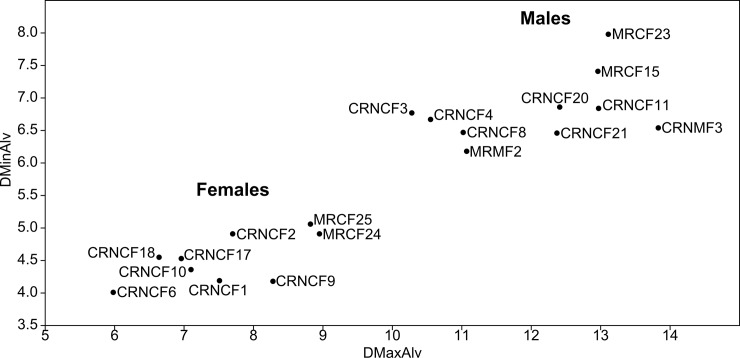
Guanacos (Lama guanicoe) are large ungulates that have been valued by human populations in South America since the Late Pleistocene. Even though they were very abundant until the end of the 19th century (before the high deforestation rate of the last decades), guanacos have nearly disappeared in the Gran Chaco ecoregion, with relicts and isolated populations surviving in some areas, such as the shrubland area near the saline depressions of Córdoba province, Argentina. In this report, we present the first data from a locally endangered guanaco wild population, through the study of skeletal remains recovered in La Providencia ranch. Our results showed that most of the elements belonged to adults aged between 36 and 96 months; sex evaluation showed similar numbers of males and females. Statistical analysis of the body size of modern samples from Córdoba demonstrated that guanacos from the Chaco had large dimensions and presented lower size variability than the modern and archaeological specimens in our database. Moreover, they exhibited dimensions similar to those of modern guanacos from Patagonia and San Juan, and to archaeological specimens from Ongamira and Cerro Colorado, although further genetic studies are needed to corroborate a possible phylogenetic relationship. Finally, we used archaeozoological techniques to provide a first characterization of a relict guanaco population from the Chaco ecoregion, demonstrating its value to the study of modern skeletal remains and species conservation biology.
原驼(Lama guanicoe)是一种大型有蹄类动物,自更新世晚期以来,一直受到南美洲人类群体的重视。尽管它们在 19 世纪末(在过去几十年的森林砍伐高峰期之前)非常丰富,但在格兰查科生态区,原驼已经几乎消失,在阿根廷科尔多瓦省的盐沼附近的灌木林地等一些地区,仍有残余和孤立的种群生存。在本报告中,我们通过研究在拉普罗维登西亚牧场回收的骨骼遗骸,首次提供了当地濒危原驼野生种群的数据。我们的结果表明,大多数元素属于 36 至 96 个月大的成年个体;性别评估显示雄性和雌性数量相似。对科尔多瓦现代样本的体型进行的统计分析表明,查科地区的原驼体型较大,与我们数据库中的现代和考古标本相比,尺寸变异性较低。此外,它们的尺寸与来自巴塔哥尼亚和圣胡安的现代原驼以及昂加米拉和科罗拉多山的考古标本相似,尽管需要进一步的遗传研究来证实可能的系统发育关系。最后,我们使用考古动物学技术对查科生态区的一个残余原驼种群进行了首次特征描述,证明了它对现代骨骼遗骸和物种保护生物学研究的价值。