Dias Flávia da Silva Lima, Lima Mário Ferreira, Velasco Patricia Coelho de, Salles-Costa Rosana, Sardinha Fátima Lúcia de Carvalho, Carmo Maria das Graças Tavares do
Universidade Federal do Rio de Janeiro. Instituto de Nutrição Josué de Castro. Laboratório de Bioquímica Nutricional. Rio de Janeiro, RJ, Brasil.
Universidade Federal do Rio de Janeiro. Instituto de Nutrição Josué de Castro. Departamento de Nutrição Social e Aplicada. Rio de Janeiro, RJ, Brasil.
Rev Saude Publica. 2018 Apr 9;52:34. doi: 10.11606/S1518-8787.2018052000292.
To determine the trans fatty acids content of processed foods frequently consumed by adults living in a Rio de Janeiro, Brazil, after the enactment of a mandatory trans fatty acids labelling policy.
Between February 2014 and January 2015, a specifically dietary questionnaire was completed by 107 adults to assess the frequency of processed foods consumption. The most commonly consumed products from the survey, including vegetable oils, margarine, biscuits, snacks, cheese bread (pão de queijo), french fries, cheeseburger and ice cream, were then analyzed for their trans fatty acids content using gas chromatography with a flame ionization detector.
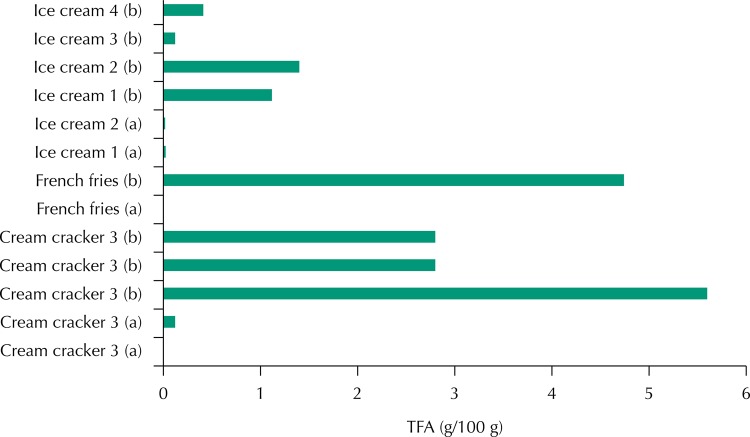
Differences in the levels of trans fatty acids were observed among 22 products analyzed, considering that trans fatty acids content ranged between 0.0 g/100 g in samples of cream cracker biscuit 1 and olive oil to 0.83 g/100 g in samples of cheeseburger (fast food), 0.51 g/100 g in samples of frozen pão de queijo and 12.92 g/100 g in samples of chocolate sandwich cookies with cream filling 2. The overall trans fatty acids content of the different samples of margarine brands was 0.20 g/100 g for brand 1 and 0.0 g/100 g for brand 2. These data are significantly lower than those observed in a survey conducted in 2003, when the regulation had been enacted.
Our data indicate that Brazilian regulation is very likely implicated in the observed drop in trans fatty acids of the most processed foods but has yet to eliminate them, which reinforces the urgent need to revise the legislation, since a minimum amount of trans fat does not mean that the food product does not contain this type of fat.
在巴西里约热内卢实施强制性反式脂肪酸标签政策后,测定当地成年人经常食用的加工食品中的反式脂肪酸含量。
2014年2月至2015年1月期间,107名成年人填写了一份专门的饮食问卷,以评估加工食品的消费频率。然后,使用带有火焰离子化检测器的气相色谱法对调查中最常食用的产品进行分析,这些产品包括植物油、人造黄油、饼干、零食、奶酪面包(pão de queijo)、薯条、芝士汉堡和冰淇淋,以测定其反式脂肪酸含量。
在所分析的22种产品中,反式脂肪酸含量存在差异,奶油薄脆饼干1和橄榄油样品中的反式脂肪酸含量为0.0克/100克,芝士汉堡(快餐)样品中的含量为0.83克/100克,冷冻奶酪面包样品中的含量为0.51克/100克,含奶油夹心的巧克力夹心饼干2样品中的含量为12.92克/100克。不同品牌人造黄油样品的总体反式脂肪酸含量,品牌1为0.20克/100克,品牌2为0.0克/100克。这些数据显著低于2003年实施该法规时的一项调查中所观察到的数据。
我们的数据表明,巴西的法规很可能与观察到的大多数加工食品中反式脂肪酸含量下降有关,但尚未消除这些反式脂肪酸,这强化了修订立法的迫切需要,因为反式脂肪含量最低并不意味着食品不含此类脂肪。