Department of Human Functional Genomics, Advanced Science Research Promotion Center, Mie University, 1577 Kurimamachiya, Tsu 514-8507, Japan.
Department of Environmental and Preventive Medicine, School of Medicine, Jichi Medical University, 3311-1, Yakushiji, Shimotsuke 329-0498, Japan.
Int J Mol Sci. 2018 Apr 6;19(4):1097. doi: 10.3390/ijms19041097.
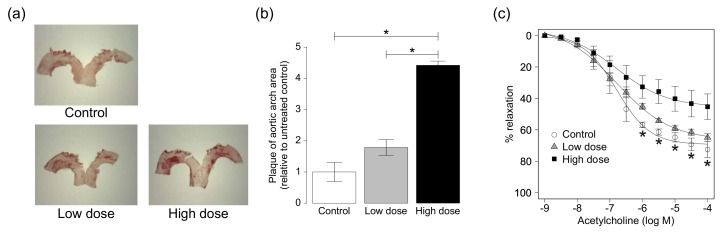
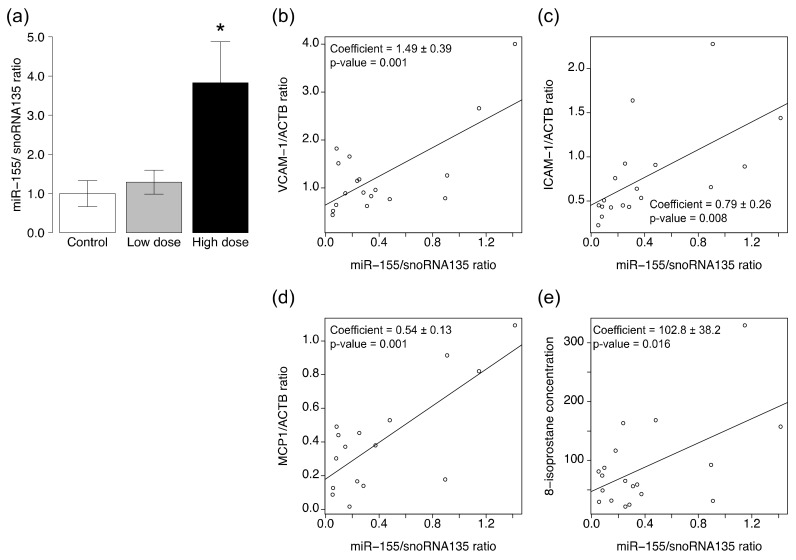
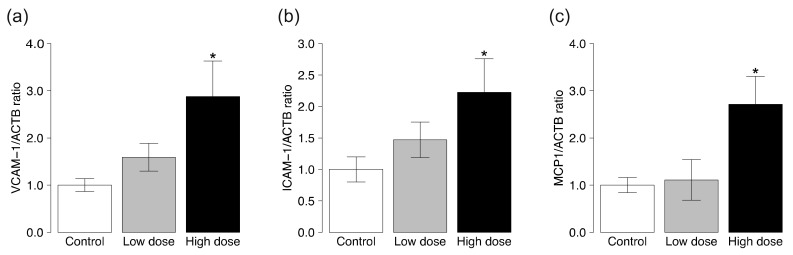
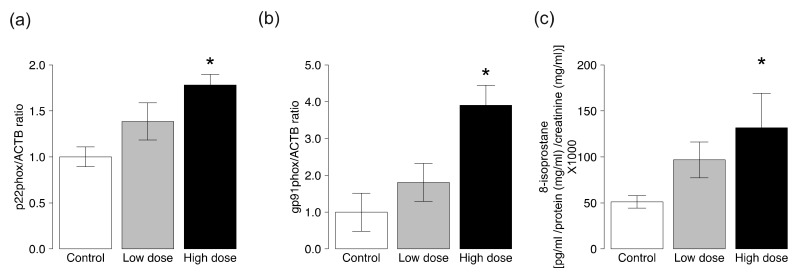
Smoking increases the risk of atherosclerosis-related events, such as myocardial infarction and ischemic stroke. Recent studies have examined the expression levels of altered microRNAs (miRNAs) in various diseases. The profiles of tissue miRNAs can be potentially used in diagnosis or prognosis. However, there are limited studies on miRNAs following exposure to cigarette smoke (CS). The present study was designed to dissect the effects and cellular/molecular mechanisms of CS-induced atherosclerogenesis. Apolipoprotein E knockout (ApoE KO) mice were exposed to CS for five days a week for two months at low (two puffs/min for 40 min/day) or high dose (two puffs/min for 120 min/day). We measured the area of atherosclerotic plaques in the aorta, representing the expression of miRNAs after the exposure period. Two-month exposure to the high dose of CS significantly increased the plaque area in aortic arch, and significantly upregulated the expression of atherosclerotic markers (, , , , and ). Exposure to the high dose of CS also significantly upregulated the miRNA-155 level in the aortic tissues of ApoE KO mice. Moreover, the expression level of miR-126 tended to be downregulated and that of miR-21 tended to be upregulated in ApoE KO mice exposed to the high dose of CS, albeit statistically insignificant. The results suggest that CS induces atherosclerosis through increased vascular inflammation and NADPH oxidase expression and also emphasize the importance of miRNAs in the pathogenesis of CS-induced atherosclerosis. Our findings provide evidence for miRNAs as potential mediators of inflammation and atherosclerosis induced by CS.
吸烟会增加与动脉粥样硬化相关的事件的风险,如心肌梗死和缺血性中风。最近的研究已经检查了各种疾病中改变的 microRNAs (miRNAs) 的表达水平。组织 miRNAs 的特征可能在诊断或预后中得到应用。然而,关于吸烟暴露后 miRNAs 的研究有限。本研究旨在剖析吸烟引起的动脉粥样硬化形成的作用和细胞/分子机制。载脂蛋白 E 敲除 (ApoE KO) 小鼠每周接受 5 天的吸烟暴露,每天两次,每次 40 分钟,低剂量(2 口/min)或每天两次,每次 120 分钟,高剂量(2 口/min)。我们测量了主动脉中动脉粥样硬化斑块的面积,代表暴露期后 miRNA 的表达。两个月的高剂量 CS 暴露显著增加了主动脉弓的斑块面积,并显著上调了动脉粥样硬化标志物(、、、、和)的表达。高剂量 CS 暴露还显著上调了 ApoE KO 小鼠主动脉组织中 miRNA-155 的水平。此外,在暴露于高剂量 CS 的 ApoE KO 小鼠中,miR-126 的表达水平趋于下调,miR-21 的表达水平趋于上调,但统计学上无显著意义。这些结果表明,CS 通过增加血管炎症和 NADPH 氧化酶表达诱导动脉粥样硬化,并且强调了 miRNA 在 CS 诱导的动脉粥样硬化发病机制中的重要性。我们的发现为 miRNA 作为 CS 诱导的炎症和动脉粥样硬化的潜在介质提供了证据。