Kisekka Victoria, Giboney Justin Scott
Information Security and Digital Forensics, School of Business, University at Albany, State University of New York, Albany, NY, United States.
Information Technology Department, Brigham Young University, Provo, UT, United States.
J Med Internet Res. 2018 Apr 11;20(4):e107. doi: 10.2196/jmir.9014.
The diffusion of health information technologies (HITs) within the health care sector continues to grow. However, there is no theory explaining how success of HITs influences patient care outcomes. With the increase in data breaches, HITs' success now hinges on the effectiveness of data protection solutions. Still, empirical research has only addressed privacy concerns, with little regard for other factors of information assurance.
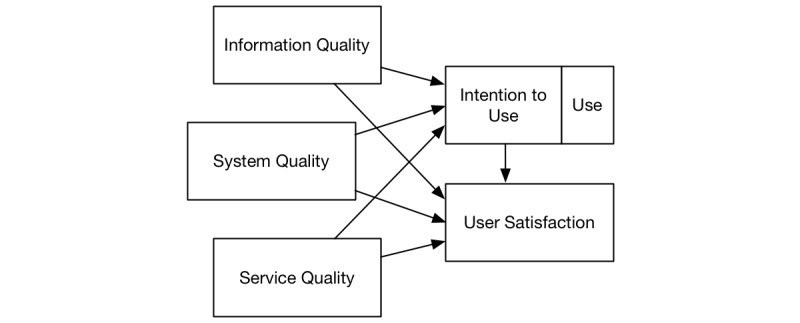
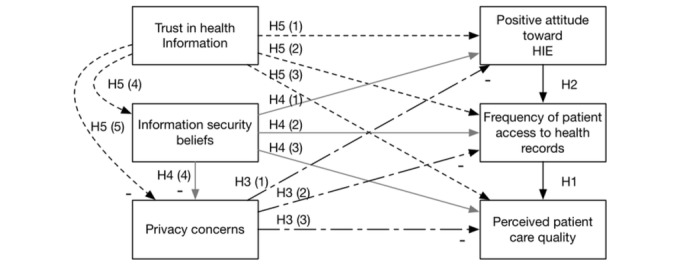
The objective of this study was to study the effectiveness of HITs using the DeLone and McLean Information Systems Success Model (DMISSM). We examined the role of information assurance constructs (ie, the role of information security beliefs, privacy concerns, and trust in health information) as measures of HIT effectiveness. We also investigated the relationships between information assurance and three aspects of system success: attitude toward health information exchange (HIE), patient access to health records, and perceived patient care quality.
Using structural equation modeling, we analyzed the data from a sample of 3677 cancer patients from a public dataset. We used R software (R Project for Statistical Computing) and the Lavaan package to test the hypothesized relationships.
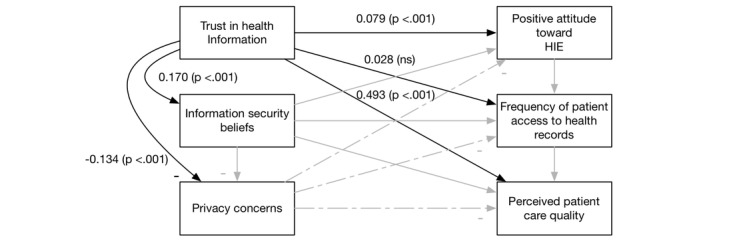
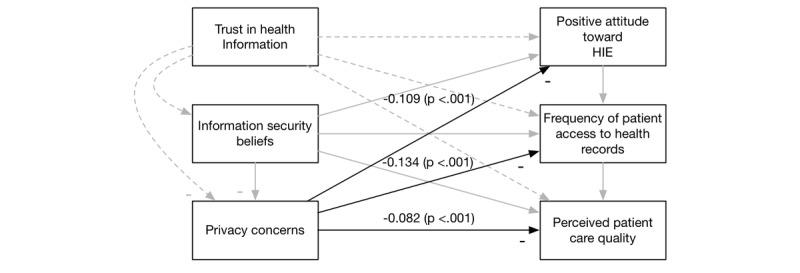
Our extension of the DMISSM to health care was supported. We found that increased privacy concerns reduce the frequency of patient access to health records use, positive attitudes toward HIE, and perceptions of patient care quality. Also, belief in the effectiveness of information security increases the frequency of patient access to health records and positive attitude toward HIE. Trust in health information had a positive association with attitudes toward HIE and perceived patient care quality. Trust in health information had no direct effect on patient access to health records; however, it had an indirect relationship through privacy concerns.
Trust in health information and belief in the effectiveness of information security safeguards increases perceptions of patient care quality. Privacy concerns reduce patients' frequency of accessing health records, patients' positive attitudes toward HIE exchange, and overall perceived patient care quality. Health care organizations are encouraged to implement security safeguards to increase trust, the frequency of health record use, and reduce privacy concerns, consequently increasing patient care quality.
卫生信息技术(HITs)在医疗保健领域的传播仍在持续增长。然而,尚无理论解释HITs的成功如何影响患者护理结果。随着数据泄露事件的增加,HITs的成功现在取决于数据保护解决方案的有效性。尽管如此,实证研究仅关注隐私问题,很少考虑信息保障的其他因素。
本研究的目的是使用DeLone和McLean信息系统成功模型(DMISSM)来研究HITs的有效性。我们考察了信息保障构念的作用(即信息安全信念、隐私担忧以及对健康信息的信任的作用),将其作为HIT有效性的衡量指标。我们还研究了信息保障与系统成功的三个方面之间的关系:对健康信息交换(HIE)的态度、患者对健康记录的访问以及感知到的患者护理质量。
我们使用结构方程模型,分析了来自一个公共数据集的3677名癌症患者样本的数据。我们使用R软件(R统计计算项目)和Lavaan软件包来检验假设的关系。
我们将DMISSM扩展到医疗保健领域的做法得到了支持。我们发现,隐私担忧的增加会降低患者访问健康记录的频率、对HIE的积极态度以及对患者护理质量的感知。此外,对信息安全有效性的信念会增加患者访问健康记录的频率以及对HIE的积极态度。对健康信息的信任与对HIE的态度以及感知到的患者护理质量呈正相关。对健康信息的信任对患者访问健康记录没有直接影响;然而,它通过隐私担忧产生间接关系。
对健康信息的信任以及对信息安全保障有效性的信念会增加对患者护理质量的感知。隐私担忧会降低患者访问健康记录的频率、患者对HIE交换的积极态度以及总体感知到的患者护理质量。鼓励医疗保健机构实施安全保障措施,以增强信任、提高健康记录的使用频率并减少隐私担忧,从而提高患者护理质量。