Institute of Physics, Chinese Academy of Sciences, 100190, Beijing, China.
University of Chinese Academy of Sciences, 100049, Beijing, China.
Nat Commun. 2018 Apr 11;9(1):1389. doi: 10.1038/s41467-018-03656-4.
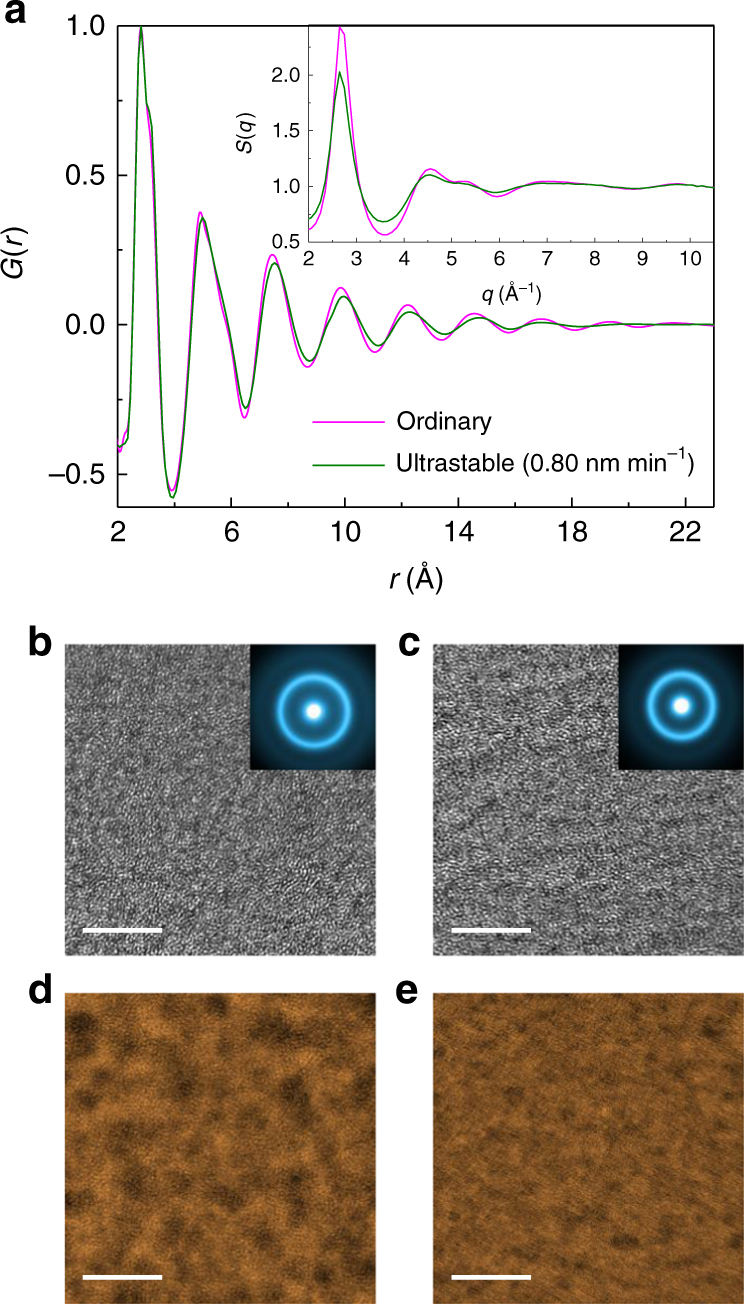
Vitrification from physical vapor deposition is known to be an efficient way for tuning the kinetic and thermodynamic stability of glasses and significantly improve their properties. There is a general consensus that preparing stable glasses requires the use of high substrate temperatures close to the glass transition one, T. Here, we challenge this empirical rule by showing the formation of Zr-based ultrastable metallic glasses (MGs) at room temperature, i.e., with a substrate temperature of only 0.43T. By carefully controlling the deposition rate, we can improve the stability of the obtained glasses to higher values. In contrast to conventional quenched glasses, the ultrastable MGs exhibit a large increase of T of ∼60 K, stronger resistance against crystallization, and more homogeneous structure with less order at longer distances. Our study circumvents the limitation of substrate temperature for developing ultrastable glasses, and provides deeper insight into glasses stability and their surface dynamics.
从物理气相沉积中进行的玻璃化转变被认为是一种有效调节玻璃动力学和热力学稳定性并显著改善其性能的方法。人们普遍认为,制备稳定的玻璃需要使用接近玻璃转变温度 T 的高衬底温度。在这里,我们通过证明在室温下(即衬底温度仅为 0.43T)形成基于 Zr 的超稳定金属玻璃(MG)来挑战这一经验法则。通过仔细控制沉积速率,我们可以提高获得的玻璃的稳定性到更高的值。与传统的淬火玻璃相比,超稳定的 MGs 表现出 T 增加约 60K,对结晶的抵抗力更强,以及更长距离上结构更均匀、有序性更低。我们的研究规避了开发超稳定玻璃对衬底温度的限制,并提供了对玻璃稳定性及其表面动力学的更深入了解。