Bitirgen Gulfidan, Tinkir Kayitmazbatir Emine, Satirtav Gunhal, Malik Rayaz A, Ozkagnici Ahmet
Department of Ophthalmology, Meram Faculty of Medicine, Necmettin Erbakan University, Konya, Turkey.
Department of Ophthalmology, Sorgun State Hospital, Yozgat, Turkey.
Front Neurol. 2018 Mar 28;9:204. doi: 10.3389/fneur.2018.00204. eCollection 2018.
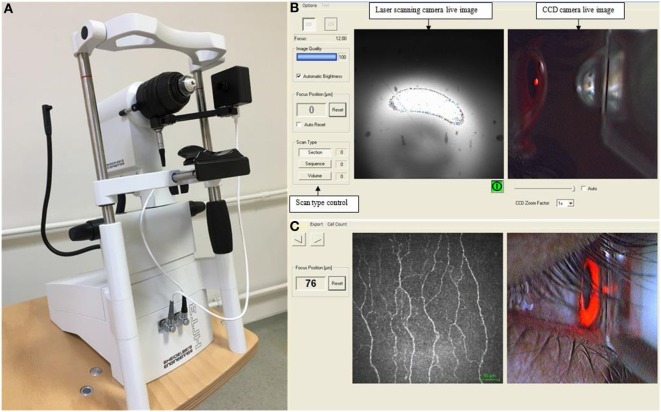
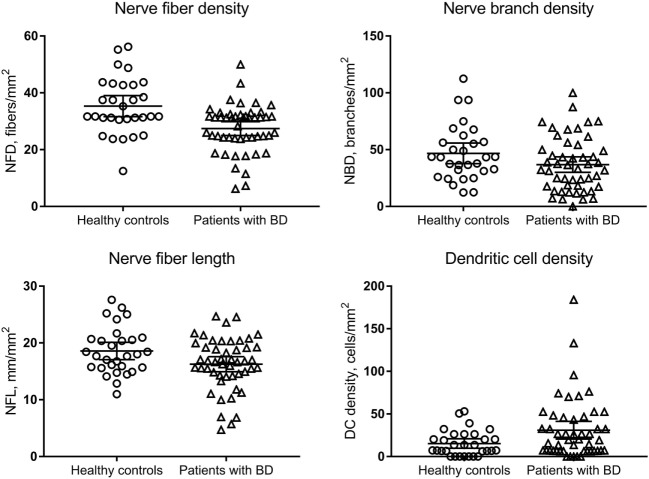
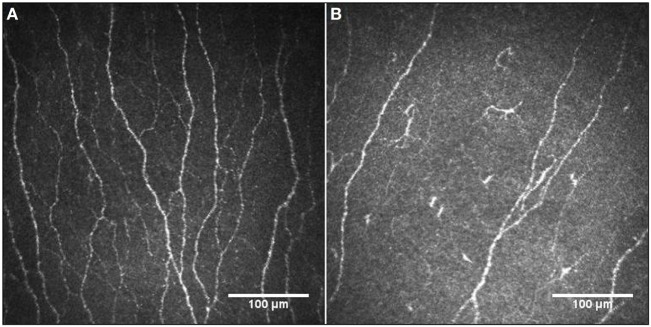
Central and peripheral nervous system involvement may occur during the course of Behçet's disease (BD). corneal confocal microscopy (CCM) can detect corneal small fiber damage and immune cell density. The aim of this study was to assess central corneal sensitivity, corneal subepithelial nerve plexus morphology and dendritic cell (DC) density in patients with BD. Forty-nine consecutive patients with BD and 30 healthy control subjects were included in this cross-sectional study conducted at a tertiary referral university hospital. Central corneal sensitivity was measured using the contact corneal esthesiometer (Cochet-Bonnet; Luneau, France). The laser scanning CCM (Heidelberg, Germany) was used to quantify corneal nerve fiber density (NFD), nerve branch density (NBD), nerve fiber length (NFL), and DC density. There was a significant reduction in NFD ( = 0.001) and NFL ( = 0.031) and an increase in DC density ( = 0.038) in patients with BD compared to healthy controls, whereas corneal sensitivity ( = 0.066) and NBD ( = 0.067) did not differ significantly. There was no difference in corneal sensitivity, corneal nerve parameters, or DC density between BD patients with [ = 18 (36.7%)] and without a previous history of uveitis ( > 0.05 for all). Disease duration [median (IQR), 6.5 (4.0-14.5) years] correlated with corneal sensitivity (ρ = -0.463; = 0.001) and NFD (ρ = -0.304; = 0.034) and corneal sensitivity correlated with NFD (ρ = 0.411; = 0.003) and NFL (ρ = 0.295; = 0.039) in patients with BD. CCM demonstrates corneal sub-basal nerve fiber loss and increased DC density, providing a non-invasive ophthalmic means to identify peripheral neuropathy and inflammation in patients with BD.
白塞病(BD)病程中可能会出现中枢和周围神经系统受累。角膜共焦显微镜检查(CCM)可检测角膜小纤维损伤和免疫细胞密度。本研究旨在评估BD患者的中央角膜敏感性、角膜上皮下神经丛形态和树突状细胞(DC)密度。在一所三级转诊大学医院进行的这项横断面研究中,纳入了49例连续的BD患者和30名健康对照者。使用接触式角膜感觉计(Cochet-Bonnet;法国吕诺)测量中央角膜敏感性。使用激光扫描CCM(德国海德堡)量化角膜神经纤维密度(NFD)、神经分支密度(NBD)、神经纤维长度(NFL)和DC密度。与健康对照相比,BD患者的NFD(P = 0.001)和NFL(P = 0.031)显著降低,DC密度增加(P = 0.038),而角膜敏感性(P = 0.066)和NBD(P = 0.067)无显著差异。有葡萄膜炎既往史的BD患者[18例(36.7%)]与无葡萄膜炎既往史的BD患者在角膜敏感性、角膜神经参数或DC密度方面无差异(所有P均>0.05)。病程[中位数(四分位间距),6.5(4.0 - 14.5)年]与BD患者的角膜敏感性(ρ = -0.463;P = 0.001)和NFD(ρ = -0.304;P = 0.034)相关,且角膜敏感性与BD患者的NFD(ρ = 0.411;P = 0.003)和NFL(ρ = 0.295;P = 0.039)相关。CCM显示角膜基底膜下神经纤维丢失和DC密度增加,为识别BD患者的周围神经病变和炎症提供了一种非侵入性眼科手段。