Lorente-Sorolla José, Truchado-Garcia Marta, Perry Kimberly J, Henry Jonathan Q, Grande Cristina
1Departamento de Biología Molecular and Centro de Biología Molecular "Severo Ochoa", Consejo Superior de Investigaciones Científicas, Universidad Autónoma de Madrid, Madrid, Spain.
2Present Address: Departamento de Biología, Facultad de Ciencias, Universidad Autónoma de Madrid, Madrid, Spain.
Evodevo. 2018 Apr 10;9:9. doi: 10.1186/s13227-018-0096-z. eCollection 2018.
Sall (Spalt-like) proteins are zinc-finger transcription factors involved in a number of biological processes. They have only been studied in a few model organisms, such as , , and some vertebrates. Further taxon sampling is critical to understand the evolution and diversification of this protein and its functional roles in animals.
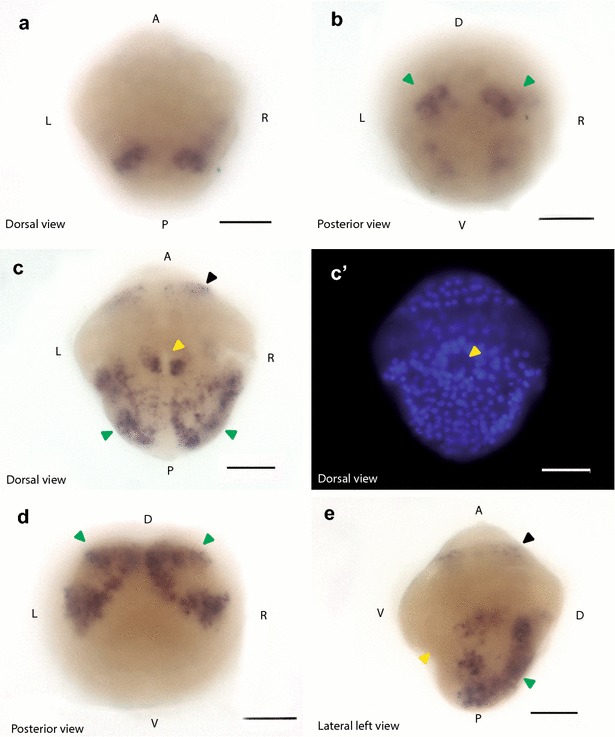
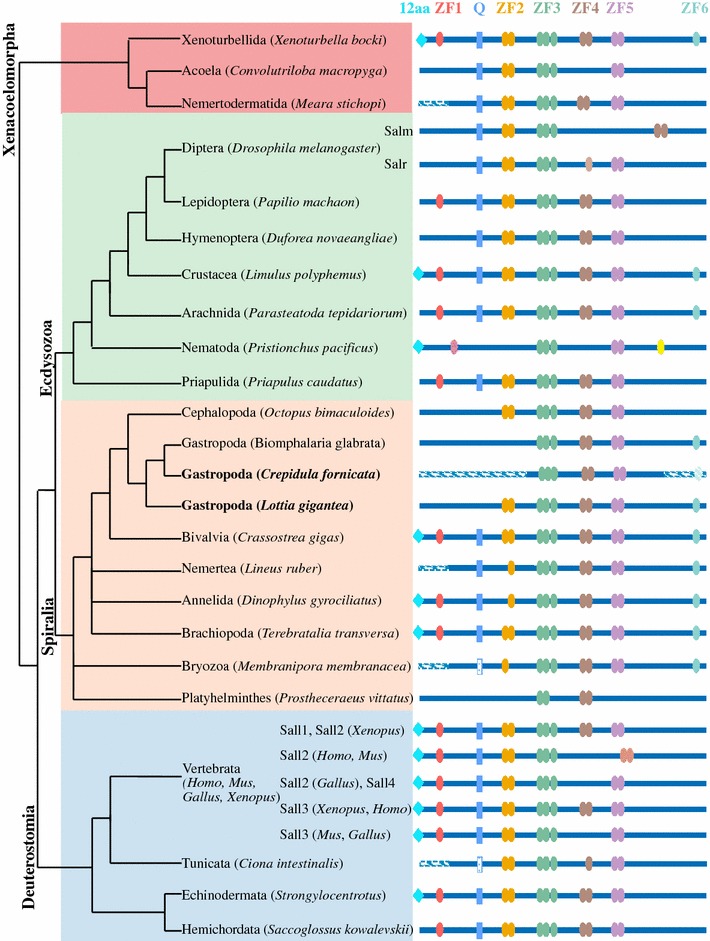
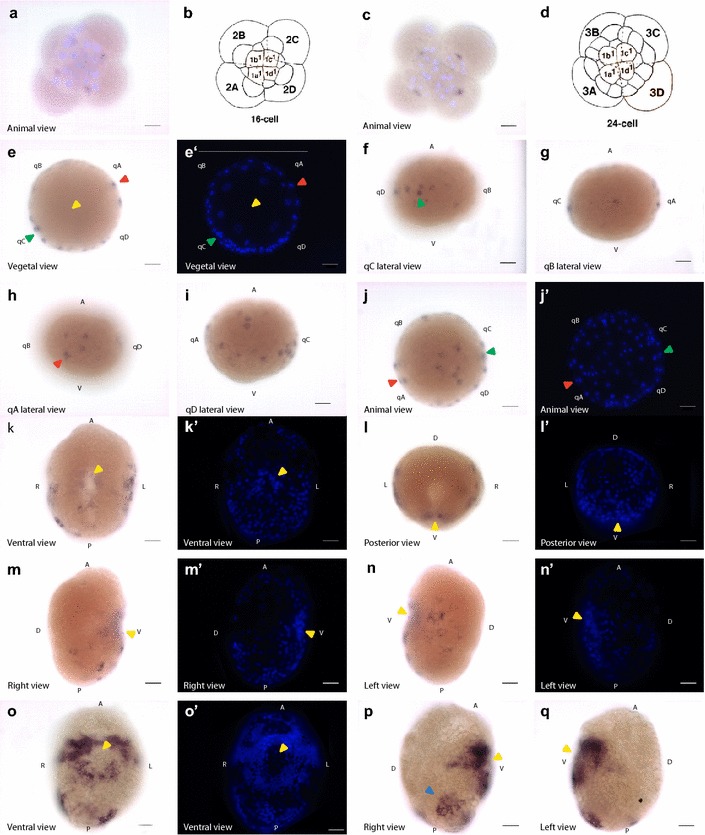
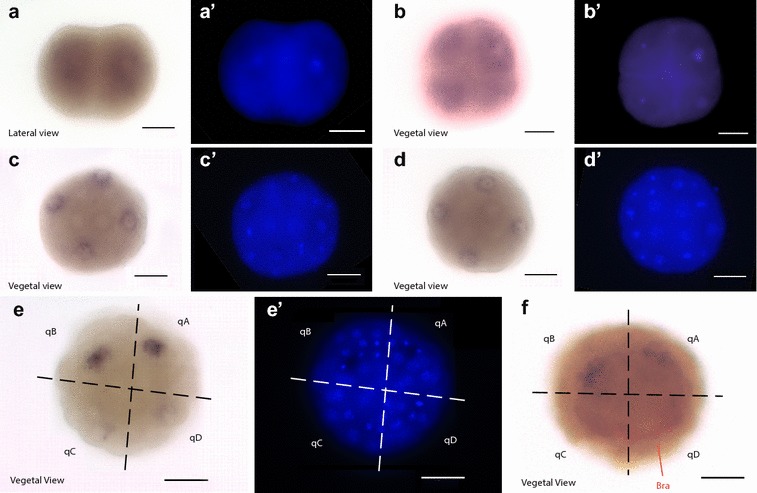
Using genome and transcriptome mining, we confirmed the presence of genes in a range of additional animal taxa, for which their presence had not yet been described. We show that genes are broadly conserved across the Bilateria, and likely appeared in the bilaterian stem lineage. Our analysis of the protein domains shows that the characteristic arrangement of the multiple zinc-finger domains is conserved in bilaterians and may represent the ancient arrangement of this family of transcription factors. We also show the existence of a previously unknown zinc-finger domain. In situ hybridization was used to describe the gene expression patterns in embryonic and larval stages in two species of snails: and . In , presents maternal expression, although later on the expression is restricted to the A and B quadrants during gastrulation and larval stage. In , has no maternal expression and it is expressed mainly in the A, C and D quadrants during blastula stages and in an asymmetric fashion during the larval stage.
Our results suggest that the bilaterian common ancestor had a Sall protein with at least six zinc-finger domains. The evolution of Sall proteins in bilaterians might have occurred mostly as a result of the loss of protein domains and gene duplications leading to diversification. The new evidence complements previous studies in highlighting an important role of Sall proteins in bilaterian development. Our results show maternal expression of in the snail , but not . The asymmetric expression shown in the ectoderm of the trochophore larva of snails is probably related to shell/mantle development. The observed expression in cephalic tissue in snails and some other bilaterians suggests a possible ancestral role of in neural development in bilaterians.
Sall(类Spalt)蛋白是参与多种生物学过程的锌指转录因子。它们仅在少数模式生物中得到研究,如[此处原文缺失具体模式生物名称]、[此处原文缺失具体模式生物名称]、[此处原文缺失具体模式生物名称]以及一些脊椎动物。进一步的分类群抽样对于理解该蛋白的进化、多样化及其在动物中的功能作用至关重要。
通过基因组和转录组挖掘,我们在一系列其他动物分类群中证实了[此处原文缺失具体基因名称]基因的存在,此前这些分类群中该基因的存在尚未被描述。我们表明,[此处原文缺失具体基因名称]基因在两侧对称动物中广泛保守,并且可能出现在两侧对称动物的干群中。我们对蛋白质结构域的分析表明,多个锌指结构域的特征性排列在两侧对称动物中是保守的,并且可能代表了这个转录因子家族的古老排列。我们还展示了一个先前未知的锌指结构域的存在。原位杂交被用于描述两种蜗牛([此处原文缺失具体蜗牛物种名称1]和[此处原文缺失具体蜗牛物种名称2])胚胎和幼虫阶段的基因表达模式。在[此处原文缺失具体蜗牛物种名称1]中,[此处原文缺失具体基因名称]呈现母源表达,尽管后来在原肠胚形成和幼虫阶段表达局限于A和B象限。在[此处原文缺失具体蜗牛物种名称2]中,[此处原文缺失具体基因名称]没有母源表达,并且在囊胚阶段主要在A、C和D象限表达,在幼虫阶段以不对称方式表达。
我们的结果表明,两侧对称动物的共同祖先拥有一种至少具有六个锌指结构域的Sall蛋白。两侧对称动物中Sall蛋白的进化可能主要是由于蛋白质结构域的丢失和导致多样化的基因复制。这些新证据补充了先前的研究,突出了Sall蛋白在两侧对称动物发育中的重要作用。我们的结果显示[此处原文缺失具体基因名称]在蜗牛[此处原文缺失具体蜗牛物种名称1]中有母源表达,但在[此处原文缺失具体蜗牛物种名称2]中没有。蜗牛担轮幼虫外胚层中显示的不对称表达可能与贝壳/外套膜发育有关。在蜗牛和其他一些两侧对称动物的头部组织中观察到的[此处原文缺失具体基因名称]表达表明,[此处原文缺失具体基因名称]在两侧对称动物神经发育中可能具有祖先作用。