Caravaca-Fontán Fernando, Azevedo Lilia, Luna Enrique, Caravaca Francisco
Nephrology Department, Hospital Infanta Cristina, Badajoz, Spain.
Clin Kidney J. 2018 Apr;11(2):246-253. doi: 10.1093/ckj/sfx083. Epub 2017 Jul 28.
At later stages of chronic kidney disease (CKD), a pattern of linear and irreversible renal function decline is thought to be the most common. The objective of this study was to describe the characteristics of the different patterns of CKD progression, and to investigate potentially modifiable factors associated with the rate of decline of renal function.
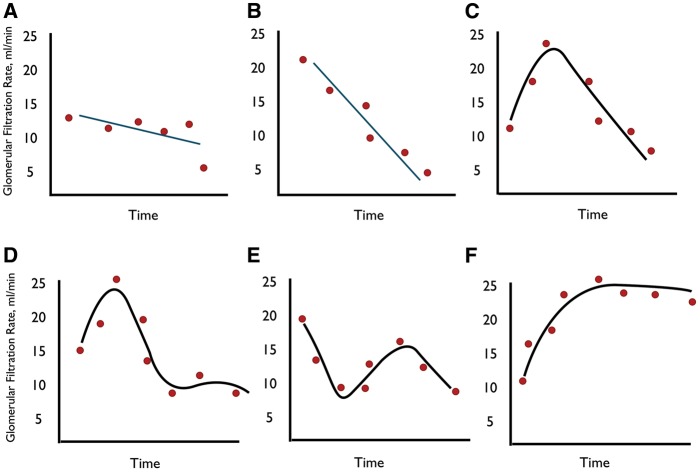
This was a retrospective, observational study in a cohort of adult patients with CKD Stage 4 or 5 not on dialysis. Decline in renal function was estimated as the slope of the individual linear regression line of estimated glomerular filtration rate (eGFR) over time. The following patterns of CKD progression were considered: unidentifiable, linear, nonlinear (curvilinear) and positive (improvement of renal function).
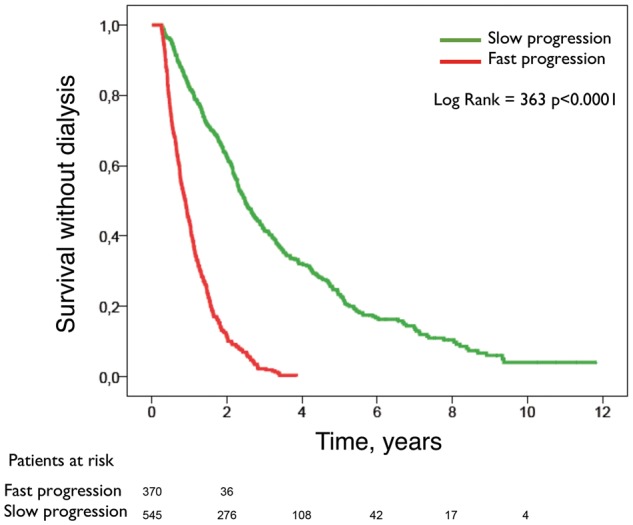
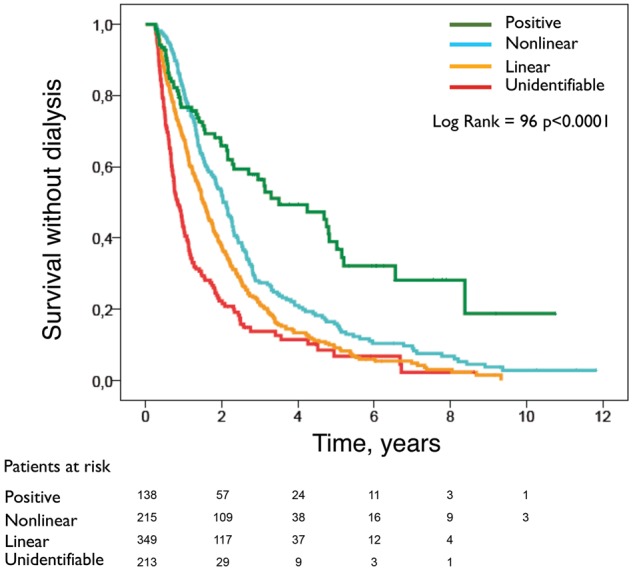
The study group consisted of 915 patients (mean ±SD age 65 ± 14 years, 48% females, median follow-up time 16 months). A linear pattern was observed in 38%, unidentifiable in 23%, nonlinear in 24% and positive in 15% of the study patients. The mean eGFR slope was: -3.35 ± 4.45 mL/min/year. Linear and unidentifiable patterns were associated with more rapid loss of renal function. By multiple linear and logistic regression analysis, the magnitude of proteinuria, the systolic blood pressure and the treatment with dual renin-angiotensin system blockade were associated with more rapid CKD progression. On the contrary, older age and discontinuation of commonly prescribed medication with potential influence on renal function or eGFR measurements were associated with slower CKD progression.
A majority of patients with advanced CKD show patterns of renal function decline different from linear, and several of the main determinants of CKD progression are potentially modifiable.
在慢性肾脏病(CKD)的后期阶段,线性且不可逆的肾功能下降模式被认为是最常见的。本研究的目的是描述CKD进展的不同模式的特征,并调查与肾功能下降速率相关的潜在可改变因素。
这是一项对未接受透析的CKD 4期或5期成年患者队列进行的回顾性观察研究。肾功能下降以估算肾小球滤过率(eGFR)随时间的个体线性回归线斜率来估计。考虑了以下CKD进展模式:无法识别、线性、非线性(曲线)和正向(肾功能改善)。
研究组由915名患者组成(平均±标准差年龄65±14岁,48%为女性,中位随访时间16个月)。在38%的研究患者中观察到线性模式,23%为无法识别模式,24%为非线性模式,15%为正向模式。平均eGFR斜率为:-3.35±4.45 mL/(min·年)。线性和无法识别模式与肾功能更快丧失相关。通过多元线性和逻辑回归分析,蛋白尿程度、收缩压以及双重肾素-血管紧张素系统阻断治疗与更快的CKD进展相关。相反,年龄较大以及停用对肾功能或eGFR测量有潜在影响的常用药物与较慢的CKD进展相关。
大多数晚期CKD患者的肾功能下降模式并非线性,且CKD进展的几个主要决定因素是潜在可改变的。