Department of Psychiatry, Amsterdam Public Health Research Institute, VU University Medical Center, Oudenaller 1, 1081 HJ, Amsterdam, The Netherlands.
Department of Public Health, Amsterdam Public Health research institute, Academic Medical Center, Amsterdam, The Netherlands.
Soc Psychiatry Psychiatr Epidemiol. 2018 Jun;53(6):629-638. doi: 10.1007/s00127-018-1512-3. Epub 2018 Apr 11.
To examine the association between obesity and depressed mood in a large multi-ethnic population and check for consistency in this association across six ethnic groups.
Data of 21,030 persons (18-70 years) were sourced from the HELIUS study. Cross-sectional relationships between obesity measures [body mass index (kg/m) and waist circumference (cm)] and depressed mood (PHQ-9 score ≥ 10) were analysed. Consistency of associations was investigated across ethnic groups by interaction terms (ethnicity*obesity measures) in basic (age, sex, education) and fully (health behaviours and somatic health) adjusted models.
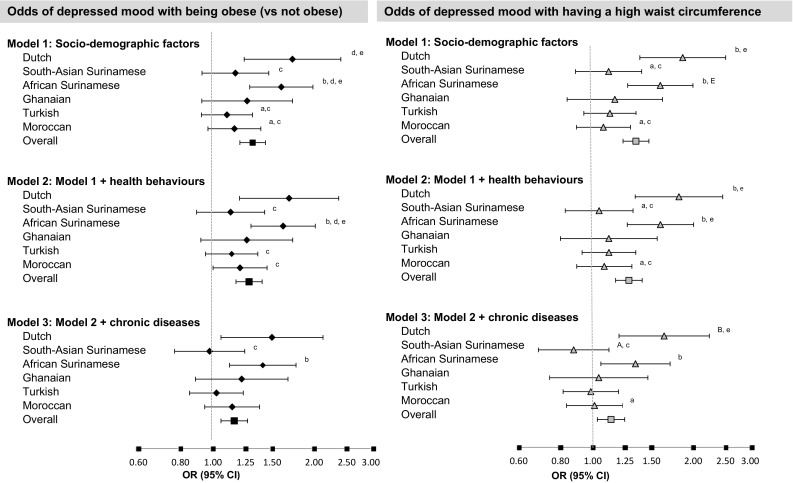
Obesity was prevalent in all ethnic groups, but varied substantially. After sociodemographic adjustment, obesity measures were associated with increased odds of depressed mood but this was inconsistent across ethnic groups. Obesity (BMI ≥ 30 or highest waist circumference quartile) was strongly and significantly associated with depressed mood in the Dutch [Odds Ratio (OR) = 1.72; 95% Confidence intervals (CI) 1.24-2.40, and OR = 1.86; 95% CI 1.38-2.50], respectively, and African Surinamese (OR = 1.60; 95% CI 1.29-1.98 and OR = 1.59; 95% CI 1.27-2.00, respectively) but had a weaker, non-significant association in other ethnic groups (South-Asian Surinamese, Ghanaian, Moroccan, Turkish groups). Adjustment for health behaviours and somatic health had limited effect on this pattern.
Obesity was associated with a higher risk of depressed mood. However, ethnic differences were found: the obesity-depressed mood association was strong in the Dutch and African Surinamese populations, but not in other ethnic groups. Future studies should explore whether differential normative values or pathophysiology across ethnic groups explain why the obesity-depression association is inconsistent across ethnic groups.
在一个多民族人群中研究肥胖与抑郁情绪之间的关联,并检查这种关联在六个民族中的一致性。
本研究的数据来源于 HELIUS 研究,共纳入 21030 名 18-70 岁的人群。分析了肥胖指标(体重指数(kg/m)和腰围(cm))与抑郁情绪(PHQ-9 评分≥10)之间的横断面关系。通过基本(年龄、性别、教育程度)和完全(健康行为和躯体健康)调整模型中的交互项(民族*肥胖指标),研究了关联在各民族中的一致性。
所有民族的肥胖患病率均不同,但差异较大。在调整社会人口因素后,肥胖指标与抑郁情绪的发生几率增加有关,但这种关联在各民族中并不一致。肥胖(BMI≥30 或腰围最高四分位)与荷兰人(OR=1.72;95%CI 1.24-2.40 和 OR=1.86;95%CI 1.38-2.50)和非洲裔苏里南人(OR=1.60;95%CI 1.29-1.98 和 OR=1.59;95%CI 1.27-2.00)的抑郁情绪显著相关,而与其他民族(南亚裔苏里南人、加纳人、摩洛哥人、土耳其人)的关联较弱且无统计学意义。调整健康行为和躯体健康状况对这种模式的影响有限。
肥胖与抑郁情绪的风险增加有关。然而,我们发现了民族差异:肥胖与抑郁情绪的关联在荷兰人和非洲裔苏里南人中很强,但在其他民族中则不然。未来的研究应探讨是否由于不同民族之间的规范值或病理生理学的差异导致了这种肥胖与抑郁情绪的关联在各民族中不一致。