Brathwaite Rachel, Smeeth Liam, Addo Juliet, Kunst Anton E, Peters Ron J G, Snijder Marieke B, Derks Eske M, Agyemang Charles
Department of Non-Communicable Disease Epidemiology, London School of Hygiene and Tropical Medicine, London, UK.
Department of Public Health, Academic Medical Center, University of Amsterdam, Amsterdam, The Netherlands.
BMJ Open. 2017 Jul 10;7(7):e016041. doi: 10.1136/bmjopen-2017-016041.
Data exploring how much of the ethnic differences in smoking prevalence and former smoking are explained by socioeconomic status (SES) are lacking. We therefore assessed ethnic differences in smoking prevalence and former smoking and the contribution of both educational level and occupational-related SES to the observed ethnic differences in smoking behaviour.
Data of 22 929 participants (aged 18-70 years) from the multiethnic cross-sectional Healthy Lfe in an Urban Setting study in the Netherlands were analysed. Poisson regression models with a robust variance were used to estimate prevalence ratios.
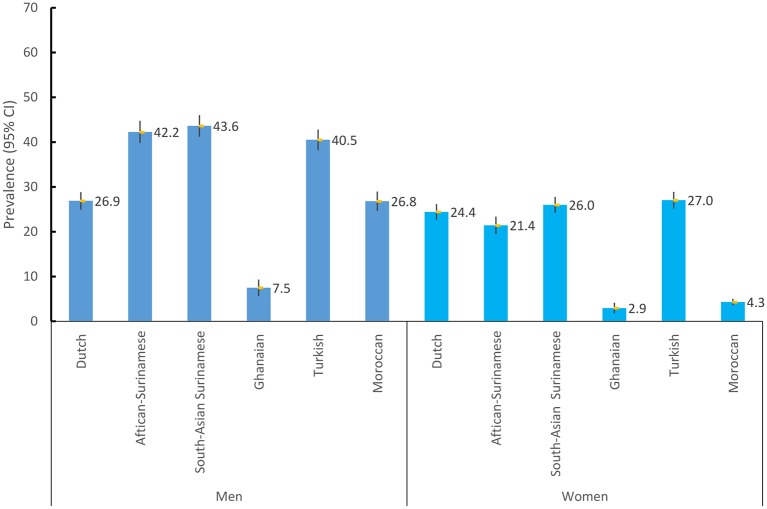
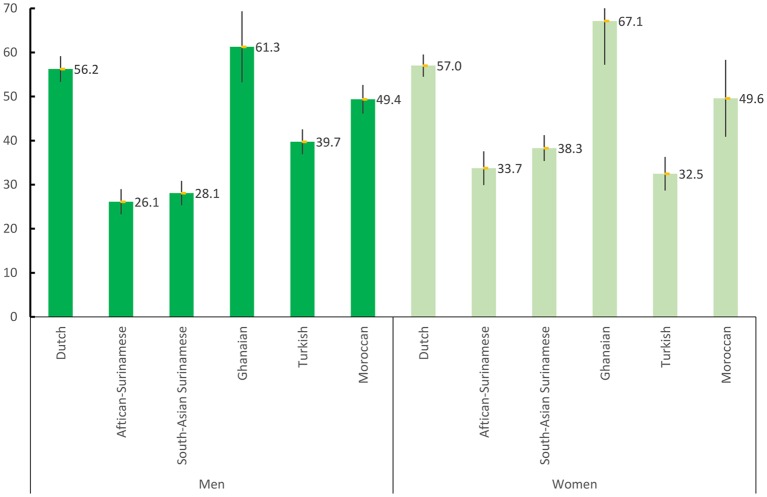
Compared with the Dutch, after adjustment for age and marital status, smoking prevalence was higher in men of Turkish (prevalence ratio 1.69, 95% CI 1.54 to 1.86), African Surinamese (1.55, 95% CI 1.41 to 1.69) and South-Asian Surinamese origin (1.53, 95% CI 1.40 to 1.68), whereas among women, smoking prevalence was higher in Turkish, similar in African Surinamese but lower in all other ethnic origin groups. All ethnic minority groups, except Ghanaians, had a significantly lower smoking cessation prevalence than the Dutch. Socioeconomic gradients in smoking (higher prevalence among those lower educated and with lower level employment) were observed in all groups except Ghanaian women (a higher prevalence was observed in the higher educated). Ethnic differences in smoking prevalence and former smoking are largely, but not completely, explained by socioeconomic factors.
Our findings imply that antismoking policies designed to target smoking within the lower socioeconomic groups of ethnic minority populations may substantially reduce ethnic inequalities in smoking particularly among men and that certain groups may benefit from targeted smoking cessation interventions.
缺乏关于社会经济地位(SES)对吸烟率和既往吸烟情况中种族差异的解释程度的数据。因此,我们评估了吸烟率和既往吸烟情况中的种族差异,以及教育水平和与职业相关的SES对观察到的吸烟行为种族差异的贡献。
分析了来自荷兰多民族横断面城市健康生活研究的22929名参与者(年龄在18 - 70岁之间)的数据。使用具有稳健方差的泊松回归模型来估计患病率比。
与荷兰人相比,在调整年龄和婚姻状况后,土耳其裔男性(患病率比1.69,95%置信区间1.54至1.86)、非洲苏里南裔男性(1.55,95%置信区间1.41至1.69)和南亚苏里南裔男性的吸烟率较高,而在女性中,土耳其裔女性吸烟率较高,非洲苏里南裔女性相似,但所有其他种族群体较低。除加纳人外,所有少数族裔群体的戒烟率均显著低于荷兰人。除加纳女性外(高学历者吸烟率较高),所有群体均观察到吸烟的社会经济梯度(低学历和低就业水平者患病率较高)。吸烟率和既往吸烟情况中的种族差异在很大程度上,但并非完全由社会经济因素解释。
我们的研究结果表明,旨在针对少数族裔社会经济地位较低群体吸烟问题的反吸烟政策可能会大幅减少吸烟方面的种族不平等,尤其是在男性中,并且某些群体可能会从有针对性的戒烟干预措施中受益。